
Carbon dioxide (CO2) separation is central to technologies ranging from natural gas purification to hydrogen production and carbon management. One widely used approach relies on thin filtering materials called membranes. However, these membranes face a major challenge: materials that allow CO2 to pass through quickly are often less effective at separating it from other gases, while highly selective materials usually slow the flow of CO2. This balancing act is known as the permeability-selectivity trade-off.
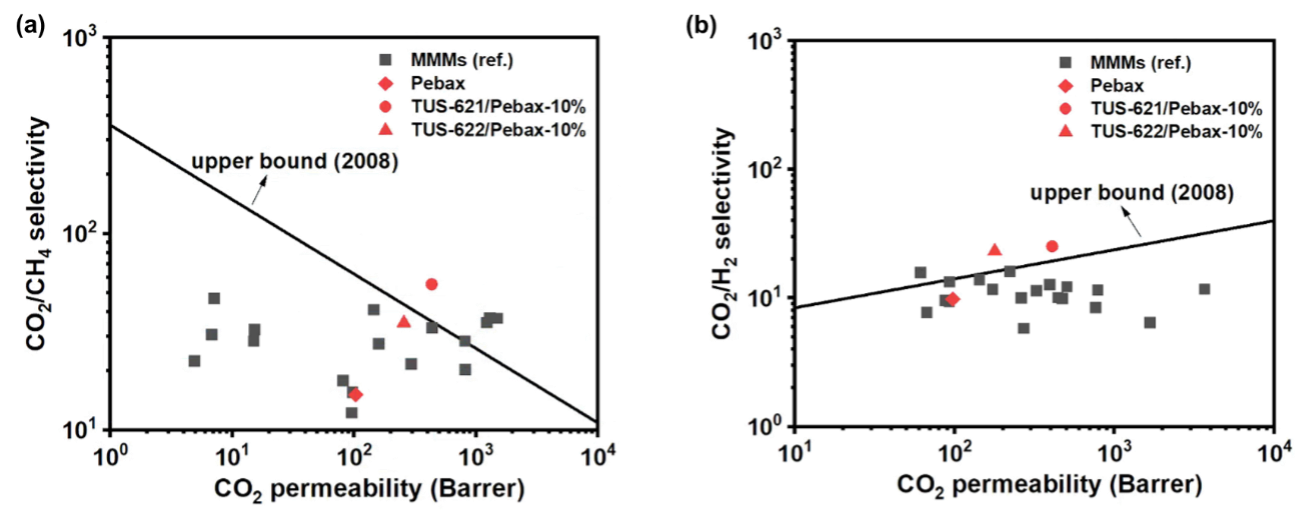
Researchers from Tohoku University and collaborating institutions have now developed a new class of heteroatom-engineered covalent organic framework (COF)-based mixed matrix membranes (MMMs) that overcome this limitation, achieving exceptional CO2 separation performance that surpasses the 2008 Robeson upper bound--a benchmark long considered the performance limit for gas separation membranes.
The work was published in the Journal of the American Chemical Society on May 21, 2026.
The researchers achieved this breakthrough by designing two new porous materials that were specially engineered to interact strongly with carbon dioxide (CO2). These materials were added to a polymer membrane, where they created pathways that both attracted CO2 molecules and allowed them to move through the membrane quickly. The best-performing membrane combined fast CO2 transport with highly accurate separation from methane and hydrogen, exceeding a performance benchmark that many conventional membranes struggle to reach.
Carbon dioxide separation is an essential process in industries such as natural gas upgrading, hydrogen purification, and carbon capture. Existing technologies including amine scrubbing and cryogenic separation are energy-intensive and operationally demanding, motivating the search for more energy-efficient membrane-based alternatives.
MMMs, which combine porous fillers with polymer matrices, offer a promising strategy for improving gas separation performance. Yet, most membranes still remain constrained by the intrinsic trade-off between permeability and selectivity. Overcoming this limitation requires materials capable of simultaneously promoting selective adsorption and rapid molecular transport.
COFs are crystalline porous polymers with atomically defined pore architectures and tunable chemical functionality. However, systematically understanding how pore-surface chemistry influences gas transport has remained challenging because changes in chemical functionality often simultaneously alter framework topology and pore geometry.
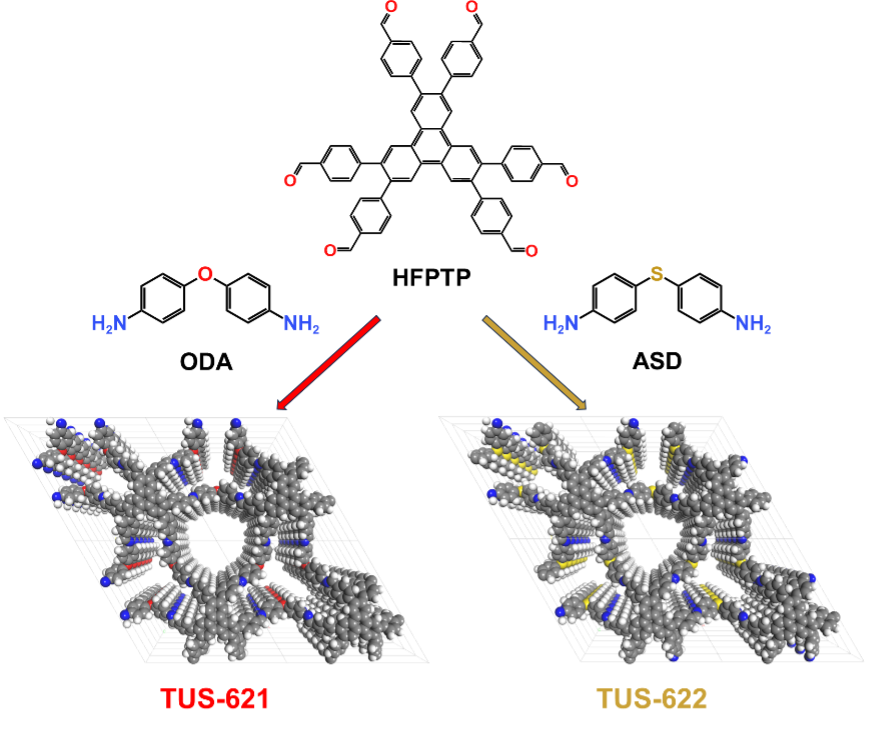
"To isolate the role of pore chemistry, we designed two isostructural COFs that differ only in their heteroatom composition," explains Dr. Saikat Das, Junior Associate Professor, Institute of Multidisciplinary Research for Advanced Materials, Tohoku University. "This allowed us to directly correlate molecular-level heteroatom engineering with membrane-level gas separation performance."
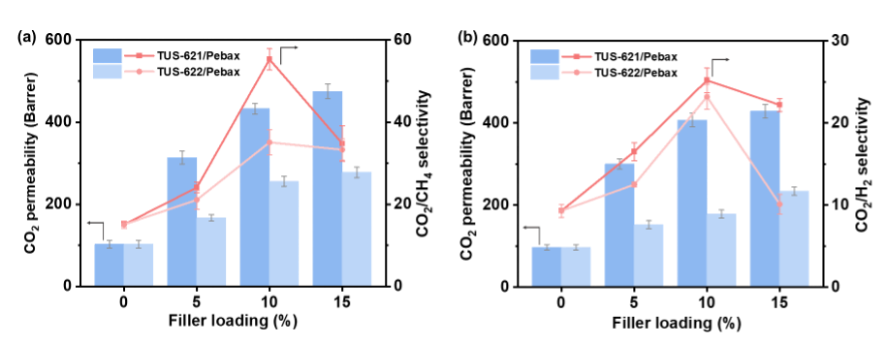
The team developed two similar porous materials, TUS-621 and TUS-622, using chemical components containing either oxygen or sulfur. While the materials shared nearly the same structure, the oxygen-rich TUS-621 showed a stronger attraction to carbon dioxide and allowed the gas to move through more easily, leading to significantly improved CO2 separation performance.
Comprehensive mixed-gas permeation experiments demonstrated that the optimized TUS-621/Pebax-10% membrane not only surpasses the 2008 Robeson upper bound for CO2/CH4 separation but also maintains outstanding separation performance over broad pressure and temperature ranges during continuous operation over 30 days. Computational studies further revealed that stronger electronic coupling between CO2 molecules and oxygen-rich pore environments plays a critical role in enhancing selective CO2 adsorption and transport.
"This study demonstrates that precise heteroatom engineering within structurally controlled COFs can fundamentally reshape membrane transport behavior," remarks Yuichi Negishi from the Institute of Multidisciplinary Research for Advanced Materials. "We believe this strategy opens a new pathway toward practical, energy-efficient carbon capture and gas separation technologies."
- Publication Details:
Title: Heteroatom-Engineered Covalent Organic Frameworks Break the CO2 Separation Trade-Off in Mixed Matrix Membranes
Authors: Tsukasa Irie, Liting Yu, Sourav Ghosh, Mika Nozaki, Kohki Sasaki, Tokuhisa Kawawaki, Ranjit Thapa, Yu Zhao, Saikat Das, Zixi Kang and Yuichi Negishi
Journal: Journal of the American Chemical Society
DOI: 10.1021/jacs.5c23169


