
Fundamental questions in quantum physics are the focus of a new international research consortium. Würzburg physicist Fakher Assaad is part of the team studying the virtues of defects.
This inclusion in a network of international scientific institutions is a mark of excellence for physics research at the University of Würzburg: As the Simons Foundation has now announced, Würzburg physicist Fakher Assaad is a member of the new Simons Collaboration "Virtues of Defects". Assaad is a professor in the Department of Theoretical Physics I at the University of Würzburg; numerical methods for so-called many-particle problems are among his primary research focuses.
The project is funded with up to two million U.S. dollars annually and is initially set to run for four years, with the option to extend for an additional three years. The project involves scientists from leading research institutions in Germany, Canada, the United States, Denmark, Italy, and Argentina-including, for example, the Perimeter Institute in Canada, the Massachusetts Institute of Technology (MIT), Princeton University, Yale University, New York University (NYU), and the California Institute of Technology (Caltech) in the United States; the University of Copenhagen in Denmark; the University of Turin in Italy; and the Instituto Balseiro in Bariloche, Argentina.
Their goal is to uncover new physical phenomena and potentially reformulate our understanding of quantum mechanics and general relativity.
Structures Beyond Measurement Points
What is the project about? "In classical physics, the universe was described primarily in local terms for centuries - one considered individual particles at a specific time and place," explains Fakher Assaad. However, modern phenomena often can no longer be adequately explained by this point-by-point approach.
This is where the work of the research group comes in, as it focuses on "defects". These "defects" are not errors in the conventional sense, but rather physical structures such as lines, interfaces, or extended regions within the space-time fabric that contain essential information about a system.
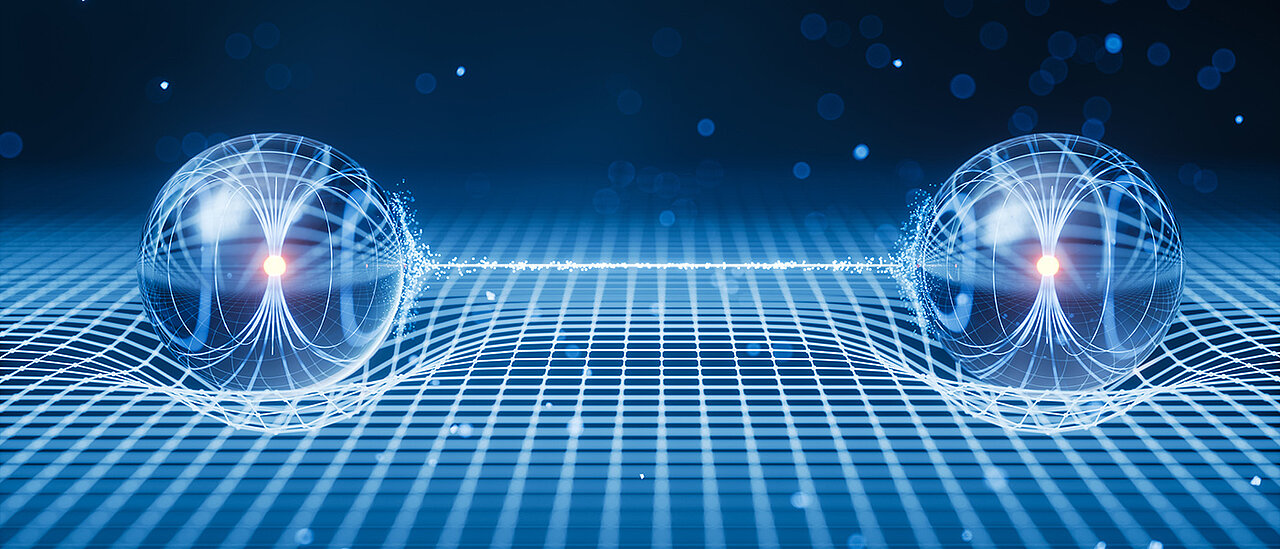
"The concept can be illustrated using the example of quantum entanglement, which Albert Einstein once described as a 'spooky action at a distance,'" explains the Würzburg physicist. In this case, particles are connected across vast distances in such a way that the state of one immediately influences that of the other. The deep structure of gravity is another example of such an observable. To understand these effects, it is not enough to consider only individual points in space.
A Look Under the Hood of the Theory
Jaume Gomis of the Perimeter Institute, a world-leading independent research center for the fundamentals of theoretical physics in Canada, is leading the project. He describes the approach as follows: "To find the nonlocal observables, you really have to look under the hood of the theory. But once you find them, you are able to diagnose new phenomena that local variables are not able to discern."
According to Gomis, the discovery of new theoretical tools is like discovering a "new ingredient in the cupboard" that allows one to cook entirely new things. Accordingly, with their approach, the researchers are able to decipher physical states that would have remained hidden using conventional local variables.
Simons Collaboration
Simons Collaborations are among the most prestigious awards in theoretical physics and mathematics worldwide. One of their key features is their interdisciplinary structure. The team that has now been approved brings together experts in theoretical solid-state physics, high-energy physics, and quantum gravity.
Fakher Assaad brings his expertise in quantum matter to this collaboration. He views his selection for this highly competitive collaboration as a significant recognition of his research. This further strengthens the University of Würzburg's reputation at the forefront of international research on the quantum foundations of physics.
"Major breakthroughs in physics typically occur when people from different backgrounds, traditions, and cultures come together to create something new," explains Jaume Gomis. Assaad also sees the collaboration as a great opportunity: "Networking with leading minds from various disciplines allows us to evaluate the theoretical foundations of our field from a completely new perspective and to bridge the gap between abstract theory and measurable data through computer-aided methods."
Simons Foundation
The Simons Foundation is one of the world's leading science-funding foundations and invests substantial resources in basic research to gain new insights into mathematics, the universe, the brain, and life. The private U.S. foundation was established in 1994 by mathematician and investor Jim Simons and his wife, Marilyn Simons.


