
The LOFAR radio telescope has delivered the most detailed radio map of the northern sky to date. It provides new insights into active galaxies, star formation and rare cosmic objects.
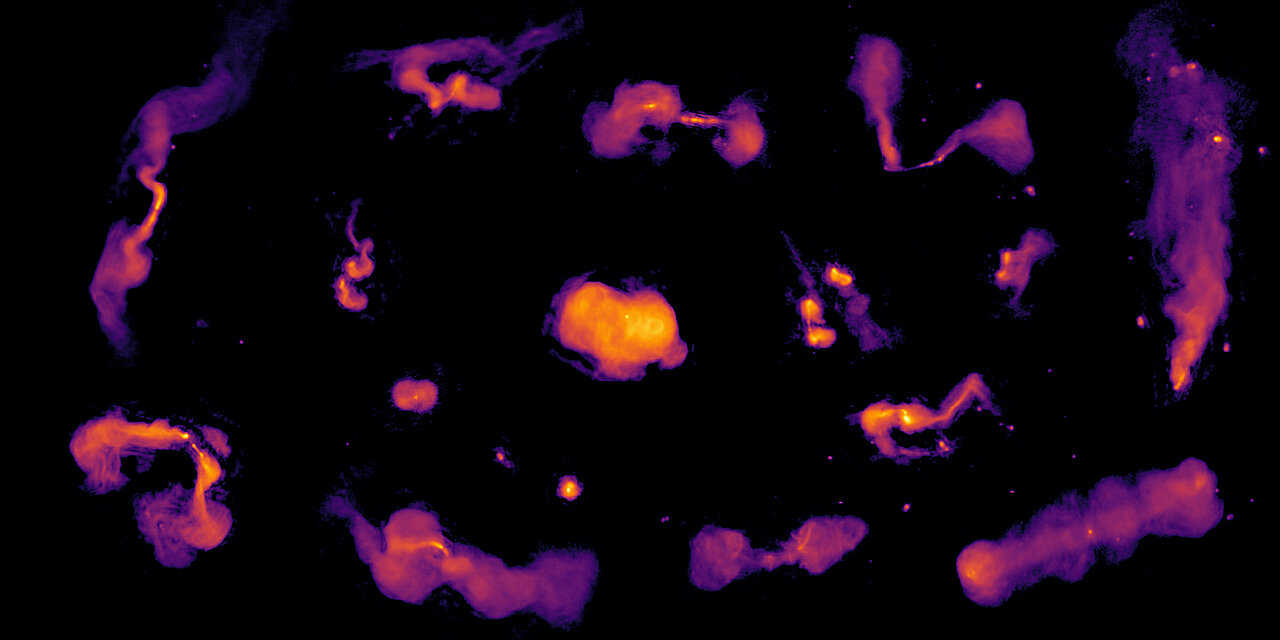
For more than ten years, an international research team observed the northern sky with the LOFAR radio telescope. The results of this sky survey have now been published in the scientific journal "Astronomy & Astrophysics".
The LOFAR Two-metre Sky Survey (LoTSS) maps the northern sky in unprecedented resolution. For this sky map, the international research team analysed almost 13,000 hours of observation time with the LOFAR radio telescope. As a result, 13.7 million radio sources were recorded in a catalogue. This is the largest collection of radio sources ever created.
LOFAR radio telescope detects rare and elusive objects
Professor Matthias Kadler from the Chair of Astronomy at the University of Würzburg was involved in the project: "Observations with radio telescopes reveal a completely different picture of the cosmos than observations with optical telescopes. For example, we can detect supermassive black holes that emit high-energy jets and thus significantly influence the evolution of their home galaxies," says the Würzburg researcher.
In addition to galaxies, the study has catalogued other objects, some of which are rare and difficult to detect, including galaxies with strong star formation, merging galaxy clusters, faint supernova remnants and active or interacting stars. The survey is already enabling hundreds of further astronomical studies. It offers new insights into the formation and development of cosmic structures, the acceleration of particles to extreme energies and cosmic magnetic fields.
The large-scale radio map of the universe with unprecedented detail is now publicly accessible. "This data release combines more than a decade of observations, large-scale data processing and scientific analysis by an international research team," emphasises study leader Dr Timothy Shimwell from ASTRON, the Dutch Institute for Radio Astronomy.
"LOFAR allows us to study cosmic magnetic fields in detail. We have discovered that shock waves can accelerate the smallest particles very efficiently. These observations are only possible with the special capabilities of LOFAR," says Marcus Brüggen, Professor of Astrophysics at the University of Hamburg. "In addition to insights into the detailed physical processes, we are also learning from the new celestial atlas how galaxies develop and how they are arranged in the universe," adds Dominik Schwarz, Professor of Physics at Bielefeld University.
Enormous challenges for software and data processing
The research team developed complex software to map the details of the radio sources. A major challenge was to precisely correct the distortions caused by a constantly changing ionosphere (the electrically charged layer of the upper atmosphere). The workflows for processing the 13,000 hours of observations had to be highly automated.
The distribution of the computing load across several supercomputers and the storage and retrieval of such huge amounts of data are a further challenge. "The amount of data we processed - a total of 18.6 petabytes - is immense and required continuous processing and monitoring with more than 20 million hours of computing time over many years," says Dr Alexander Drabent, scientist and software developer for LOFAR at the Thuringian State Observatory.
JUWELS at the Jülich Research Centre, which is one of the fastest supercomputers in Europe, was used for the data analysis. "For this sky survey, it was the first time that such large amounts of data had to be stored, processed and made accessible as part of an astronomical observation project. LOFAR has thus also paved the way for future large-scale projects," says Cristina Manzano, Head of the Operation & Development Team Technical Services at the Jülich Supercomputing Centre (JSC).
New LOFAR stations in Italy, Bulgaria and the Czech Republic
The LOFAR radio telescope has been organised as the European Research Infrastructure Consortium (LOFAR ERIC) since 2024. Its member states include the Netherlands and the Federal Republic of Germany. Research institutes in Germany operate six of the international LOFAR stations. The network continues to grow: a new LOFAR station is currently being built in Italy and one in Bulgaria. In 2025, the Czech Republic will join LOFAR ERIC and a new station will also be built there.
LOFAR is currently being modernised. The data from the recently published LOFAR Two-metre Sky Survey (LoTSS) will provide researchers with plenty of material for astronomical discoveries in the coming years. They are now being carefully searched for rare astrophysical phenomena.
Publication
"The LOFAR Two-metre Sky Survey VII. Third Data Release" T.W. Shimwell et al., 2025, in: Astronomy & Astrophysics, DOI: 10.1051/0004-6361/202557749
About LOFAR-ERIC
The LOw Frequency ARray (LOFAR) is a revolutionary radio telescope developed and built by the Dutch Institute for Radio Astronomy ASTRON. In contrast to conventional parabolic antennas, LOFAR consists of thousands of simple antenna elements distributed across Europe and connected to each other by fibre optic networks. The data from all the antennas is combined using powerful computers to create images of the radio sky.
LOFAR is operated by the LOFAR European Research Infrastructure Consortium (LOFAR ERIC), a consortium of institutions from eleven countries (Netherlands, Bulgaria, Czech Republic, France, Germany, Ireland, Italy, Latvia, Poland, Sweden, United Kingdom). LOFAR ERIC is an excellent example of successful international scientific cooperation: institutions in different countries pool expertise, computing power and research infrastructure across national borders to deepen humanity's knowledge of the origin of our universe.
The international LOFAR telescope is unique due to its sensitivity, its large field of view and its image resolution and clarity. The LOFAR data archive is the largest astronomical data collection in the world to date.
Astronomical research with LOFAR in Germany
The data from the LOFAR sky survey is of great importance for German astronomy. They are also used in research networks such as the Cluster of Excellence "Quantum Universe", the Collaborative Research Centre 1491 "Cosmic Interacting Matters - From Source to Signal" and the DFG research group FOR 5195 "Relativistic Jets in Active Galaxies". The Federal Ministry of Research, Technology and Space (BMFTR) is funding the development of LOFAR as part of the joint project 05A2023: "LOFAR: New possibilities and new structure for the leading low-frequency radio telescope". As part of the German GLOW (German Long Wavelength) consortium, six universities (Bielefeld, Bochum, Dortmund, Erlangen-Nuremberg, Hamburg and Würzburg) as well as the Jülich Research Centre, the Leibniz Institute for Astrophysics Potsdam, the Max Planck Institute for Astrophysics in Garching, the Max Planck Institute for Radio Astronomy in Bonn and the Thuringian State Observatory Tautenburg are involved in the operation of the six German LOFAR stations.


