
The third annual Cornell Systems Summit, held Nov. 1-3 on Cornell's Ithaca campus, brought together leaders from academia, industry and government to examine how artificial intelligence is reshaping engineering, education and the workforce.

Size Liu, a student of lecturer Xinlai Liu, explains his project "Trustworthy Battery Life Prediction for EV Battery Circularity" to Juan Amenabar during a poster session at the Cornell Systems Summit.
The summit was founded by Cornell's Systems Engineering program as a collaborative forum to unite researchers, practitioners and other experts to address global systems engineering challenges. This year's participants were asked to help define the AI-driven skills gap and to help close it to better prepare students for evolving workforce needs in the era of AI.
"Since last year's summit, we have seen how prevalent AI has become and how frequently it enters conversation," said Cliff Whitcomb, professor of practice and executive director of the Systems Engineering program at the Cornell Duffield College of Engineering. "For this year's summit, we decided it was time to examine AI's effects on workforce development, education, and systems engineering across key areas including energy, healthcare, and semiconductor manufacturing."
Emmanuel Giannelis, the Walter R. Read Professor of Engineering and associate dean for innovation in the Cornell Duffield College of Engineering, opened the summit by encouraging attendees to think about what skills will be needed in the era of AI.

Systems Engineering M.Eng. students Alexis Staveski (left) holds a prototype of the the Xplorer, an submersible based on the XRP robot platform, and her Cornell Cup teammate Sophia Velandia (right) displays the Augmented Reality XRP Racer during a showcase at the Cornell Systems Summit.
"It's always better not to have to react, but rather to anticipate the changes that are ahead of us," Giannelis said. "Can we put ourselves to that challenge of anticipating what is happening and how we best prepare ourselves and prepare our students to be able to be discharged?"
The summit included three keynote speakers: Ricardo Daziano, professor of civil and environmental engineering at Cornell, discussed how policy, human preferences, infrastructure and domain-informed AI shape adoption of clean energy technologies, electrification and policy; Fei Wang, the Frances and John Loeb Professor of Medical Informatics at Weill Cornell Medicine, spoke how AI is being applied to disease characterization, treatment and prediction; and Paul Heremans, corporate CTO and senior fellow at the Interuniversity Microelectronics Centre in Belgium, outlined how semiconductor technology and cross-industry collaboration help scale AI within energy, thermal and power-delivery constraints.
AI and systems: From education to research and innovation
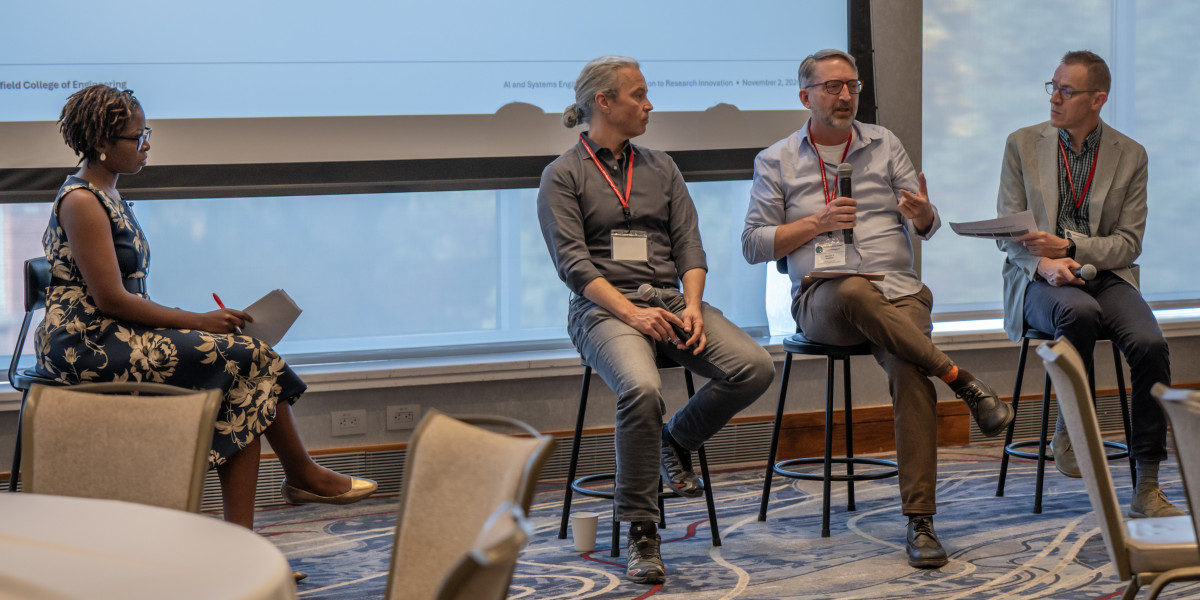
The AI and Systems: From Education to Research and Innovation Panel (left to right): Jessica Rush Leeker, professor of practice in Systems Engineering and the Office of Inclusive Excellence (moderator), Thorsten Joachims, vice provost for artificial intelligence; Steven Jackson, vice provost for academic innovation; and Martin Teschl, director of business development and licensing at the Center for Technology Licensing.
A panel discussion brought together senior Cornell leaders to explore how AI is changing engineering, education and society. Moderated by Jessica Rush Leeker, professor of practice in Systems Engineering and the Office of Inclusive Excellence, the panel included Steven Jackson, vice provost for academic innovation; Thorsten Joachims, vice provost for artificial intelligence; and Martin Teschl, director of business development and licensing at the Center for Technology Licensing.
Panelists considered what knowledge and judgment must remain uniquely human, who shapes emerging technologies, and how success should be measured in increasingly AI-enabled systems. They emphasized that AI cannot simply replace people, and that it is strongest when well-defined, measurable objectives are defined, with people responsible for defining success and judging whether a result makes sense.
"AI doesn't understand anything," Jackson said, "AI is just different versions of text prediction, so judgment of whether it makes sense is important. People will talk about the importance of having a human in the loop in AI systems, but what we need is something stronger than that. Engineers should be in the lead, not just 'in the loop.'"
AI in the professional workforce
A second panel focused on how AI is changing engineering industries was moderated by Kurt Kuhn, M.Eng. '21, a technical fellow at Boeing, and included Charlie Chen, Ph.D. '01, a senior fellow at L3Harris; Teejay Momoh, M.Eng. '20, VP of industrial engineering at Cummins; and Adam Sawicki, senior technical fellow at Boeing.

The Professional Workforce Panel (left to right): Kurt Kuhn, M.Eng. '21, a technical fellow at Boeing (moderator); Adam Sawicki, senior technical fellow at Boeing; Charlie Chen, Ph.D. '01, a senior fellow at L3Harris; Teejay Momoh, M.Eng. '20, VP of industrial engineering at Cummins.
Panelists raised the concern of what happens if AI removes the routine, tedious work that traditionally helped young engineers gain experience.
"I absolutely would have outsourced a lot of the tedious administrative stressful work of combing through data before AI," said Momoh, although he emphasized that he received important learning and competency that came from that work. "We have to challenge ourselves to think about what is the right way to build judgment in a way that we can actually leverage this technology to solve the problems that we're trying to solve."
The discussion also addressed the relationship between industry and academia and stressed the importance of tighter collaboration between these two groups. The panelists suggested that universities and employers will need new apprenticeship, mentoring and onboarding models to develop fundamental skills in the age of AI.
"I think companies view onboarding as an expense necessary to train people," said Sawicki. "But people who teach learn more about what they're doing, and they gain expertise from teaching. We're going to learn about AI not by hiring a bunch of specialists. We're going to learn about it by onboarding recent graduates who are going to help teach our workforce about it."
AI in education
The educational curriculum panel was moderated by Hiroki Sayama, the SUNY Distinguished Professor of Systems Science and Industrial Engineering at Binghamton University and the Mary Shepard B. Upson Visiting Professor in Engineering at Cornell, and included Juan Amenabar, chief systems engineer at Liedos and assistant director of training and education at INCOSE; David Flanigan, associate dean for non-residential graduate education at John Hopkins University; Tim Fraser, assistant teaching professor at Cornell; and Alice Schwarze, head of research at the Office for AI Policy at the Utah Department of Commerce.

Hiroki Sayama, the SUNY Distinguished Professor of Systems Science and Industrial Engineering at Binghamton University and the Mary Shepard B. Upson Visiting Professor in Engineering at Cornell, moderator of the Educational Curriculum Panel.
The panel discussion touched on a wide variety of topics related to systems engineering and AI in the educational setting but focused on how to prepare systems engineering students for a workforce that is being reshaped by AI, and where AI fits into current curricula.
"What skills do students need now, and what does our field need if we jump deep into AI?" asked Fraser. "What happens if they stop knowing how to code? It makes me think about how our education system has gone through this change before. There are some things that we have cut out of education because we got new technologies and new skills - long division is an example. This raises the question, are there some things that must be dropped to make room for us to teach our students how to create big things they couldn't before?"
Participants agreed that while curricula will need to adapt, the most important skills remain foundational ones: coding and logical problem-solving; the ability to read, verify and debug code; critical thinking in complex and uncertain situations; and the capacity to continually learn new tools as technology evolves. The group viewed AI as increasing the importance of strong analytical skills and lifelong learning rather than replacing them.
"Curiosity is really important, and personally, I think that the AI might be actually affecting it negatively," said Sayama. "Students will simply use AI tools, and the answer is provided. This might be a demotivator for them to remain curious. But we really need to push the student to be curious and exploratory, so that they can be the drivers of all kinds of problem-solving."
Systems Engineering Professor Al George Award

Hilary Soohoo Gambardella '13, M.Eng. '17, was the inaugural recipient of the Systems Engineering Professor Al George Award, presented to her by Cliff Whitcomb (left), professor of practice and executive director of the Systems Engineering program, and Oliver Gao (right), director of the Systems Engineering program.
Presented at the summit was the inaugural Systems Engineering Professor Al George Award to recognize outstanding contributions to the field of systems engineering, professional accomplishments and a continued connection to the Cornell Systems Engineering community. Named in honor of professor Al George, one of the founders of Cornell's Systems Engineering program, the award celebrates his lasting impact as a leader and educator who helped shape generations of systems engineers.
The 2026 award was presented to Hilary Soohoo Gambardella '13, M.Eng. '17. An experienced systems engineer with a strong track record of developing software-based machine learning products in the medical device industry, Gambardella, a former student of George, created her own Systems Engineering Health Systems Pathway as an M.Eng. student at Cornell before it existed as part of the Systems Engineering curricula, in much the same way that George helped establish new programs and areas of study that expanded the reach of engineering education at Cornell.
Surrounded by members of both her family and the George family, Gambardella thanked her family and mentors and emphasized the impact George had on her career.
"Professor George predicted that systems engineering belonged in a healthcare and medical settings much sooner than even the industry," Gambardella said. "He always treated his mentees and peers with kindness and openness, while teaching and pushing us to improve and take our systems engineering knowledge further. He was generous with his knowledge."
Gambardella added, "And for everyone, it's not just about the technical engineering. Create the culture that you want because it matters more than you think. For Professor George, that culture was being human, kind and collaborative - but also challenging. Bring forth the teachings of your mentors and they will live on through you."


