
Adam Ouattara and Makongo Traoré have four children and a home on the edge of Torla village in Côte d'Ivoire. He herds cattle. She grows vegetables on a small plot nearby. For years, the dry season pitted their two livelihoods against each other.
As grazing land and water points dried up, Mr. Ouattara and other herders have had to push their cattle farther from the village, often straight through cultivated fields.
Damaged crops led to disputes with farmers, a familiar dry-season strain across much of northern Côte d'Ivoire, where seasonal pastoral movement and expanding farmland increasingly compete for the same ground.
"When resources become scarce, everyone is trying to protect their livelihood," said Mr. Ouattara, who has led the local herders association since 2021, representing pastoralists in disputes and community talks.
Changing the tone
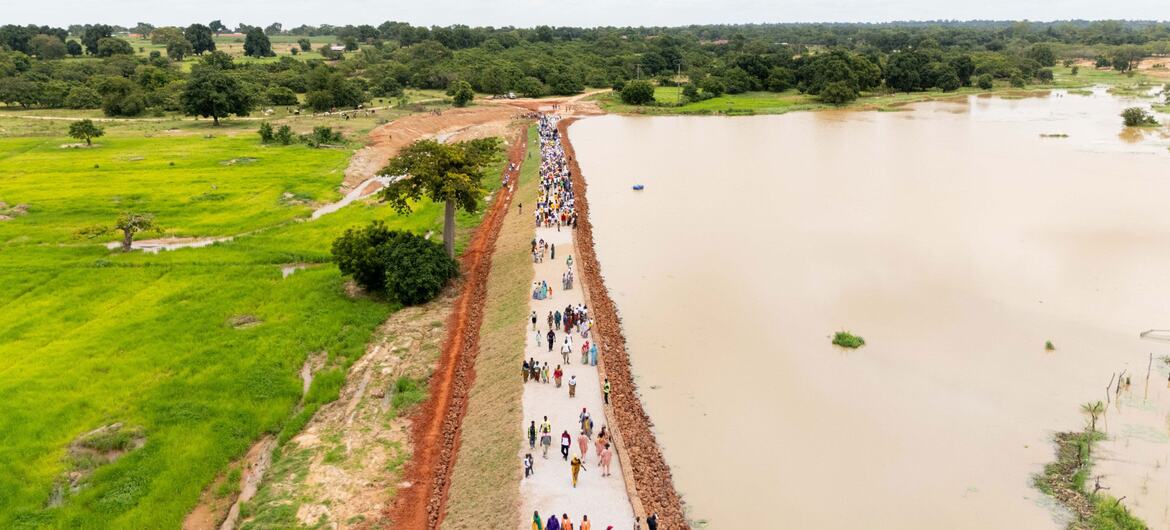
A rehabilitated agropastoral dam, completed this August, is changing that math. The dam now holds more water and releases it more reliably through the dry months, for livestock and irrigation alike.
For Mr. Ouattara, the shift shows up in fewer confrontations. "Today, we sit together and discuss," he said. "There are fewer conflicts."
For Ms. Traoré, it shows up in her fields. A steady water supply has let her expand her vegetable plot - work she says now supports her children's schooling. The maths is easy.
"If we can work well in our fields," she said, "we can provide for our children and send them to school. Before, the lack of water made life difficult."
'The dam brings peace'
In a region where many herders move seasonally with their livestock, access to water plays a critical role in supporting livelihoods and fostering social cohesion between pastoralist and agricultural communities.
The dam is already helping create conditions for peaceful co-existence between herders and farmers in Torla, managed locally by the community and supported by the International Organization for Migration ( IOM ), the UN Peacebuilding Fund and partners.
The goal is simple: Prevent conflicts linked to competition over natural resources and boost community resilience.
The results are already playing out in Torla, where a new chapter of community dialogue and shared resource management has begun.
For residents, this project goes beyond livestock or agriculture, representing an opportunity to build a more resilient future.
"The dam brings peace to the village," Mr. Ouattara said. "Today, we can access water here and that reduces many of the challenges we faced before."
Building a better future
For Ms. Traoré, reliable access to water means greater stability for her vegetable plot and her family. It also means new opportunities for women in the community for market gardening, an important source of household income in the area.
"Now, we have the possibility to work harder and ensure a better future for our children," she said.
Like many communities across northern Côte d'Ivoire, Torla has witnessed changing environmental conditions in recent years.
According to Adam Ouattara, increasing pressure on land has affected traditional grazing patterns: during the rainy season, agricultural production expands, leaving less space available for livestock.
'Fewer conflicts'
"When the cultivators grow crops, much of the land is occupied, and our animals have to move farther away, sometimes towards the borders, to find pasture," he explained.
Such challenges highlight the importance of investments that support both farming and pastoral activities while promoting peaceful co-existence. As president of the herders' association, Mr. Outtara has witnessed significant progress through improved dialogue.
"Today, we sit together and discuss," he said. "We approach one another to talk and understand each other. There are fewer conflicts."


