
Geothermal is poised to become an important source of electricity that is both cost-competitive and emission-free, thanks to innovations under development by the University of Utah and Utah companies.
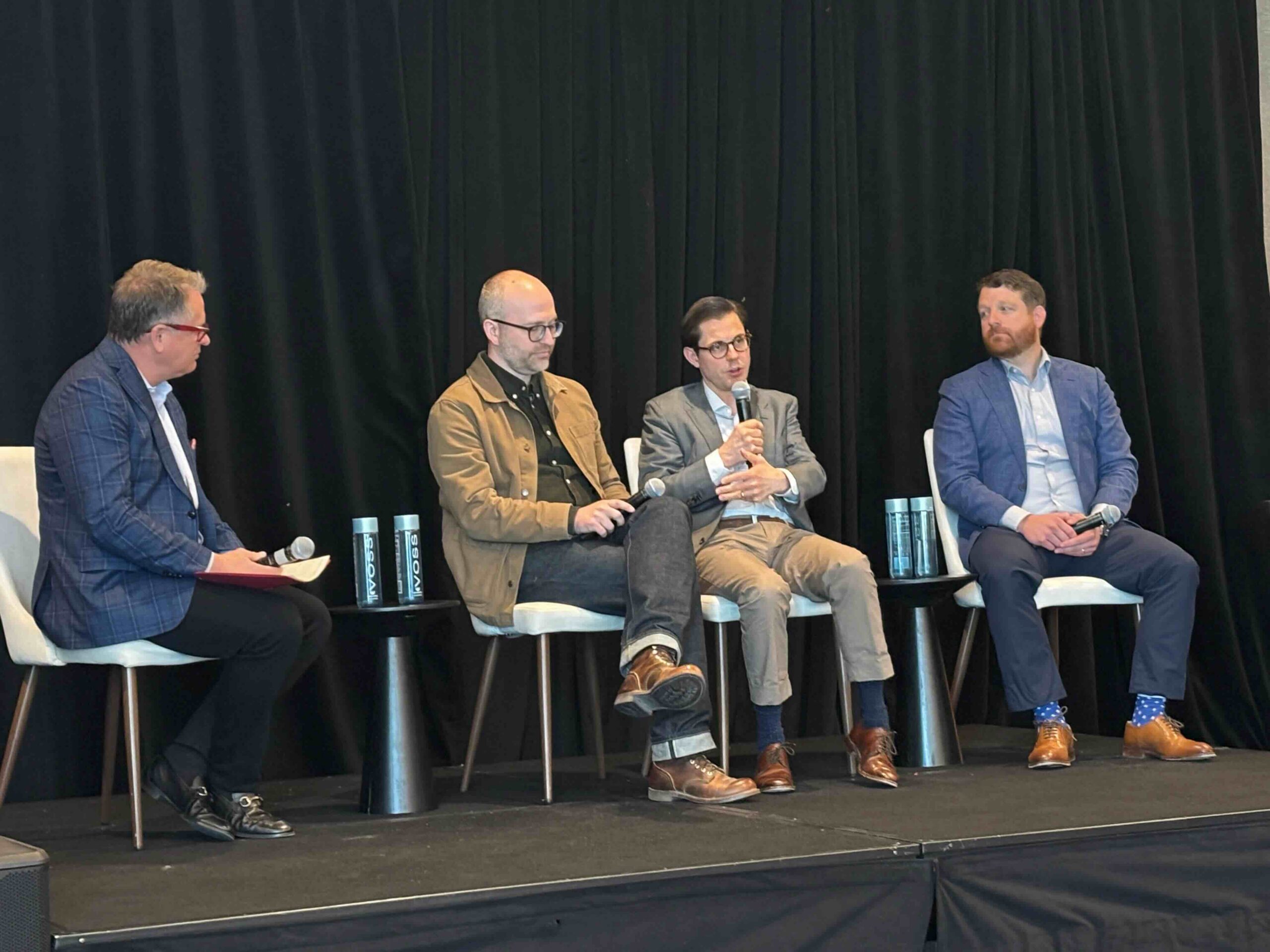
That is the message from a panel moderated by U President Taylor Randall, Park City, May 22, as part of Utah Gov. Spencer Cox's Operation Gigawatt Summit.
"If you had asked me 20 years ago if it was possible the next generation power plant would be underground in southwestern Utah, it would be producing firm power at scale for some of the largest companies in the United States, you would've laughed and walked away. But guess what? Here we are today," Randall said. "A recently announced IPO, which is just absolutely phenomenal. We also have today the next-generation Utah-based company and artificial intelligence exploration, all underground."
Randall was referring to Fervo Energy, which has raised $2.1 billion following its initial public stock offering, and Zanskar, a Salt Lake City-based exploration company that uses AI to identify spots with good geothermal potential.
Fervo and Zanskar co-founders, Tim Latimer and Carl Hoiland, respectively, joined Randall on the panel along with Julius Krein of the New American Industrial Alliance.
What's not to like about geothermal?
The panelists agreed that geothermal is one energy source that now enjoys support from both ends of the political spectrum, but for decades it had been largely ignored by both sides. As an emission-free source, it is seen today as a win for the environment and the climate on the one hand, and on the other, it delivers steady base-load power that wind and solar can't. The obstacle is how to scale up geothermal to become a major source. The technology for that is rapidly developing, but progress is slower on the policy front.
"Everybody basically likes geothermal, thinks it's a good idea, wants more of it and that's obviously a positive thing. At the same time, though, what happens so often in D.C. is that it's very easy to get someone to say they like your idea. It's much harder to get them to actually make it a priority, make it something where they actually enact real policy and move the needle," Krein said. "I think we're getting there. In that sense, geothermal is in a lot better position than various other sources."
Fervo is actively developing a geothermal power station in Utah's Beaver County, deploying deep-drilling technology adapted from the oil and gas industry. Cape Station is set to begin generating its first 100 megawatts of capacity in six months, with a build-out slated for an additional 400 megawatts.
"So by 2028, it's going to be 500 megawatts, the largest enhanced geothermal systems project in the world and a huge part of both Utah's electricity mix and the country's geothermal mix," Latimer said. "And that's just the beginning of where our industry's going. So it's round-the-clock, carbon-free electricity that is price competitive, that can grow rapidly and is already a mature technology that's in construction today."
Drilling deeper
He credited the Department of Energy-funded research project led by U scientists known as the Frontier Observatory for Research in Geothermal Energy, or Utah FORGE, for pioneering the technical breakthroughs that could lead to a dramatic scaling of geothermal. Cape Station is situated on public land just a mile from the FORGE research station outside Milford.
"The Utah FORGE project, about 10 years ago, started drilling wells out in the Great Basin far from where the conventional geothermal resources that sat on top of hot springs and showed that actually all of this hot rock could be developed for power," Latimer said. "Then we saw the results of that from a great public-private partnership spurred by this Department of Energy effort and said, 'If it works from a research standpoint, it could work from a commercial standpoint.'"
The Cape Station's nearly four-mile-long well extends 12,000 feet deep and 7,500 feet horizontally, drilled in 25 days through solid granite, according to Latimer. To generate electricity, the station will pump water deep underground into superheated rock, then pull it back up as steam to spin turbines.
Historically, geothermal has exploited near-surface hydrothermal features, but such spots are relatively rare and often hard to find. While Fervo is getting around this limitation by drilling ultra-deep, Zanskar puts AI to work to locate target zones closer to the surface. It turns out there are plenty of good geothermal locations that were previously known, according to Hoiland.
Exploring smarter
"The U.S. led the world from the 1960s to the 1980s in exploring for and developing geothermal energy. We're still the largest producer of geothermal energy in the world, but almost all of that growth stopped in the 1980s," Hoiland said. "In fact, it's been over 10 years since we've seen a greenfield geothermal power plant built and commissioned in the U.S."
For a time, new exploration had a poor success rate and it was believed most of the promising geothermal locations had been tapped out.
"That reputation persisted for decades. It sort of killed all new investment in this space. Why go after it if it's too small, it's too risky?" Hoiland said.
But Zanskar's AI-powered prospecting toolkit could fundamentally alter the geothermal landscape by expanding the nation's inventory of reliable geothermal locations. The company has located several excellent potential geothermal sites in Western states-including most recently Big Blind in western Nevada-in areas with no history of geothermal exploration or other prior well data.
"Big Blind is exactly one of these types of resources where there was nothing there, no indication of a hot spring or geothermal site, and yet about 50 feet below the surface, you hit near-boiling temperatures and as you go deeper, that system gets hotter and bigger," Hoiland said.
The DOE has set an ambitious cost goal of $45 per megawatt-hour of electricity by 2035.
"Fervo and Zanskar are way ahead of that trajectory," Hoiland said. "We would say that there are already resources today that if you knew where they were and you knew how to drill into them, would already be the cheapest form of power in the Western United States."
Banner image shows Fervo Energy's Cape Station project under construction in southwest Utah's Beaver County. Credit: Fervo Energy


