
Crystals - whether in the form of gemstones, snowflakes or table salt - are undeniably beautiful.
At Sandia National Laboratories, researchers are exploring a less aesthetic use for them: measuring intense magnetic fields in some of the harshest experimental environments in science.
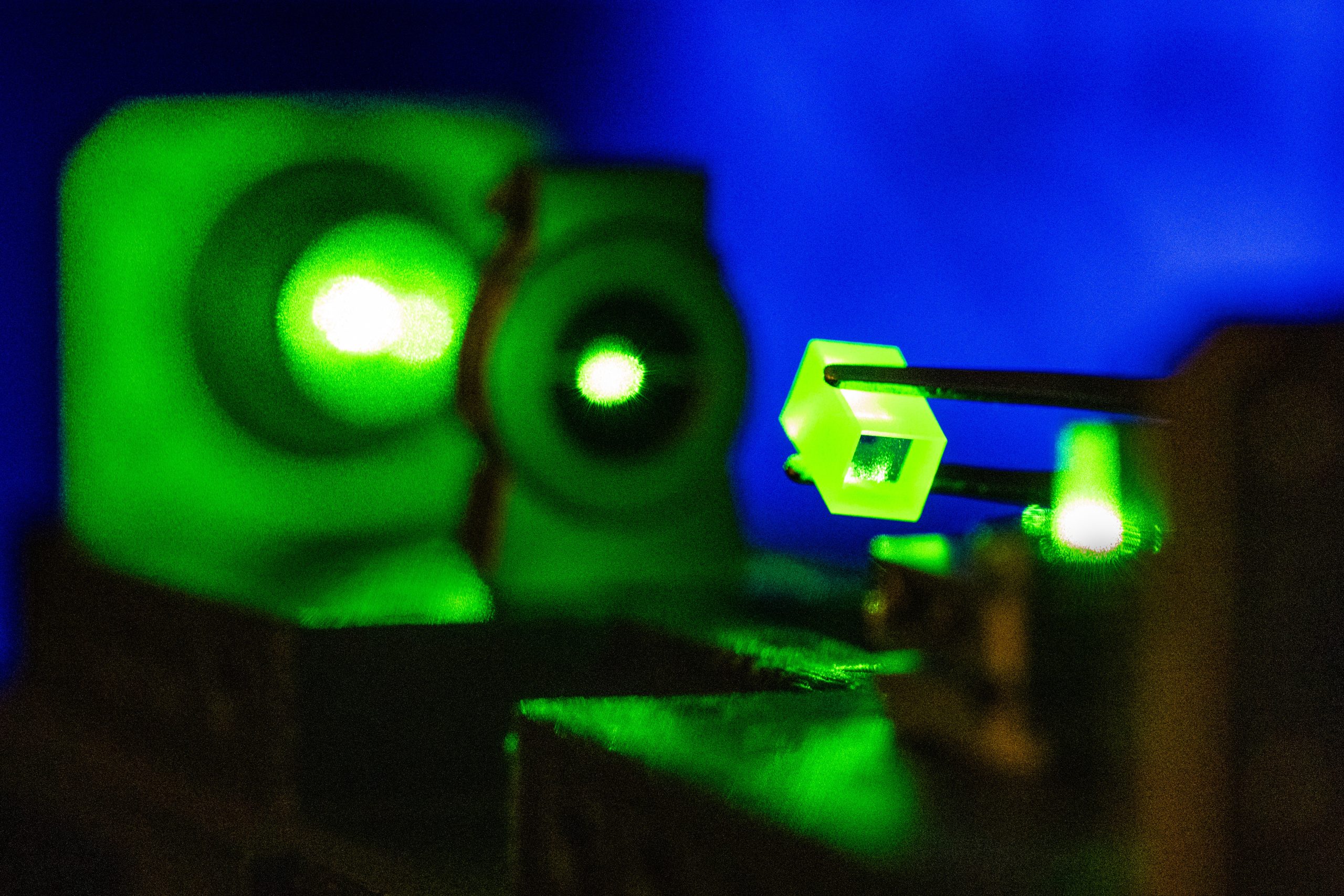
The team has developed a sensor that uses a rare earth crystal and laser light to measure the intense magnetic fields needed for fusion research, pulsed-power experiments and high-energy physics. The technology could help researchers collect precise measurements in places where conventional sensors can struggle with radiation, electrical interference or plasma conditions. The sensor has been submitted to this year's R&D100 Awards.
"We're really excited about where things are going," said Israel Owens, a Sandia physicist and co-inventor of the sensor. "We think this technology is a pretty major improvement in measuring magnetic fields. We think it'll be essential especially for research in fusion, high-energy physics and the power utilities industry."
Sandia's sensor sends laser light through a tiny crystal, about the size of a pencil eraser. The crystals are made from combinations of rare earth elements, such as terbium scandium aluminum garnet or terbium gallium garnet. Rare earth elements are useful metals that aren't actually rare, just very hard to purify. Most of this purification currently takes place in China.
Sandia experts, led by Owens, combine the garnet with a small laser, two light filters and a light detector. When laser light passes through the crystal, the light rotates. A magnetic field parallel to the long side of the garnet changes how much the light turns as it travels through the crystal. By precisely measuring that rotation, the system can determine the strength of the magnetic field, Owens said.
Pioneered for pulsed power
Owens began researching how to use rare earth garnets to measure magnetic fields in 2021, with an eye toward challenging environments such as those found in Sandia's Z Machine.
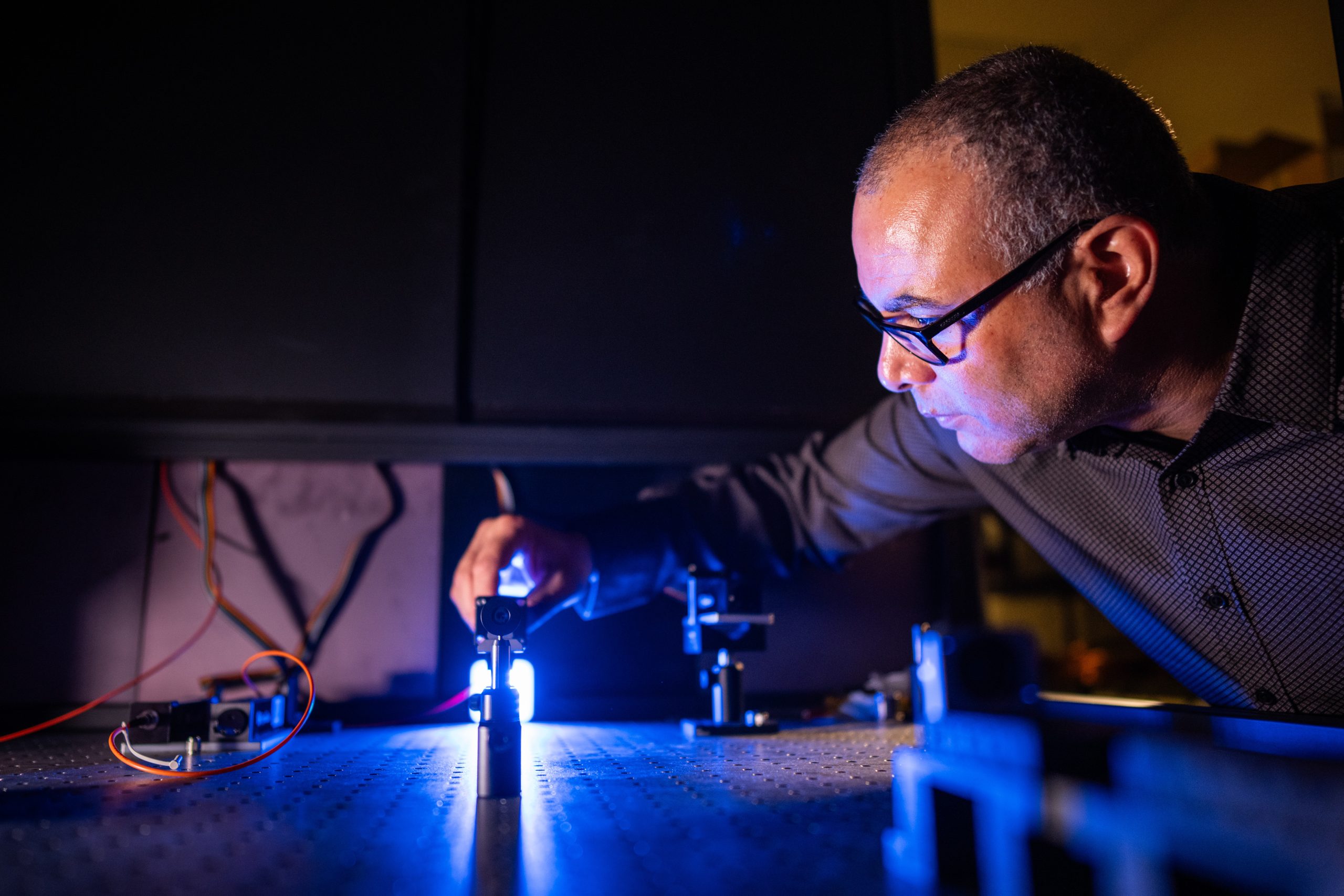
The Z Machine is the world's most powerful laboratory radiation source. It is used for basic science research, studies of magnetized liner inertial fusion and for national security applications. Experiments on facilities such as Z depend on diagnostics that can capture fast-changing signals without being overwhelmed by radiation or electromagnetic noise.
Rare earth garnets are dielectric materials, a type of electrical insulator commonly found inside capacitors used in everything from computer RAM to utility substations. The internal properties of these materials change with external electromagnetic fields in a way that is useful for measuring magnetic field strength. Electromagnetism is a fundamental force of the universe that describes how electric and magnetic fields are two sides of the same coin.
Using calculations, small-scale experiments and large-scale testing on Sandia's High-Energy Radiation Megavolt Electron Source III and Short Pulse High Intensity Nanosecond X-Radiator, known as SPHINX, Owens' team showed that the rare earth crystal sensors are just as good at measuring magnetic fields as conventional sensors but can better withstand intense radiation and electromagnetic interference.
"We've done quite a bit of testing over at SPHINX and we saw less statistical spread compared to conventional sensors," Owens said. "There are advantages in terms of measurement accuracy and precision and also the ability to work in challenging environments that are not accessible by conventional sensors."
The garnet-based sensor also would not need frequent calibration and maintenance like conventional sensors, which could reduce operational costs, he added.
Fruitful future in fusion
One particularly challenging environment for electronic devices is inside the plasma of a fusion reactor. Researchers use a variety of methods to confine plasmas and cause fusion. Many of those methods use intense magnetic fields.
"There's a lot that goes into fusion," Owens said. "They hold a plasma in place using strong magnetic fields. It's important for them to be able to measure the magnetic confinement of their plasma. Our technology has the unique capability of working in areas where conventional sensors would short out."
In theory, the garnet-based sensors can function in plasmas where conventional metallic sensors, such as B-dots, would short out and conventional fiber optic sensors would darken because of radiation, Owens said. Fiber optic sensors also need to be quite long to pick up enough signal, which can increase noise pickup and the risk of breakage.
The technology is still in development. The team has tested the sensor in vacuum and air and is beginning to test it in low-density plasma, Owens said. The ultimate goal is to test it in high-density plasma comparable to what is needed for fusion power.
"The magneto-optical sensor technology is a game-changing diagnostic for measuring varying magnetic fields in difficult radiation and electromagnetic environments," said Bryan Oliver, director of Sandia's Radiation and Electrical Sciences center. "The magnetic field is a very important parameter in understanding phenomena associated with super-high-current accelerator technology like the Z Machine and Saturn accelerators, radiation and fusion energy generation, lightning and electrical breakdown."
The team was granted a patent on the sensor in December and one company has taken a non-exclusive license option to commercialize the technology.
The research was funded by Sandia's Laboratory Directed Research and Development program, which also has provided additional support to develop the sensors for other applications.


