
Australia's push to widen access to higher education will require universities to rethink not only who they admit, but how they teach, according to Southern Cross University higher education expert Professor Jim Nyland, who argues curriculum innovation must become a central part of the nation's equity agenda.
His new book, Access and the Making of Mass Higher Education: From Workers to Students , co-authored with Emeritus Professor David Davies from the University of Derby (UK), examines more than 50 years of efforts to widen participation in higher education in Australia and the United Kingdom.
/prod01/channel_8/media/scu-dep/news/images/2026/Book-cover-Access-and-the-Making-of-Mass-Higher-Education-02.jpg)
Professor Nyland said history showed that increasing the number of university places alone was not enough.
"The challenge is that we are trying to bring many more students from backgrounds that have traditionally been underrepresented in higher education into a system that was not necessarily designed around their lives or their needs," Professor Nyland said.
"If we are serious about widening participation, universities need to think beyond access and ask what happens when those students arrive.
"The most powerful changes I have seen during 30 years in higher education have happened through the curriculum."
Professor Nyland said previous expansions of Australian higher education increased overall participation but failed to deliver comparable gains for underrepresented groups.
"Curriculum innovation is an equity intervention," he said.
"It is not simply about changing when classes are delivered. It is about reconsidering assessment, feedback, the relevance of what students are learning and how academics and professional staff work together to design the student experience."
Professor Nyland points to block teaching models as one example of curriculum reform that has emerged internationally and in Australia.
Southern Cross University introduced the Southern Cross Model across its courses, replacing the traditional semester structure with shorter, focused teaching terms in which students generally study one or two units at a time.
Professor Nyland said its significance, however, went well beyond timetabling.
"Block teaching creates an opportunity to start again and ask what the curriculum should actually look like for the students we are trying to support," he said.
With students increasingly combining study with work and caring responsibilities, and governments seeking greater participation among regional, First Nations and other traditionally underrepresented groups, Professor Nyland said universities could no longer expect students to adapt to structures designed for previous generations.
"There has been a lot of focus historically on getting people through the door," he said.
"That matters, but if the student arrives and the institution itself has not changed, we have only solved part of the problem.
"Success has to be about attraction, retention and helping students progress through their degree."
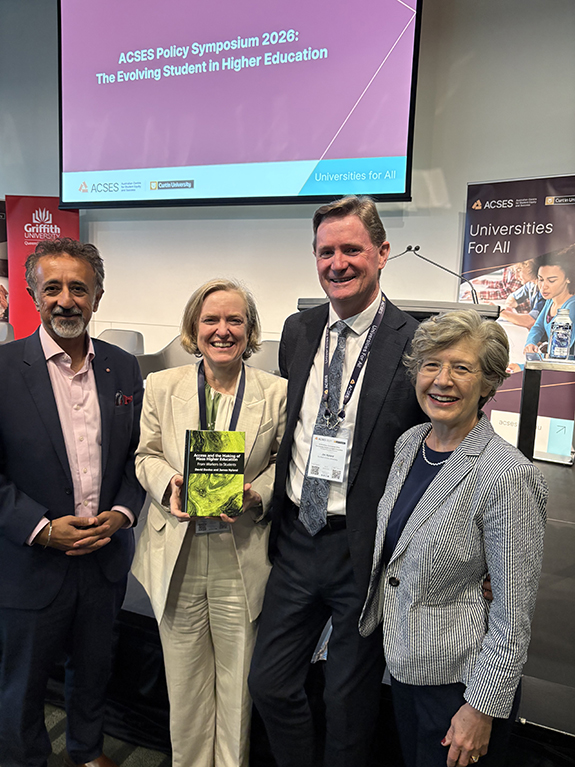
Professor Jim Nyland (2nd from right) launched his book as part of a panel discussion with (right) Professor Kerri-Lee Krause, TEQSA Chief Commissioner, (2nd from left) Professor the Hon. Verity Firth AM of UNSW and moderator (left) Shamit Saggar at the Australian Centre for Student Equity and Success (ACSES) Policy Symposium.
The book draws comparisons between Australia and the United Kingdom, including the development of the Open University and other approaches that expanded opportunities for mature-age students and people outside traditional pathways into higher education.
Professor Nyland said those experiences demonstrated that greater access did not have to come at the expense of quality and highlighted a broader role for universities in lifelong learning as technological change, including artificial intelligence, reshapes the skills required across the workforce.
"If we get this right, universities can play a much bigger role for people throughout their lives, not simply for young adults immediately after school," he said.
"If we get it wrong, we risk creating the opportunity to enter higher education without creating the conditions students need to succeed."
Professor Nyland said the Australian Universities Accord provided an important blueprint for widening participation, but its ambitions would ultimately be realised through decisions made inside universities.
"For institutions that are serious about improving outcomes for underrepresented students, curriculum innovation has to be part of the answer," he said.
Access and the Making of Mass Higher Education: From Workers to Students was launched during the third annual Australian Centre for Student Equity and Success (ACSES) Policy Symposium, held in Brisbane on September 8-9, 2026. This year's theme is 'The evolving student in higher education'.
Accolades for Southern Cross Model at ACSES
The transformative impact of the Southern Cross Model was recognised by the Australian Centre for Student Equity and Success (ACSES) during the Symposium.
Southern Cross University took out the Impact and Effectiveness category at the ACSES Awards for Innovation and Excellence in Impact on Higher Education Policy and Practice 2026.


