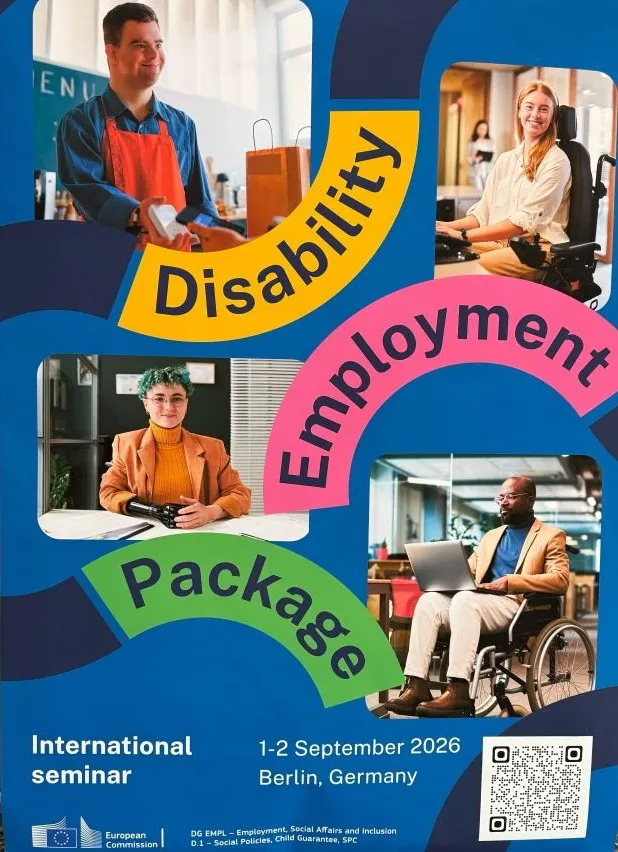
Public employment services (PES) can strengthen labour market inclusion for persons with disabilities by looking beyond job placement to sustained employment, reasonable accommodation, skills development and progression, participants heard at a European mutual learning seminar in Berlin.
The Disability Employment Package Mutual Learning Seminar for Employment Services, held on 1-2 September 2026, brought together PES, organizations of persons with disabilities and practitioners to exchange experience on improving employment outcomes for persons with disabilities. The event was organized by the European Network of Public Employment Services.
The seminar exchanges were complemented by an International Labour Organization (ILO) perspective on the role of digital technology in supporting more inclusive employment pathways.
This perspective draws on ILO work beyond Europe, including through the PROSPECTS Opportunity Fund Digital Accelerator, which explores digital employment opportunities for refugees and host communities, facing multiple barriers to employment, including disability.
"What we are seeing is that digital tools remain concentrated on access, job search, skills development and matching, with much less evidence on their use to support people in work - through reasonable accommodation, retention and career progression. This is an important next frontier for inclusive digital employment services," said Zulum Avila, Labour Market Services Officer at the ILO.
Supporting different stages of the employment pathway
Placement is an important milestone, but employment pathways can take different forms and require support at different stages - from preparation and matching to reasonable accommodation, retention and progression. This broadens how employment services can understand and measure successful outcomes.
Finland highlighted that success can mean supporting a person to build autonomy and move closer to the mainstream labour market, while Estonia emphasized outcomes such as skills development, adaptation, placement and sustained employment.
Belgium's Actiris, the PES for Brussels, highlighted an emerging challenge: some disabilities or support needs may go unnoticed. For example, some young people experiencing hearing loss may be unaware of it, affecting their engagement with employment services and the labour market.
Organizing support around the person
Personalization does not necessarily require separate services for persons with disabilities. Mainstream provision can be complemented by individualized or specialist support according to people's needs, drawing on expertise from within or outside the PES.
There is no single institutional model. Germany has developed vocational psychological services and engineering expertise to support workplace adaptation. Sweden emphasized that disability does not in itself determine a person's capacity to perform a particular job and that counselling can help identify skills, development opportunities and appropriate support.
This shifts the focus from limitations to identifying a person's capabilities, their potential for development and the conditions and support needed to succeed in employment.
PES cannot do this alone. Employers, organizations of persons with disabilities, social and health services, training providers and specialized actors bring complementary expertise. The European Federation of Hard of Hearing People, for example, highlighted practical workplace solutions ranging from automated captioning and assistive technologies to flexible working hours and accessible onboarding.
Effective employment services also depend on the capacity to mobilize an ecosystem of support around jobseekers and employers.
Working on both sides of the labour market
Person-centred support is only one side of the equation. Employment services can also work with employers to foster accessible and inclusive workplaces. Actiris combines employer engagement with diversity plans, incentives and support for reasonable accommodation, while France's Handimatch connects jobseekers with disabilities with employers engaged in inclusive recruitment.
In Germany, the compensatory levy on employers that do not meet statutory disability-employment requirements supports the labour-market participation of persons with severe disabilities. As emphasized by the Federal Employment Agency (BA), however, the objective is not to collect levy payments, but to see more persons with disabilities in employment.
These experiences illustrate the role PES can play on both sides of the labour market: supporting jobseekers while also helping employers recruit and retain workers with disabilities and create the conditions for sustainable employment.
Digital technology for inclusive employment pathways
The growing digital economy is opening new employment opportunities, including for persons with disabilities. Digital technologies can help improve access, skills development and job matching, but their potential extends further into the employment pathway.
As part of this work, the ILO is mapping emerging practices from around the world on how digital technology can support disability-inclusive employment pathways. The mapping suggests that digital tools remain concentrated mainly on access to services, job search, training and matching, with less evidence of their use for workplace inclusion, reasonable accommodation, retention and career progression.
European examples show how this could evolve. Greece is experimenting with AI-supported job matching based on skills, while Germany has explored AI-based assistance systems, including smart glasses and digital work instructions, to support workplace adaptation and participation in working life.
Digitalization, however, is not automatically inclusive and can create new barriers if accessibility is overlooked. Accessibility needs to be built into digital tools and processes, alongside assistive technologies and features such as automated captioning.
Accessibility can drive innovation. Solutions designed to remove barriers for persons with disabilities can make employment services and the world of work more accessible and effective for everyone.
Taking these lessons forward
Lessons from disability inclusion have wider relevance for employment services. Success goes beyond job entry to sustained employment, progression and equality of opportunity. Person-centred services, employer engagement, accessible workplaces, coordinated support and inclusive digital technology can help make this possible.