
For the first time ICFO and UAB researchers have directly imaged a spin-orbit-coupled supersolid. The team has observed quantum fluids of atoms forming stripes whose spacing oscillates in time, as the spacing of a crystal does. These results, published in Science, demonstrate unequivocally the dual superfluid and crystalline nature of such systems.
The 20th century was marked by the discovery of exotic states of matter. First, liquid helium was observed to flow without friction at extremely low temperatures, a phase now known as superfluid. Soon after, it was also discovered that, under appropriate external conditions, some materials can conduct electricity without resistance; these materials were therefore named superconductors. Later, in the 1960s, scientists added the idea of supersolids to the list: in this state of matter, atoms would flow without friction like a superfluid, while maintaining the periodic spatial order characteristic of a crystal.
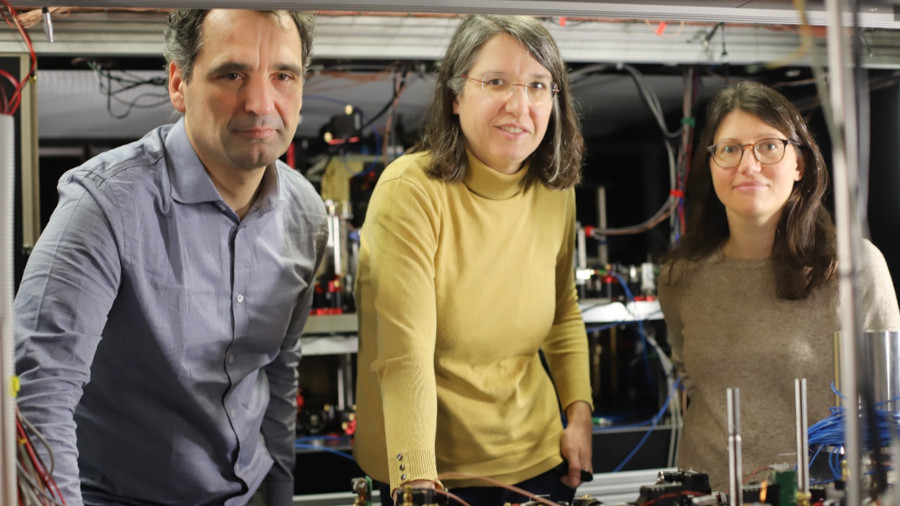
Although supersolids were predicted decades ago, researchers have only recently managed to realize them and experimentally explore their dual superfluid and crystalline nature. Many open questions remain about how and if these properties manifest in different platforms. Now, researchers at ICFO, Craig Chisholm, Sarah Hirthe, Vasiliy Makhalov, Ramon Ramos, and Rémy Vatré, led by ICREA Professor Leticia Tarruell, in collaboration with Josep Cabedo and Professor Alessio Celi at the Universitat Autònoma de Barcelona (UAB), have succeeded in unequivocally demonstrating supersolidity in ultracold potassium atoms coupled to light.
For the first time, researchers have imaged the so-called spin-orbit-coupled supersolids, providing compelling evidence of both their solid and superfluid features. These direct observations, now published in Science, show a cloud of potassium atoms spontaneously forming stripes (a crystal-like structure) whose spacing oscillates in time, alternately getting closer together and moving farther apart.
Through the collaboration with the UAB researchers, the team managed to explain the experimental results by describing the atomic cloud as a mixture of modified atoms that interfere, what they called the mixture model developed during Josep Cabedo's doctoral study at UAB, supervised by the Associate Professor of the Optics Group at the Department of Physics of the UAB Alessio Celi.
The semi-analytical mixture model "stands out for its simplicity and its strong agreement with the data" says Professor Alessio Celi. "Surprisingly, we managed to explain the supersolid stripes and their exceptional dance with modified atoms that behaves differently due to light coupling".
"Crystal structures are never perfectly static," explains ICREA Professor Leticia Tarruell. "Atoms slightly vibrate around their positions, changing the spacing between them. A true supersolid should also share this feature, which is exactly what we saw." The researchers also observed that, as the total cloud size expands or shrinks, new stripes appear or existing ones vanish, respectively, a behavior that is related to its superfluid nature.
Is a spin-orbit-coupled Bose-Einstein condensate a true supersolid?
Naturally, to take these images, the researchers first had to create the supersolid. By cooling a cloud of potassium atoms to temperatures close to absolute zero, they were slowed down until they became nearly motionless, eventually forming a Bose-Einstein condensate —an exotic phase of matter in which all atoms occupy the lowest-energy state, sharing a single quantum wavefunction and thus behaving collectively.
Next, the researchers sent two laser beams from different directions to couple the atoms' spin state with their momentum. Ultimately, this generated a spin-orbit-coupled Bose-Einstein condensate where two atomic states of different momentum interfered with each other. The interference is what produced a pattern in the cloud in the form of stripes, thereby giving rise to a supersolid.
"Most of the previous work on supersolids was done with magnetic quantum gases, while other platforms such as spin-orbit coupled Bose-Einstein condensates had remained largely unexplored," says Prof. Tarruell. As she explains, the question of whether a spin-orbit-coupled Bose-Einstein condensate could become a true supersolid had been debated for years, that is, whether a crystal-like structure with its rich dynamics could really emerge out of it.
"In previous experiments, one could indirectly infer whether a crystalline pattern arose, but we really wanted to see pictures of it," shares Dr. Sarah Hirthe, one of the first co-authors of the article. The first direct images of this kind of supersolid have, in fact, settled the debate surrounding spin-orbit-coupled Bose-Einstein condensates, establishing them as an excellent new platform for studying supersolidity. "Potassium was essential for amplifying the pattern, allowing us to directly observe its dynamics. In earlier experiments with other atomic species, the stripes' contrast was too low to be seen clearly and could only be inferred," the researcher adds.
A glimpse into future exotic states of matter
The team is now already thinking of taking one step further by applying the acquired knowledge to create what they call a "supersolid liquid". This hypothetical phase of matter would consist of liquid droplets stabilized by pure quantum effects —such as those discovered by the same ICFO group back in 2017— that also contain an internal crystalline structure. If realized, supersolid liquids would join the family of exotic states of matter, whose exploration began a century ago.
But, for the time being, the pictures have already marked a milestone for the field by revealing the stripes' dynamics as indicative of both superfluid and crystal behavior. According to Prof. Tarruell: "For the first time, we have really seen the crystal-like structure of a supersolid being truly dynamic, essentially 'breathing', as if it were alive."
Reference:
C. S. Chisholm, S. Hirthe, V. B. Makhalov, R. Ramos, R. Vatré, J. Cabedo, A. Celi, L. Tarruell, Probing supersolidity through excitations in a spin-orbit-coupled Bose-Einstein condensate, Science (2026).


