
The discovery of MoVes, a new type of extracellular vesicles containing DNA from migrating cancer cells, could provide valuable insights into how cancer spreads throughout the body.
Researchers at the Research Institute of the McGill University Health Centre (The Institute) have discovered a new type of extracellular vesicle released by migrating cancer cells, revealing a previously unknown way in which these cells shed their DNA as they move. Published today in the journal Nature Cell Biology, the findings show that these cells release tiny structures called motile vesicles (MoVes), which carry their genetic material, including cancer-associated mutations. The discovery raises important questions about the role these vesicles may play in cancer progression.

"Extracellular vesicles, or EVs, have been studied for decades, yet we are still discovering entirely new ways in which cells produce and release them. Studying this new type of vesicle, which we've named MoVes, could uncover new mechanisms involved in cancer progression and ultimately reveal new therapeutic targets," says Prof. Julia Burnier, PhD, Scientist in the Cancer Research Program at The Institute and senior author of the study.
"What makes this discovery particularly exciting is that we were not looking for a new type of vesicle. We were trying to understand how cancer cells release DNA and unexpectedly uncovered a biological process through which migrating cancer cells release genetic material and communicate with their surroundings," says Thupten Tsering, first author of the study and a PhD student in Prof. Burnier's laboratory at The Institute.
The role of extracellular vesicles in cancer
Found in tissues as well as in biofluids like blood, saliva and urine, extracellular vesicles are tiny, bubble-like structures produced and released by virtually all human cells. Once thought to be cellular waste, they are now known to play an important role in communication between cells, travelling throughout the body and carrying various molecules, including proteins, RNA and DNA, that can be transferred to other cells.
In cancer, some of these vesicles can travel to distant organs, where they may alter the surrounding tissues and create conditions that favour the formation of metastases. In other cases, they can transfer cancer-related molecules to other cells, potentially making them resistant to chemotherapy or interfering with the immune system's ability to fight cancer.
A newly discovered link between cell migration and DNA release
To better understand how and why cancer cells produce and release vesicles containing tumour DNA, the team studied a range of cancerous and non-cancerous cell lines using several experimental approaches, including genomic and proteomic analyses, alongside advanced imaging techniques like live-cell imaging and scanning electron microscopy. These in vitro experiments led to the unexpected discovery of MoVes.
Working with Dr. David Lyden, professor of pediatrics at Weill Cornell Medical College in New York, the researchers developed methods to separate MoVes from other EVs and began exploring their biological functions.
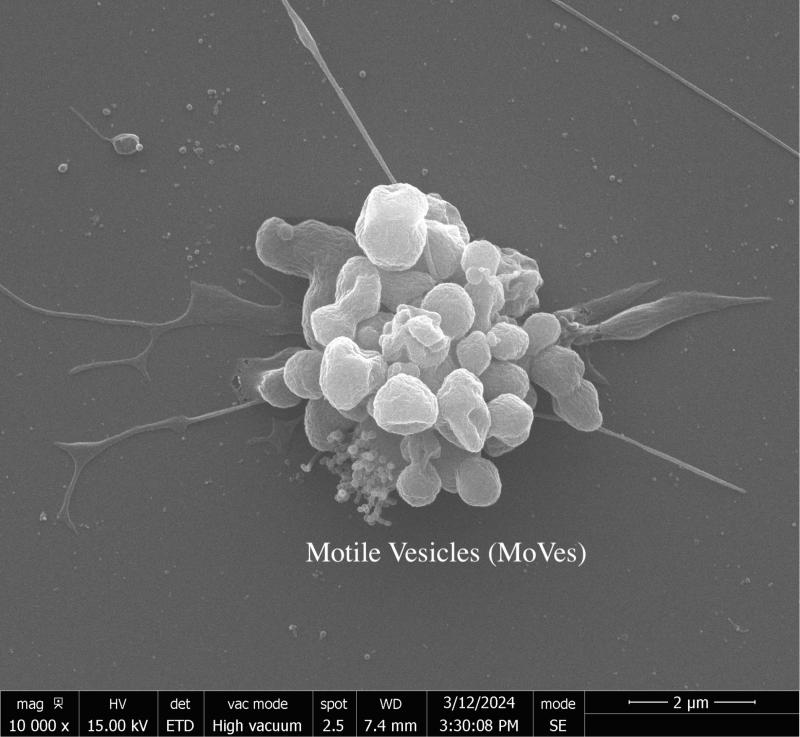
"Unlike previously described EVs, MoVes are specifically formed at the trailing edge of migrating cells through a distinct biological process. They are relatively large (2-5 µm), carry the entire parental cell genome as well as functional organelles," says Thupten Tsering.
Importantly, the researchers found that MoVes production was linked to a process called epithelial-to-mesenchymal transition (EMT), which allows cells that normally stick together to become more mobile and invade surrounding tissues. In cancer, this process is associated with tumour progression and resistance to certain treatments.
The researchers also observed that aggressive triple-negative breast cancer cells produced far more MoVes than non-cancerous breast cells.
"The breakthrough came when we induced EMT in non-cancerous cells, making them more mobile. We saw a dramatic increase in MoVes production, establishing a direct link between EMT and cell migration and the formation of these vesicles," explains Prof. Burnier, who is also Associate Professor at McGill University.
Studying MoVes to better understand cancer spread
Prof. Burnier's team is now working to better understand the mechanisms that control how MoVes are formed and released, as well as their effects on the cells that receive their molecular cargo. This could help them determine whether they play a role in cancer progression and identify potential ways to interfere with these processes.
The team also hopes to determine whether MoVes can be detected in animal models and patients. If confirmed, this could open new avenues for investigating their potential as cancer biomarkers-measurable biological indicators that can help detect cancer, monitor its progression or assess treatment response.
About the study
The study "Motile vesicles (MoVes) are a cancer cell migration-associated extracellular vesicle population" by Thupten Tsering, Amélie Nadeau, Masoud Ghasemi, Felippe Mousovich-Neto, Tobias Gabriel, Yunxi Chen, Laura Kienzle, Kyle Dickinson, Noélie Douanne, Inna Serganova, Roberta Zappasodi, Irina Matei, David Lyden and Julia V. Burnier, is published in Nature Cell Biology.
DOI: 10.1038/s41556-026-02097-2
The study was supported by the Canadian Institutes for Health Research (CIHR). Julia Burnier was supported by the Fonds de recherche du Québec (FRQ). Thupten Tsering received funding from the FRQ, the Gaden Phodrang Foundation, the McGill University internal studentship, the Fiera Capital Prize from the McGill University Health Centre Foundation, the CIHR Travel Award and the McGill Mobility Award. Yunxi Chen received Master's and PhD awards from FRQ, a PhD studentship award from the Research Institute of the McGill University Health Centre, and Graduate Excellence Fellowship from McGill University.
The Centre for Applied Nanomedicine (CAN) and the proteomics platform at The Institute played a key role in this discovery, along with McGill University's Facility for Electron Microscopy Research (FEMR) and McGill Genome Centre.


