
UConn Ph.D student's program selected for observation time on our most powerful space telescope
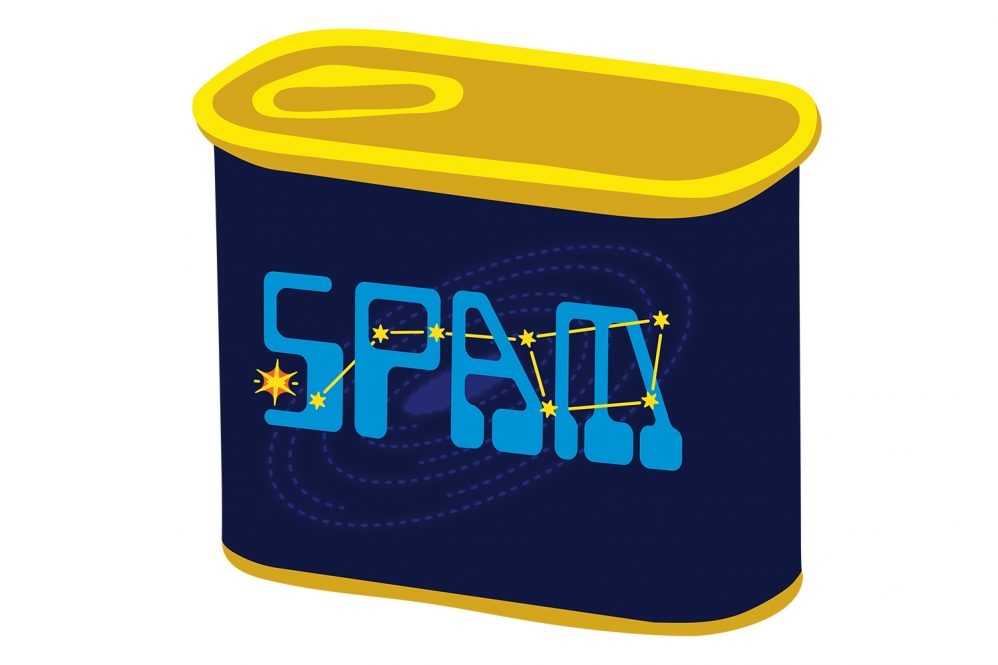
The logo for the program is a can of SPAM and includes the big dipper because to find CEERS/SPAM in the night sky, Davis says to use the big dipper as a reference and the brighter star on the logo indicates the position of CEERS relative to the big dipper. (Logo by Julie Wakefield, UConn Design Center)
The next time you look up at the night sky, know that even regions of seemingly blank, inky space contain massive quantities of information that are helping to answer some of astronomy's biggest questions.
UConn Department of Physics Ph.D. student Kelcey Davis explains the only way astronomers can survey these dark areas is by taking "deep field images," essentially pointing space telescopes like Hubble or JWST at the same abyss-like spot for extended periods of time. Davis is the principal investigator on an exciting project using highly sought-after JWST observation time which will double the amount of data collected about distant galaxies from a segment of sky first surveyed by JWST as part of the Cosmic Evolution Early Release Science Survey (CEERS)
The observation time for Davis's project, Star formation from Photometry via the Addition of Medium-bands (SPAM), is set for June, and preparations are well underway. Getting to this point was no small feat, Davis explains, because the proposal process for JWST is extremely competitive. With the encouragement and support from her advisor – Department of Physics associate professor Jonathan Trump – and her research community, Davis and project co-principal investigator Rebecca Larson were thrilled to secure over 60 hours of observation time and funding.
The long observation time used in deep field imaging enables the telescope to capture information on dim objects such as distant galaxies and the supermassive black holes, millions to billions of times the mass of our sun, that Trump's research group studies.
"I work exclusively in galaxies that we can only see that way," says Davis. "I study those galaxies and the supermassive black holes at their centers."
CEERS imaging revealed a huge array of new galaxies to study, in this case, tens of thousands of galaxies within that single image. To get a sense of the size of the area of space at the focus of the observation, Davis says to hold your hand out at arm's length, and if you focus on one of your fingernails, the thickness of the fingernail represents a unit of measure called an arc minute. The region of sky for the SPAM observation is about 10 arc minutes wide.
JWST captures images using filters, and to visualize how this works, Davis says to imagine someone making a screen print, where layers of color are stacked to create an image. JWST detects light in the infrared and near-infrared range of the spectrum, which we cannot see but to get around this, the researchers divide up the spectrum, and each of these divisions add a new layer to the image.
"We chunk that end of the spectrum up with different filters and translate the infrared light into visual colors. Right now, CEERS uses only 10 filters that are mostly broad and miss subtle changes in hue (blending cyan and blue together, for example)," Davis says. "SPAM is going to add 10 more filters that provide much finer detail about the light emitted by objects in the survey field. SPAM uses narrower imaging filters that are much more effective at resolving the 'rainbows' of color from distant galaxies and black holes. Many follow-up programs have targeted CEERS with focused spectroscopic data, which gives lots of information about the light output of individual sources. However, these efforts require targeting individual galaxies and has been done for a few thousand targets. Our program targets all of the galaxies in CEERS at once."
The addition of these medium band filters will yield more discrete information to help the researchers gain a better understanding of the light coming from distant galaxies.
"We take the different imaging data and fit models to it. Is that a young galaxy forming stars? Is that galaxy hosting a supermassive black hole? Is this something I've never seen before? All of that comes from fitting models to the data and we are basically doubling the amount of data points that we can fit with this program, and that's for everything within this CEERS image, so tens of thousands of galaxies."
In the lead up to the June observation time, the team is gearing up for what will be an all-hands-on-deck experience. Davis plans to prioritize organizing the SPAM data products so her research team can begin diving into the research, while co-PI Larson will begin writing the initial survey paper detailing key aspects of the data.
"The observations are made public right away. A lot of other people are excited about this observational data set because it will enable a lot of really cool science," says Davis. "I see my duty as cataloging all the data products so the broader community can use it for their research. It is going to be a lot of late nights and hard work. I have spent a lot of time like this working in such a competitive field. Previously that kind of work has been focused on proposals, and it can be so crushing because award rates are so low. It is nice that this hard work will go toward a project that was funded."
SPAM, in conjunction with a competing program, will mean this is the first, and so far, only, observation to use every imaging filter from JWST. This adds to the excitement that comes with each new batch of observations from JWST because they reveal so much, says Davis, including complete surprises.
"All galaxies have supermassive black holes at the center which are millions to billions of times the mass of a typical star and we have no idea how you get all that mass into one spot. There are lots of theories on how that happens and with JWST we are seeing the first galaxies that formed within the first billion years of our universe, which is about 13.8 billion years old, so this is just the beginning. We are starting to learn that at some point in the evolutionary phase of supermassive black holes, they grow in cocoons of hydrogen gas which is surprising to us. We have done a lot of work into theories about how these formed, there is no simulation or theory that included this, so that is why it was surprising."
Davis says that her favorite part of working in this highly competitive field has been the team of around 100 CEERS collaborators, who have been instrumental.
"While I am leading this project I would not have been able to do this without my giant, supportive team. If I'm working on a paper or a proposal, they all give great feedback, and I know they will be huge supports when we get the data. This is a team effort and lots of people are helping me along the way."


