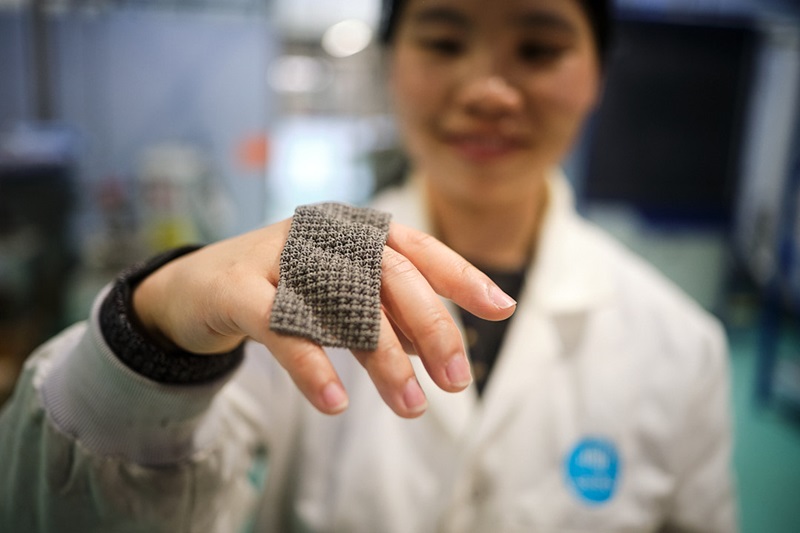
3D printing produces small, complex or bespoke items from various materials, or 'inks', like plastic, metal or even food. Useful for producing one-off or parts in small numbers, the technology has become ever more sophisticated over time. It's now even being trialled on space missions to produce components on demand if required.
3D printing has also been a game changer for the manufacturing industry. New data released by Additive Manufacturing Research shows the worldwide 3D printing market reached $4.35 billion in the first quarter of 2026.
So, what role does 3D printing play in manufacturing here in Australia?
All quotes below are available for use by media.
How does 3D printing work?
At its core, 3D printing builds up objects layer by layer from a digital design. Instead of cutting material away – the process used in traditional machining – additive manufacturing adds material only where it is needed.
The process begins with a 3D model created in computer aided design (CAD) software. That design is then sliced into hundreds or thousands of thin layers, which the printer builds up sequentially using materials such as polymers, metals or ceramics.
3D printing offers a fundamentally different approach to manufacturing and has been a game changer for the manufacturing industry. Parts can be produced without expensive tooling, it speeds up production and makes it possible to create highly complex or customised designs.
Dr Daniel East, Advanced Manufacturing and Metals Group Leader, CSIRO
How did 3D printing develop?
3D printing began in the 1980s with machines that used ultraviolet light to harden liquid resin, mainly for expensive industrial prototyping. A breakthrough came in 1989 with fused deposition modelling, which creates objects by melting and depositing very thin lines of plastic.
When key patents expired in 2009, competition increased, prices fell and 3D printing became accessible to hobbyists and the wider public for the first time.
The first high-quality metal printers hit the market in the mid-2000s, and these are the same machines we continue to use today. They work in a similar way to the early printers but instead of UV light and resin they use a high-powered laser and metallic powder.
3D printing has been enthusiastically embraced in Australia as local manufacturers look for more flexible, resilient and efficient ways to produce high-value components.
Dr Daniel East, Advanced Manufacturing and Metals Group Leader, CSIRO 
What can – and can't – be made using 3D printing?
3D printing excels at producing complex shapes that are difficult, costly or impossible to make using conventional methods. This includes lightweight lattice structures, internal channels for cooling or fluid flow, highly customised parts and intricate assemblies consolidated into a single component.
Metal 3D printing is especially useful for making smaller (around the size of a softball), complex, high-performance parts like medical implants or aircraft components.
Rather than just copying parts we already know how to make, 3D printing lets engineers design entirely new shapes that work better – for example parts that cool more efficiently, are lighter or last longer. Some of these designs wouldn't be possible with traditional manufacturing.
But 3D printing isn't always the right solution. For simple parts produced in high volumes, traditional manufacturing methods are usually faster and cheaper. The 3D process also isn't 'print and done' – parts often need extra steps like heating, trimming or smoothing before they're ready to use and that extra time and cost needs to be built into the plan.
Dr Daniel East, Advanced Manufacturing and Metals Group Leader, CSIRO
Is there a difference between 3D printing and additive manufacturing?
The terms are often used interchangeably, but there is a subtle distinction. 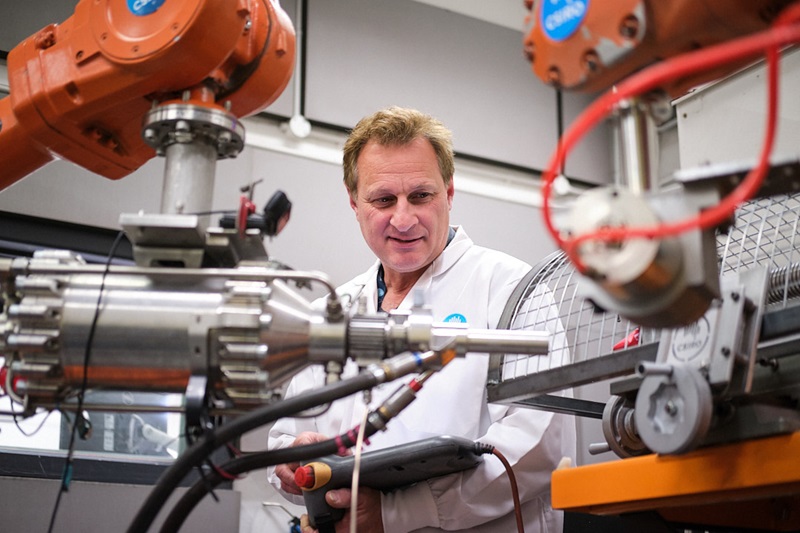
'3D printing' originally described early polymer-based printing technologies and is still commonly used in consumer and desktop contexts.
'Additive manufacturing' is the broader industrial term, encompassing a wide range of polymer, metal and ceramic processes used in professional manufacturing environments.
In practice, both refer to the same family of technologies that build parts layer by layer from digital designs.
Dr Daniel East, Advanced Manufacturing and Metals Group Leader, CSIRO
What materials can be used?
Today's additive manufacturing supports a growing range of materials, including:
- polymers, such as thermoplastics and fibre‑reinforced composites
- metals, including titanium, aluminium, steels and copper alloys
- ceramics, used for high-temperature or wear‑resistant applications.
One of the major advances in recent years has been the development of materials specifically engineered for additive manufacturing, rather than adapted from conventional production methods. These materials have been designed to handle the rapid heating and cooling that happens during printing.
Researchers are also experimenting with printing parts that are made from more than one material at once, or single parts made of gradually changing materials. This enables engineers to design for strength, lightness, heat resistance or durability exactly where it's needed, creating parts that perform better than anything made using traditional methods.
Dr Daniel East, Advanced Manufacturing and Metals Group Leader, CSIRO
How long does 3D printing take compared to traditional manufacturing?
Print times can range from hours to days, depending on part size, complexity and process. While this may sound slow, additive manufacturing can reduce overall lead times by eliminating tooling, moulds and multiple production steps.
For prototypes, small batch production or highly customised parts, additive manufacturing often delivers components much faster and more cost effective than traditional methods. Newer technologies, such as robotic printing, are further accelerating production rates and the size of printable parts.
Traditional manufacturing is based on making a large number of parts with a single design. First a tool or mould is designed and produced, which can take several months and be an expensive process, but from there production can be fast and high-volume.
If time to delivery is valuable or the batch run is small, additive manufacturing can often be a good economic option for production.
Dr Daniel East, Advanced Manufacturing and Metals Group Leader, CSIRO
What are the benefits and limitations of 3D printing?
3D printing offers many advantages, including the freedom to create highly complex designs, reduced material waste, faster prototyping and iteration, and the ability to customise parts at scale. It can also support more resilient and distributed supply chains by enabling production closer to where parts are needed.
But it's not without limitations. Costs are still higher for high-volume, simple components and manufacturers must meet strict material and process qualification requirements. Parts often require additional post‑processing and inspection, and specialised skills and infrastructure are needed.
As the technology continues to mature, many of these challenges are being addressed through ongoing research, improved equipment, smarter software, real-time monitoring and stronger quality assurance frameworks.
Dr Kathie McGregor, Advanced Materials and Processing Research Director
What's CSIRO's role in additive manufacturing for industry?
CSIRO, Australia's national science agency, created a dedicated facility to solve research and development problems facing companies using metallic additive manufacturing - the Lab22 Innovation Centre .
Lab22 houses an array of state-of-the-art metallic additive manufacturing technologies. Located at CSIRO's Clayton site in Melbourne, Lab22 means companies can explore additive manufacturing opportunities, with new materials, manufacturing techniques and research expertise compared to commercially offered services. The lab has now been operating for a decade and is one of the nation's leading research and development hubs for metallic 3D printing.
Dr Daniel East, Advanced Manufacturing and Metals Group Leader, CSIRO
Where to from here?
Additive manufacturing is transitioning from an emerging technology to a mainstream industrial capability. In Australia, it is increasingly valued for strengthening sovereign manufacturing capability, reducing supply chain risk and enabling high-value, locally produced components.
Future progress will focus on larger-scale systems, lower-cost feedstocks, advanced simulation and quality assurance, and closer integration with traditional manufacturing. Rather than replacing conventional processes, additive manufacturing will sit alongside them as a complementary tool – one that expands what is possible in design, performance and production.
As adoption continues to grow, the real impact of 3D printing will be measured not by how many parts we print, but by how much smarter, faster and more resilient our manufacturing systems become.
We're working towards a future where parts can be printed close to the point of use rather than in a factory that might be on the other side of the world. Printers will be fitted with multiple sensors that monitor the build process so we'll know the mechanical properties, performance and safety of the parts. And we want parts that can be used directly out of the machine without needing extra steps and expense in heating, trimming or smoothing that they often need today.
This reality is still years away but we are working on the sensing systems, the digital models and the materials science to make this happen.
Dr Kathie McGregor, Advanced Materials and Processing Research Director