
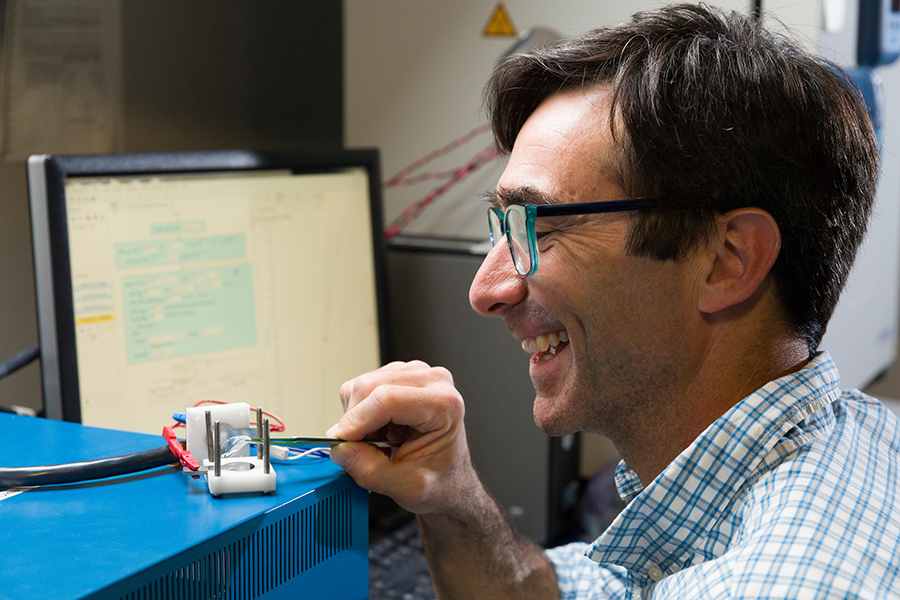
FAMU-FSU College of Engineering researchers are applying fuel cell technology to new applications like sustainable energy and water treatment.
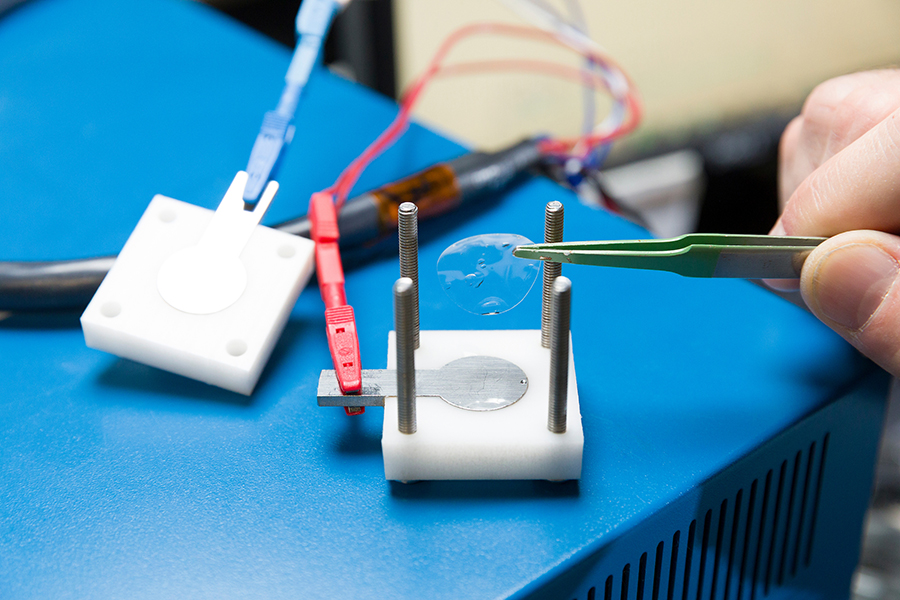
In a study published in Frontiers in Membrane Science and Technology, the researchers examined a type of membrane called a perfluorosulfonic acid polymer membrane, or PFSA polymer membrane. These membranes act as filters, allowing protons to move through, but blocking electrons and gases.
In the study, the researchers examined how boiling these membranes - a common treatment applied to the material - affects their performance and helps them work as specialized tools for different applications.
"PFSA membranes are essential for making fuel cells function, but we wanted to examine understudied uses of this technology," said Daniel Hallinan Jr., a professor in the Department of Chemical and Biomedical Engineering and the study's co-author. "The qualities that make them useful in one application may not be optimal for another purpose. Our goal was to understand how pretreatment affected the final material properties."
Expanding the Possibilities for PFSA Membranes
PFSA membranes are advanced materials engineered for selective movement of protons, which are positively charged ions. The membranes' unique chemical synthesis results in thin, flexible sheets that act as high-performance filters, letting protons pass while blocking unwanted substances. The amount of water inside the membrane strongly affects how ions move, and controlling water content is one of the most important parts of designing these systems.
During production, PFSA membranes sometimes undergo boiling as pretreatment, which helps them to absorb more water and thereby transport ions faster.
The research team showed how pretreatment leads to design tradeoffs: Treated membranes showed increased water absorption, which led to better conductivity (faster transport of desired material through a membrane) but worse selectivity (more of the unwanted material also gets through the filter). Untreated membranes had the opposite qualities.
"If you want speed, pretreatment is helpful. If you want precision, pretreatment might hurt performance," said co-author Youneng Tang, associate professor in the Department of Civil and Environmental Engineering. "Understanding how this process works will help engineers optimize membrane selection and pretreatment for specific applications."
Breakthroughs in Membrane Applications
The team measured membrane permeability, water uptake, salt partitioning and conductivity, metrics that determine how quickly salts and ions pass through PFSA membranes versus conventional materials, which are important for applications like flow batteries and lithium extraction.
Along with their use in fuel cells, PFSA membranes play a vital role in other applications. Hallinan highlighted three promising areas for research:
• Mineral Harvesting from Desalination Brine: Membranes are critical for extracting valuable minerals such as lithium from desalination processes, providing resources that are used in batteries.
• Redox Flow Batteries for Energy Storage: PFSA membranes improve rapid ion transport needed for efficient energy storage in renewable power systems.
• Electrochemical Reactors for Fuel Conversion: These reactors use PFSA membranes as part of the process, converting carbon dioxide into fuel.
This research helps engineers customize membranes for their specific use cases, said co-author Sebastian Castro, a former chemical engineering undergraduate who is now a doctoral student at New York University.
"Membranes are crucial in electrochemical systems, serving to separate substances in the presence of an electric field," he said. "A deeper understanding of these membranes will enhance the viability of large-scale electrochemical processes. This work contributes to global efforts to improve renewable energy technology, making it more efficient and sustainable, ultimately providing better access to clean and affordable energy for everyone."
Collaborators and Support
Graduate student Dennis Ssekimpi was a co-author of this study. The work was supported by Florida State University and by the National High Magnetic Field Laboratory's Research Experiences for Undergraduates.


