
Farmed oysters are mixing with and potentially adding to populations of wild oysters - a once-abundant species in New York's estuaries and rivers that has declined drastically over the last century.
A new study, which published April 23 in the journal Molecular Ecology, offers genetic evidence and the first documented proof that farmed eastern oysters are adding to and breeding with wild eastern oyster populations in the western and central Long Island Sound.
"Oyster farms might provide ecosystem services to the natural system, with one of those being a boost to oyster populations that are dwindling," said Matthew Hare, associate professor in the Cornell CALS Ashley School and senior author of the paper.
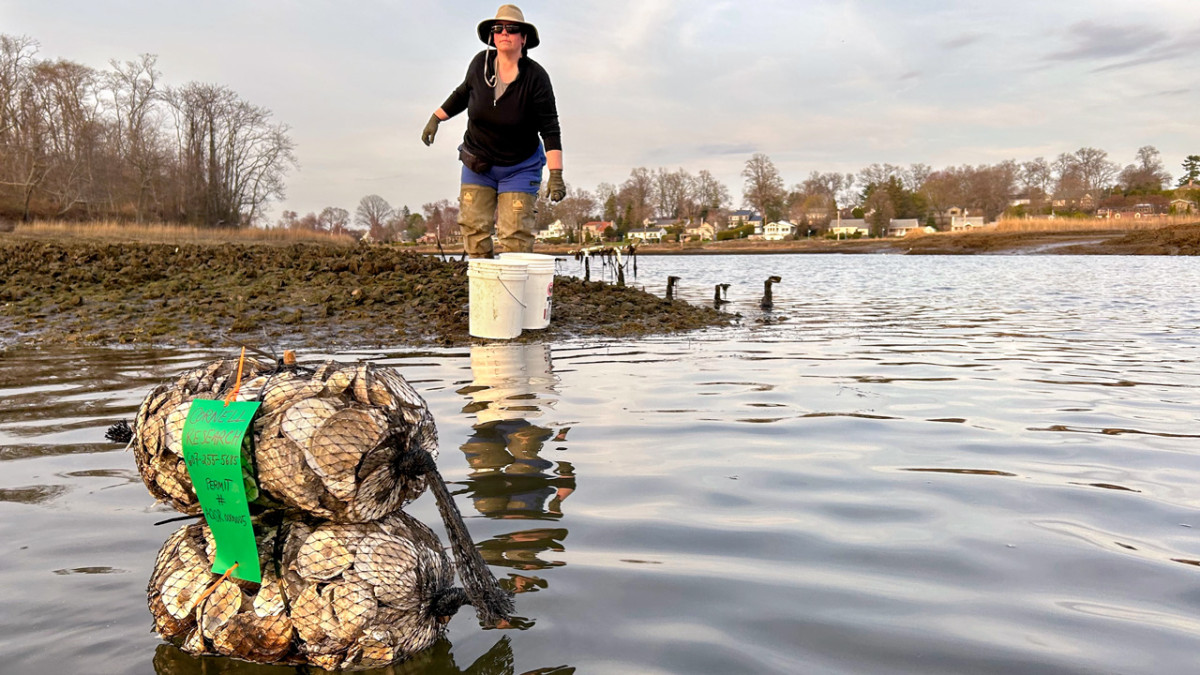
Harmony Borchardt-Wier, lab manager, checks mesh bags full of clean, cured shells set up to attract swimming oyster larvae to attach to them.
"If a farm is near an oyster population and there's any reproduction on the farm, it's possible that it can provide a demographic supplement and basically build up populations nearby, because the offspring from the farm could end up in the wild population," Hare said.
A rise in oyster populations could be good news for these waterways because they eat organic matter such as algae, essentially filtering the water. This allows sunlight to travel further down the water column, benefiting plant life and other animals. Oysters also sequester polluting nutrients and deposit them on the estuary floor.
In the 1600s, New York's estuaries and rivers were home to some 220,000 acres of oyster reefs until overfishing, pollution and siltation led to their decline by the 1900s. Scientists estimate wild oyster numbers have declined globally by 85% over the last century, with similar rates of declines of eastern oysters in New York occurring mostly in the 19th Century. In 2023, 84% of New York eastern oysters were reared in oyster farms.
Adult oysters - which can live up to 10 years in today's environment - cement themselves to the floor of estuaries, where the water is less salty than in the open ocean. Still, their life cycle includes a larval stage where they swim around for up to three weeks eating algae before they drop down and fasten themselves. They can travel many kilometers during this stage, far enough for farmed, domesticated oysters to drift and mix with wild ones.
Regulations require farmers to raise oysters in clean water, since oysters can be tainted by polluted waterways, and become harmful if eaten. As a result, regulatory agencies prohibit aquaculture in places with compromised water, mostly near urban areas, where sewage and runoff can contaminate waterways. For this reason, most of the Hudson River, the East River and the far western Long Island Sound are closed to oyster farming.
In the study, Hare and colleagues analyzed the genomes of native oyster samples collected from the Hudson River, the East River and the Long Island Sound in Connecticut. Hare had previously found and documented genetic markers that contain signatures of domestication. "We use those markers to detect differences between wild and farmed oysters," said Hare, who is also director of the cross-college Environment and Sustainability major and a fellow with the Cornell Atkinson Center for Sustainability.
Samples of wild populations from the Hudson River revealed genetic variation consistent with a single breeding population, meaning they had rarely mixed with farmed oysters, if at all, as predicted from the absence of oyster farms. "Whereas in the East River and in Connecticut, we saw oysters had this kind of mixed pattern, the mixture being the wild and also the farmed aquaculture ancestry," Hare said.
Though more study is needed to fully understand the long-term effects of bred, farmed oysters mixing their genes with wild oysters, some of the traits breeders have selected for in agricultural strains - such as disease resistance - may benefit wild populations.
In many cases, aquaculture can do more harm than good to the surrounding ecology. Coastal fish aquaculture also requires farmers to feed the animals, and some of that uneaten food drifts down and pollutes and overfertilizes the seabed. But oysters don't carry this risk, since they eat phytoplankton and organic matter found naturally in the water, and in doing so clean the water. Also, farmed salmon escape from farms and often interbreed with the wild stock. Studies have shown that the offspring of these salmon pairings have lower fitness and survival rates and reproduce less. No comparable studies have been done on oysters, and their life history differs from salmon too much to compare the two.
"Bivalves and kelp are a very different kind of aquaculture that has benefits," Hare said.
Yuqing Chen, a doctoral student in Hare's lab, is the paper's first author, and Yuka Kutsumi, M.S. '17, is a co-author.
The study was funded by New York Sea Grant.


