A study including the involvement of the UAB reveals that communities of anatomically modern humans modified the selection, management and circulation of flint in response to technological, climatic and mobility changes over 25,000 years.
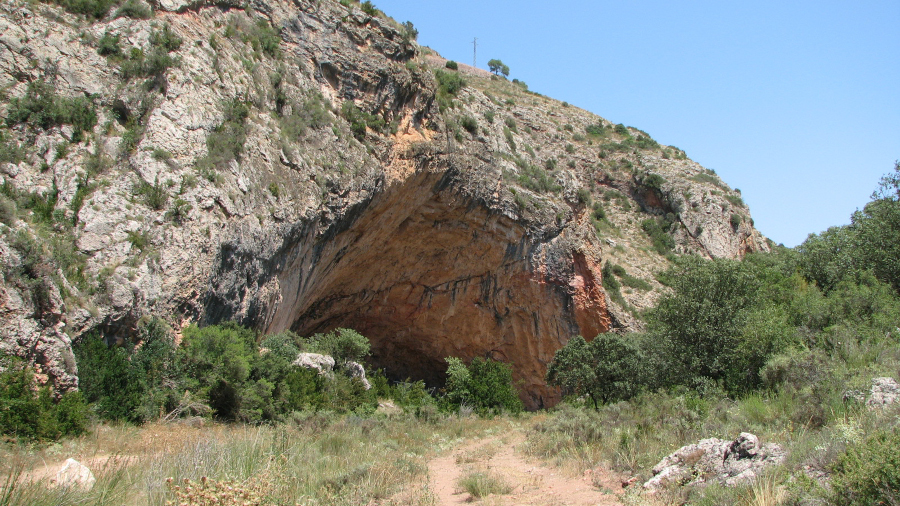
The analysis of more than 3,000 lithic tools from the Cova Gran de Santa Linya site (Les Avellanes and Santa Linya, Lleida) shows that anatomically modern human communities that occupied the southern Pyrenees during the Upper Paleolithic exclusively used flint to make their tools. The results published in the journal Quaternary International indicate that the selection of raw materials was closely linked to technological changes, the organisation of mobility, and the way these groups interacted with their surroundings.
The research was led by the Catalan Institute of Human Paleoecology and Social Evolution (IPHES), the Interdisciplinary Centre for Archaeology and the Evolution of Human Behaviour (ICArEHB) and the University of Barcelona (UB), in collaboration with the Centro Nacional de Investigación Sobre La Evolución Humana (CENIEH), and the Universitat Autònoma de Barcelona (UAB). Jorge Martínez Moreno, researcher in the Department of Prehistory was the co-author of the study and researcher Javier Sánchez (IPHES and CEPAP-UAB) was the first author. The study focuses on an exceptional archaeological sequence that documents repeated human occupations from the transition between the Middle Paleolithic and Upper Paleolithic to the Late Glacial period.
The team analysed lithic cores and retouched tools from 19 archaeological levels of the Cova Gran, dated between approximately 13,500 and 39,000 years ago, using an archaeopetrological approach that allows recognising the sedimentary origin of the flint artifacts and propose possible catchment areas.
The study distinguishes two large groups of flint used recurrently: evaporitic varieties (formed in saline environments), with a wide distribution in the pre-Pyrenees environment, and lacustrine varieties (originating in ancient lakes), present in different areas of the Ebro Basin and of very good quality.
Although the main sources of supply remain stable, researchers document a progressive shift towards the predominant use of lacustrine flint starting from the last glacial maximum, about 25,000 years ago. This shift coincides with a reorganisation of lithic technology towards the manufacturing of small-sized tools, such as scrapers, truncates and projectiles.
Long-distance flint
One of the most relevant results of this study is the identification of flint of marine origin, from areas located more than 100 km from the site, which include areas of the northern side of the Pyrenees and possibly southwest France.
The identification of long-distance flint coincides with the coldest phases documented at the site, indicating greater mobility of populations across the Pyrenees or contact networks that were sustained over time. "The presence of long-distance flint in the form of retouched elements indicates that it was possibly introduced to the Cova Gran site as part of toolkits or sets of multifunctional tools that travelled with these populations as they moved from one place to another", the authors point out.
The site of the Cova Gran de Santa Linya is thus consolidated as a key site for studying human interactions with the landscape on the southern side of the Pyrenees. The long archaeological sequence allows us to observe how in the same territory the dynamics of flint supply and management change depending on the technological, social and cultural choices of prehistoric populations.
Original article: Sánchez-Martínez, J., Rafart-Vidal, E., Benito-Calvo, A., Martínez-Moreno, J., & Sánchez de la Torre, M. (2026). Variations in human ecodynamics in the southern Pyrenees: chert procurement and use at Cova Gran de Santa Linya during the Upper Paleolithic. Quaternary International, 771, 110312. https://doi.org/10.1016/j.quaint.2026.110312