The Mars we know today is a cold, dry world of dust and rocks. However, around 3.8-3.6 billion years ago, it may have looked very different. Geological and mineral evidence suggests that, in its distant past, the planet experienced periods warm and wet enough for water to exist on its surface, potentially forming rivers, lakes, and even an ocean in the northern hemisphere.
Earlier research has also shown that formaldehyde (H₂CO) could have been produced in the atmosphere of warm early Mars. The importance of this substance is that once delivered to water, formaldehyde can serve as a starting material for chemical reactions that produce sugars, amino acids, and other complex organic molecules - compounds important to ultimately start life. Yet one major question remained unanswered: where on Mars would this formaldehyde have actually reached the surface?
To answer this question, a research team led by scientists from Tohoku University, the Earth-Life Science Institute, and the Institute of Science Tokyo created a global map showing where atmospheric H₂CO may have been delivered across the planet during its early history.
To build this visualization, the researchers simulated warm conditions around 3.8-3.6 billion years ago and examined how temperature, water vapor, pressure, and UV light affected the formation of H₂CO. Their research showed that water vapor was especially important for Martian formaldehyde production. UV light broke apart water molecules, releasing reactive hydrogen needed to form H₂CO in the atmosphere, while rainfall carried the formaldehyde down to the surface. As a result, water-rich regions were predicted to receive more formaldehyde than drier areas.
Because water influenced both the formation of H₂CO and its delivery to the surface, the researchers suggest that the Martian water cycle may have determined where this prebiotic molecule could accumulate. The map they created shows where these predicted hotspots lie in relation to the landing sites of Mars missions.
"By comparing our map with findings from rovers, we can begin to test whether places that received more H₂CO were also more favorable for early life-related chemistry," said Dr. Koyama. "If future observations confirm this relationship, our map could help identify promising targets for future Mars missions."
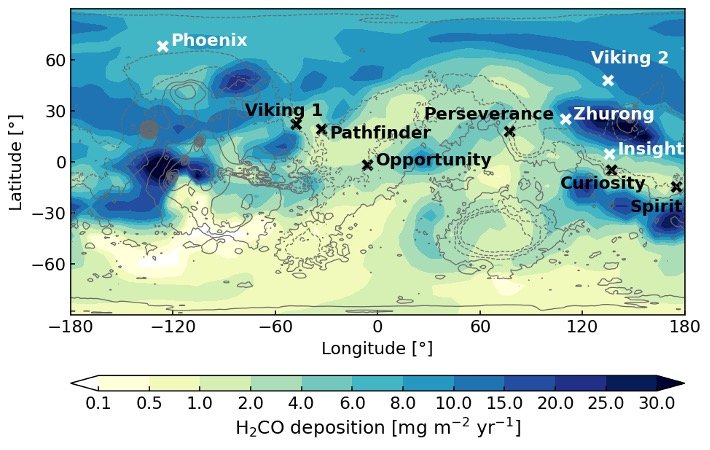
Some areas of Mars stood out clearly on the map. For example, the model predicted that mountainous regions such as Tharsis and Elysium received about ten times more H₂CO than the global average. However, these estimates show how much H₂CO may have reached the surface in the past, not how much remains there today.
This study may provide guidance toward potential landing sites for future Mars missions, which may help us better understand how organic chemistry developed on the planet billions of years ago, bringing us one step closer to unraveling the mysteries surrounding the origins of life there.
The findings were published in The Planetary Science Journal on September 30, 2026.
- Publication Details:
Title: Global distribution of atmospheric formaldehyde deposition correlated with water vapor on a warm early Mars
Authors: Shungo Koyama, Arihiro Kamada, Naoki Terada, Yoshihiro Furukawa, Tatsuya Yoshida, Yuki Nakamura, Takeshi Kuroda, Ann Carine Vandaele, and Shohei Aoki
Journal: The Planetary Science Journal
DOI: 10.3847/PSJ/ae9942