
It has been a harrowing week for women in Australia. Five Sydney Swans players were stood down for the remainder of the AFL season following an incident of alleged sexual assault at a Melbourne hotel, which police are investigating. This news broke simultaneously with reports of three 17-year-old boys charged for an alleged gang rape in Western Sydney, while three Scots College boys have appeared in court charged with the rape of a 14-year-old girl in a Sydney alley. Meanwhile, Queensland police confirmed a First Nations woman allegedly murdered by her former partner had contacted them earlier this month seeking help over allegations of domestic violence.
Australian Femicide Watch reports such violence is not unusual — she is the 45th Australian woman killed in 2026.
On average, a woman in Australia is killed by an intimate partner or trusted family member every 11 days , prompting nationwide protests and urgent calls for systemic and governmental reform. "We see reform after reform, but what we don't see is a marked improvement in the safety of women and girls in this country," says Senior Macquarie Law School Lecturer Dr. Amira Aftab.
Dr. Aftab believes that's because the efforts "aren't adopted on a cultural level," due to persistent "victim-blaming myths" perpetuated by "negative actors" like One Nation leader Pauline Hanson. Earlier this month, Senator Hanson declared domestic violence was "a two-way street" .
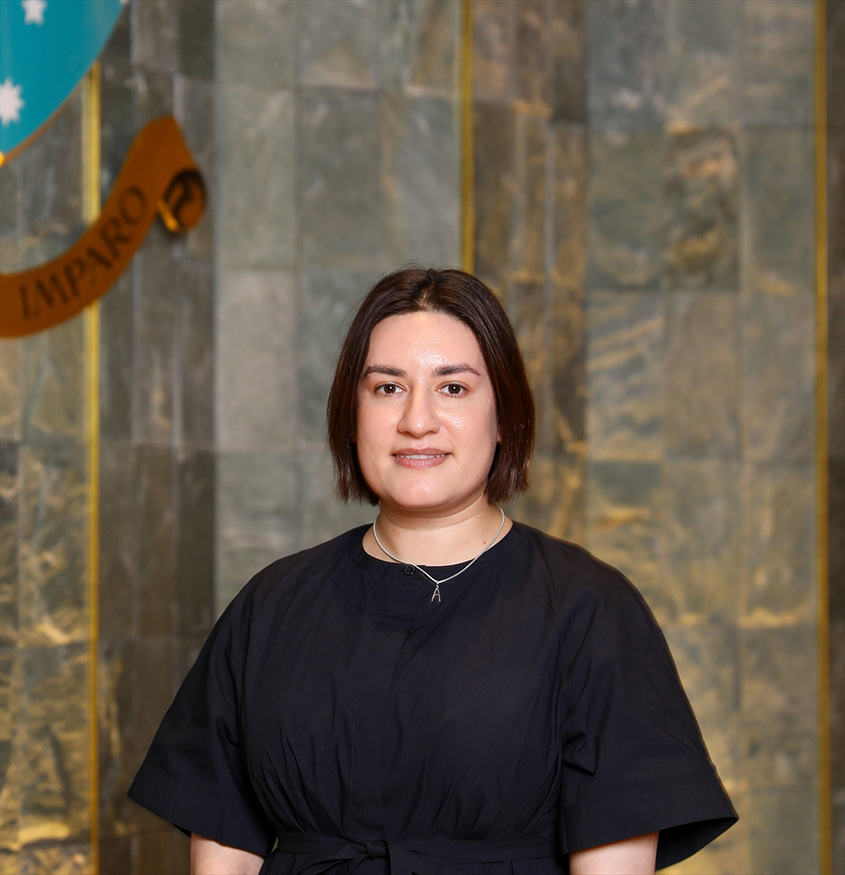 Macquarie Law School Senior Lecturer Dr. Amira Aftab researches the gendered-nature of institutions. Photo: Supplied.
The highly controversial remark saw journalists resurface an episode of the Broken Fathers podcast from November, in which Hanson labelled paid family and domestic violence leave a "holiday", described it as a "scam" that encouraged false claims and argued child support had become a "cash cow". She also claimed police spend too much time on family violence instead of "real crime" and mused that DV-related murders are born of "frustration and jealousy".
For two decades, Hanson has been beating the same drum. She first called for the Family Court to be abolished in 1996, doubling down on the effort in 2016 after her son, Adam Hanson, pleaded guilty to breaching a domestic violence order in the Cairns Magistrates Court. In 2019, Hanson used parliamentary privilege to call her former daughter-in-law "nasty" and accuse her of making false claims.
Dr. Aftab has been working with culturally diverse victim-survivors for the past five years, researching why legal reforms aren't always as effective as they're billed to be. For example, coercive control is now legally recognised as domestic violence in New South Wales, Queensland, and South Australia. Since the law came into force two years ago, just four sentences have been imposed in New South Wales from 41 charges, and more than 300 reports. Dr. Aftab's work is about understanding why.
"For me, on a really personal level, I can't fathom someone who has experienced violence, turning around and going, well, women should not be believed," she says. "What Hanson's saying is deeply problematic but can be easily refuted by academic evidence and case law."
Child support as a "cash cow"
In the podcast, Hanson argued child support had encouraged custody disputes.
"I believe that you've got to wind back a lot of issues to do with the family law court … Go after the child support. A lot of people see it as a cash cow," she said.
Dr. Aftab says the claim is illogical and contradicted by evidence.
"What the research is actually showing us is that the child support system is one of the sites of continued abuse, overwhelmingly targeting the parent who receives the payments."
A 2024 study found more than 80 per cent of women felt significantly or completely controlled by an ex‑partner through child support manipulation, which included tactics like income minimisation, inflating care‑time claims, deliberate non‑payment and interference with Family Tax Benefit. "On the surface, incidents may not seem like much, but when it's all put together it has a huge impact on the victim-survivor parent," Dr. Aftab says.
Australia currently has $1.9 billion in unpaid child support , and Women's Legal Services Australia identifies non‑payment as a form of economic abuse, recognised under section 4AB of the Family Law Act 1975 (Cth).
Weakening the system, Aftab says, would further disadvantage single‑parent households, who are already among Australia's lowest‑income families.
Policing "real crime"
Hanson claimed domestic violence takes up "about 75 per cent of police officers' time", preventing police from addressing "real crime".
Dr. Aftab says the figure is wrong and the framing is dangerous.
Domestic violence accounts for around 40 per cent of NSW Police work, not 75.
"Firstly, domestic violence is crime and usually constitutes things Hanson would consider 'real crimes' such as assault, stalking, intimidation, property damage, breach of protection orders, and homicide," Dr. Aftab says.
National data shows up to 39 per cent of homicide victims are killed in domestic violence contexts , and the Australian Institute of Criminology recorded one‑third of all homicide victims last year were killed by a current or former partner or family member.
Far from being over‑reported, domestic violence is severely underreported. "In First Nations and culturally diverse communities, it's compounded by fear of the police," she says. "Will I lose my visa or get deported? Will I lose my children? Will they believe me? All of that is deeply embedded in why people don't report in the first place. "
Violence against women costs Australia $22 billion annually across law enforcement, health, housing, and lost wages. "If you remove police from the equation," Dr. Aftab says, "the burden simply shifts to health and emergency services."
Does the family court favour women?
Asked whether the family court favours women, Hanson replied: "Of course it is," blaming feminist groups and "too many woke people" in parliament.
Dr. Aftab says the claim is not supported by law or evidence.
"This claim is difficult to reconcile because of the sheer volume of research. Victim-survivors, who are overwhelmingly women, consistently describe the family law system as re-traumatising, unaffordable and unsafe."
Many have limited access to funds after separation, she says, creating major bargaining power imbalances when one party can afford private representation and the other relies on legal aid.
The Family Court was merged with the Federal Circuit Court in 2021. The 2006 presumption of equal shared parental responsibility — a reform driven by fathers' rights groups Hanson has long supported — was repealed in 2024 after reviews found it operated dangerously in family violence cases. "Partly because equal responsibility was misread as equal time," Dr. Aftab says.
Courts now prioritise safety of the child. "If there is evidence of family violence, that will of course impact the assessment of safety," Dr. Aftab notes.
"Frustration" killings
Hanson suggested some domestic violence killings may stem from men's "sheer frustration" over family breakdowns or "jealousy" about restricted contact with children.
She argued restrictions on contact between parents and children should require evidence of physical abuse.
Dr. Aftab says this is victim-blaming rhetoric.
"Violence is a choice," Dr. Aftab says, "and responsibility rests entirely with the person who commits it."
The legal definitions of family violence in both criminal and family law recognise non-physical forms of violence and abuse (such as economic and psychological).
"A single text message about children, as Hanson suggests, would not meet the threshold for coercive control in NSW. It requires an engaged course of conduct that a reasonable person would consider likely to cause fear of violence."
Requiring evidence of physical abuse to achieve protective orders "would mean the law is only capturing a really small percentage of cases," Dr. Aftab says. "It would also exclude a majority of intimate partner homicides on record from protection."
Domestic homicide is characterised by escalating control, she says, not grief. "I always think about the case of Hannah Clarke, which was really pivotal to Queensland criminalising coercive control," Dr. Aftab says.
Clarke left her husband, Rowan Baxter, in late 2019 after enduring years of controlling and abusive behaviour. In 2020, he tragically murdered Clarke and her three young children.
"Loss of control is the trigger and that's why separation is a high-risk period for victims," Dr. Aftab says. "To frame murder as valid frustration is dangerous."
It also echoes the discredited "provocation" defence (also called the "gay panic defence") which Australian law has moved away from due to its discriminatory impact.
Domestic violence "holiday" leave
Hanson labelled paid domestic violence leave a "holiday" and a "scam", claiming it creates "an incentive to go out there and make false accusations".
Dr. Aftab says this myth is one of the most damaging in the DV landscape.
"This simply isn't true," Dr. Aftab says. The Australian Law Reform Commission found no clear evidence that false allegations are routinely made in family law matters . Meanwhile, national statistics show one in four Australian women have experienced intimate partner or family violence since the age of 15.
Domestic violence leave is 10 non‑accruable days per year under the Fair Work Act 2009, used for essential safety tasks such as attending court, securing housing, and meeting police. "Ten days of leave is a modest intervention," Dr. Aftab says, "and rationally would not be an incentive to make up false claims."


