
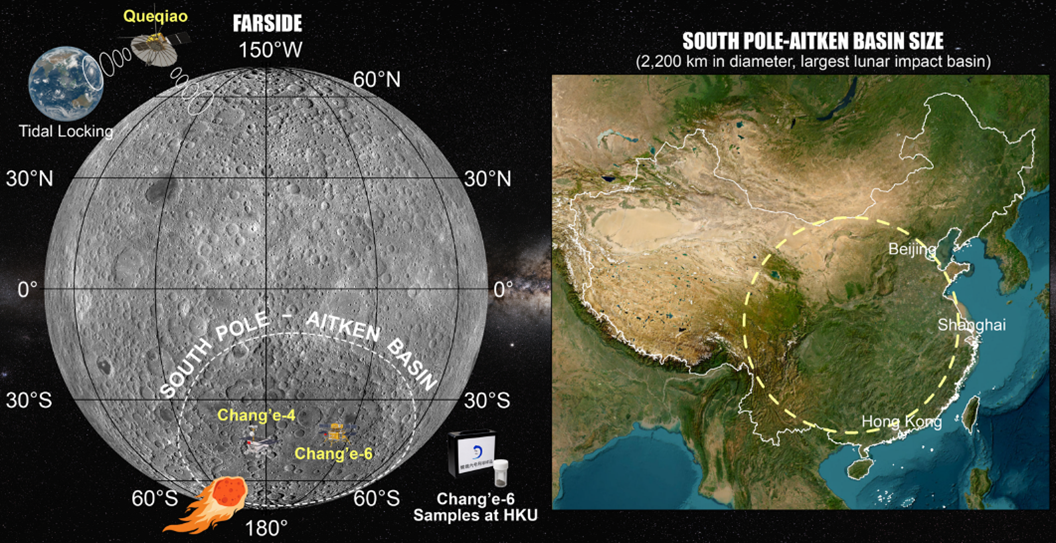
An international research team led by geologists from the Department of Earth and Planetary Sciences (DEPS) at The University of Hong Kong (HKU) has uncovered new evidence of how the Moon's largest impact basin, the South Pole-Aitken (SPA) basin, formed and evolved over billions of years.
Using lunar samples collected by Chang'e-6 and allocated to HKU DEPS for research, along with data from Chang'e-4 and satellite observations, the team identified two types of magnesium-rich rocks with distinct geological origins and reconstructed the sequence and timing of major impacts that shaped the basin.
The study, led by Professor Guochun ZHAO, Mok Sau-King Professor in DEPS, and Dr Yuqi QIAN, first author of the study, was recently published in Science Advances. The findings shed new light on the Moon's early geological evolution and how massive collisions reshaped its surface.
Tracing the Origins of Lunar Rocks and the Basin's Impact History
Located on the Moon's farside, the SPA basin is one of the oldest and largest impact structures in the Solar System, believed to have formed following a massive collision billions of years ago. Studying this ancient basin could help answer fundamental questions about the Moon's early history, including why its near and far sides differ so dramatically, what lies beneath its surface, and when major impacts occurred during its early evolution.
The basin remained largely unexplored until Chang'e-4 achieved the world's first landing on the Moon's far side in 2019, followed by Chang'e-6, which returned the first samples from the farside in 2024. These missions have provided scientists with unprecedented opportunities to investigate the basin's geological history.
In their earlier studies, the HKU-led team uncovered evidence of prolonged volcanic activity and previously unrecognised magma activity in the SPA region. Their research also suggested that ilmenite-bearing cumulates - accumulations of titanium-rich minerals - contributed to the contrasting volcanic histories of the Moon's near and farside.
In their latest study, the team shifted its attention to the basin's impact history, investigating how successive collisions shaped its geological evolution. These impacts excavated and scattered large quantities of rock fragments across the region, leaving valuable clues to its past.
By combining analyses of Chang'e-6 lunar samples with surface measurements from Chang'e-4 and Chang'e-6, the researchers obtained the first direct, on-site evidence from the two landing sites. They further employed remote sensing and numerical simulations to extend their findings across the wider SPA basin.
The findings reveal two types of magnesium-rich rocks with distinct geological origins. The first type, moderately magnesium-rich norites, formed when the original SPA impact melted enormous quantities of rock, creating a thick sheet of molten material that gradually cooled and differentiated. These rocks were later exposed at the central peaks of large impact craters. Some were excavated by the Finsen impact and transported to the Chang'e-4 landing site in Von Kármán crater. The second type, highly magnesium-rich rocks, likely originated from a different process known as magnesium-suite magmatism, associated with the SPA impact. These materials were exposed along the western peak ring of the Apollo basin and later transported to the Chang'e-6 landing site by the Chaffee S impact.
The researchers also constrained the timeline of major impacts that shaped the basin over billions of years. Their findings suggest that the SPA basin formed approximately 4.34 billion years ago, followed by the Apollo basin around 4.2 billion years ago and the Orientale basin approximately 3.87 billion years ago. Together, these events shaped the structure of the Moon's largest impact basin, providing a clearer picture of its geological evolution.
International Leadership in Lunar Science and Exploration
HKU has been advancing lunar research through the study of samples returned by China's Chang'e missions, international collaboration and participation in the national lunar exploration programme.
In 2023, HKU became the first university in Hong Kong to obtain Chang'e-5 lunar samples for scientific research. Dr Yuqi QIAN, Research Assistant Professor in the Department of Earth and Planetary Sciences, leads HKU's Chang'e-5 and Chang'e-6 sample studies, involving 822.6 milligrams and 1,000 milligrams of lunar materials, respectively. He is also actively involved in other robotic and human lunar exploration missions of China, and supports their implementation.
HKU continues to strengthen its planetary research through international collaborations. Professor Guochun ZHAO leads the NWU-HKU Joint Center of Earth and Planetary Sciences and the GIG-CAS & HKU Joint Laboratory of Chemical Geodynamics, supporting HKU's participation in the national space programme. Professor Nicolas DAUPHAS is establishing the ORIGINS COLLECTIVE at HKU to develop advanced facilities for studying planetary materials from the Moon, Mars and beyond.
Since 2025, HKU and the Institute of Geology and Geophysics, Chinese Academy of Sciences, have jointly organised the International Lunar Sample Research Symposium, bringing together over 200 researchers worldwide to share findings and foster collaboration in lunar science annually.
The latest study involved collaborators from Northwest University, Brown University, the University of Münster, Peking University, the University of Hawaiʻi, the European Space Agency and the Chinese Academy of Sciences.
For details of the research, please refer to the journal paper: https://doi.org/10.1126/sciadv.aeh9798


