In classical acoustics, the "mass law" dictates a frustrating compromise: the heavier and thicker a barrier, the quieter the room. This principle presents a persistent dilemma for architects and designers, who must often choose between blocking noise with dense walls or allowing fresh air to flow through open vents. Conventional attempts to circumvent this limit by tuning thin acoustic metamaterials to a single frequency often suffer from narrow bandwidths, failing to block noise just outside the target range.
A research team led by Professor Nicholas X. Fang from the Department of Mechanical Engineering of Faculty of Engineering at the University of Hong Kong (HKU) has found a radical way out. By translating a fundamental rule from quantum field theory into acoustics, they have crafted a universal mathematical blueprint for optimal sound scattering-opening the door to ultra-broadband, ventilated noise reduction.
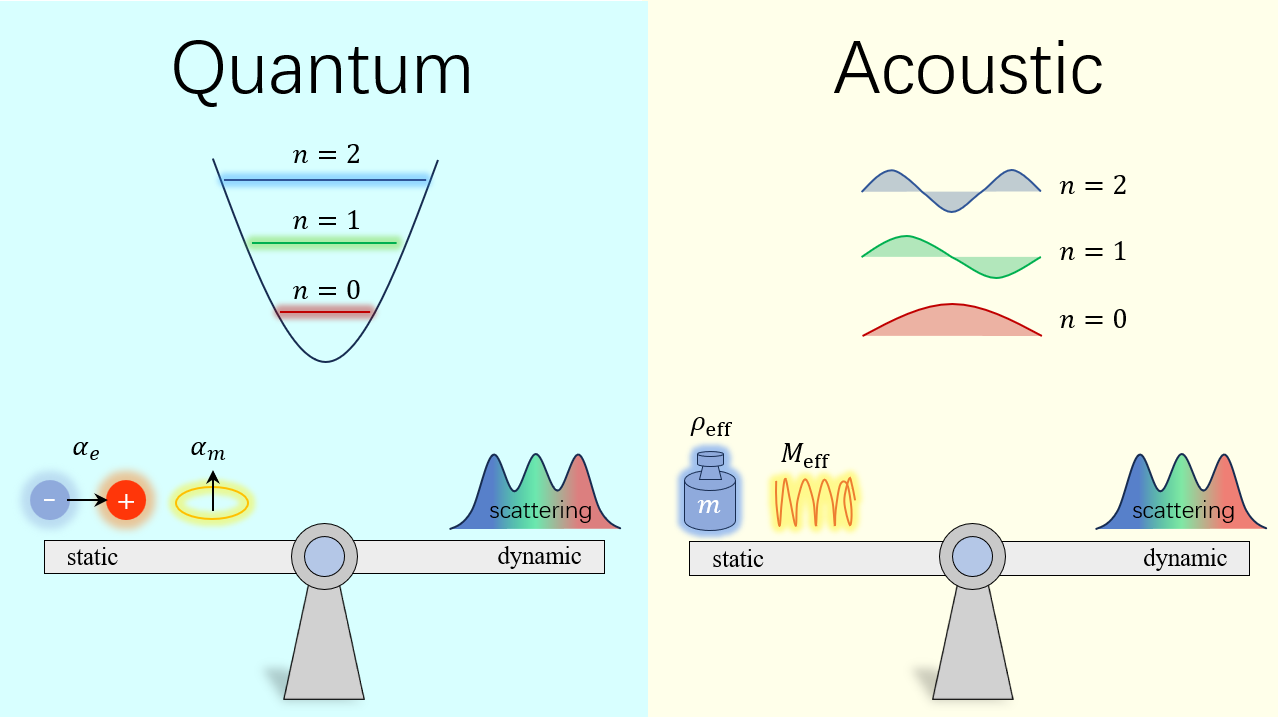
To tackle this fundamental limit, the team looked beyond classical mechanics and into the microscopic quantum world. They adapted the "Baldin-sum-rule"-a powerful theorem originally used to link the electric and magnetic polarizability of atomic nuclei to their absorption of light-and recast it for macroscopic sound waves. "We discovered that the integral of the extinction cross section is fundamentally locked by the scatterer's static effective mass and stiffness," explains Dr Sichao Qu, the paper's first author. In plain language: you cannot silence every frequency perfectly, but you can optimally redistribute this finite "scattering budget" to dramatically broaden the range of blocked frequencies.
Using this newly formulated acoustic Baldin-sum-rule, the researchers predicted an optimal design condition for anomalously broad transmission loss. They engineered a "Fano resonator"-the simplest possible system, coupling a single discrete resonance with a continuous background. In air-duct experiments, this minimalist structure achieved vastly superior broadband sound insulation compared with conventional foam liners and Helmholtz resonators.
The implications reach far beyond the laboratory. Imagine a summer breeze flowing through an open window while city traffic fades to a whisper. Picture hospital intensive-care units free from the relentless drone of ventilators, or airplane cabins where conversation no longer requires raised voices. "Counterintuitively, our Fano structure is remarkably simple, representing the minimal physical elements required to achieve causally optimal scattering," said Professor Fang. "This universal rule provides a practical blueprint for next-generation ventilated silencers that can efficiently block noise without blocking airflow."
The findings were published in the prestigious journal Physical Review Letters, titled "Acoustic Analogy of Quantum Baldin Sum Rule for Optimal Causal Scattering". The research team also includes Dr. Zixiong Yu, Dr. Erqian Dong, and Dr. Min Yang.
Link to the paper: https://journals.aps.org/prl/abstract/10.1103/dbs8-g68w
About Professor Nicholas Fang
The research efforts in Professor Fang's group concentrate on focusing wave physics into sub-wavelength scales. While the main efforts focus on new insights of design for advanced manufacturing of wave functional material and devices, his group also actively pursue the applications in the areas of energy conversion, communication, and biomedical imaging. His research also leads to over 16 patent applications on nano- and micro-fabrication, additive manufacturing, and imaging technologies with successful technology transfer to industry (e.g. Osram, BASF, Nissan) and startups.