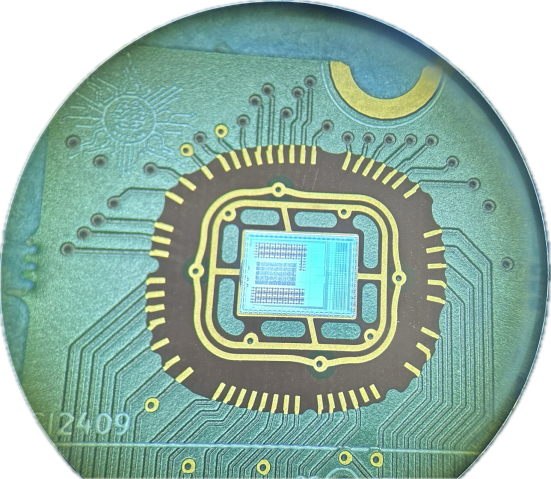
In the animal kingdom, energy conservation is essential for survival. That's why our brains have evolved to be extremely energy and resource efficient at storing and processing information. Since the 1980s, computational scientists have tried to mimic brain structure and function in the hopes of achieving such efficient, fast processing of complex data. However, researchers have not yet succeeded in creating functional, low-memory solutions that work in real-world scenarios, where energy is limited and training data is received over time.
Published in Neuromorphic Computing & Engineering, a new brain-inspired algorithm developed by researchers at the Okinawa Institute of Science and Technology (OIST) demonstrates promise for achieving practical applications under realistic constraints. Based on an olfactory (scent classification) system, the algorithm was trained and tested on experimental odor data sets, showing accurate classification of these scents, particularly in scenarios with limited training data.
The fruit fly is not to be sniffed at
To create their new algorithm, the researchers looked to a tiny source of inspiration. Smaller than a poppy seed, yet stuffed full of around 140,000 neurons, the fruit fly brain is ubiquitous within modern neuroscience research.
"It's one of the best-mapped brains; it's simple enough that we can study the brain as a whole, but it still achieves complex processing," emphasizes co-author Dr. Yang Shen of OIST's Biological Nonlinear Dynamics Data Science Unit. "It has a particularly interesting olfactory system that implements sparse coding, a computational scheme that helps reduce overlap between different signals without training, so we can efficiently represent odors with lower energy cost."
In Spi-Fly, the fly olfactory system is adapted and modelled as a three-layer network, with input signals projected randomly and sparsely onto a hidden middle layer of 1000 neurons, to activate just a few per scent. These active neurons act as a specific bar code, which is recognized by output neurons, with the help of an associative learning rule.
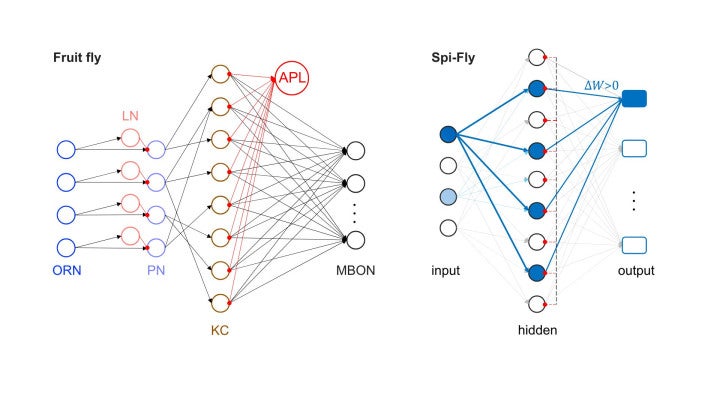
In fruit flies, odor receptor neurons (ORNs) sense different scents in the environment, activating projection neurons (PNs). Signals are normalized - adjusted to be within a particular range - by local neurons (LNs). PNs and Kenyon cells (KCs), of which there are around 2000, make lots of random connections, to expand each signal. Then, to reduce overlap between different signals, 95% of KCs are inhibited by another neuron (the APL), so just a few remain active for each different scent. These active KCs speak to output neurons (labelled here as MBONs). Through this dimension expanding and shrinkage, the unique pathways enable identification of each smell. If new smells are encountered, a learning algorithm at the connection between KCs and MBONs enables fast, continuous learning.
Spi-Fly is essentially a smaller version of this scheme, exhibiting the same dimension expansion and contraction, but using less layers. The active neurons in the hidden middle layer act as a unique bar code, which can be recognized by output neurons with the help of an associative learning rule.
In fruit flies, odor receptor neurons (ORNs) sense different scents in the environment, activating projection neurons (PNs). Signals are normalized - adjusted to be within a particular range - by local neurons (LNs). PNs and Kenyon cells (KCs), of which there are around 2000, make lots of random connections, to expand each signal. Then, to reduce overlap between different signals, 95% of KCs are inhibited by another neuron (the APL), so just a few remain active for each different scent. These active KCs speak to output neurons (labelled here as MBONs). Through this dimension expanding and shrinkage, the unique pathways enable identification of each smell. If new smells are encountered, a learning algorithm at the connection between KCs and MBONs enables fast, continuous learning.
Spi-Fly is essentially a smaller version of this scheme, exhibiting the same dimension expansion and contraction, but using less layers. The active neurons in the hidden middle layer act as a unique bar code, which can be recognized by output neurons with the help of an associative learning rule.
To test their system, the researchers used two different scent databases and compared performance to a range of other classification algorithms.
"Spi-Fly was the best performing method for few-shot learning - classifying scents easily after seeing only a few samples," explains co-author Dr Kevin Max of OIST's Neural Computation Unit. "It was also good at continual learning, correctly learning to classify new odors without forgetting about past learned ones - a huge issue with standard training methods, known as catastrophic forgetting."
As with any method, Spi-Fly has its limitations. Overall, its performance compared to the best traditional machine learning classification methods could be improved and more testing needs to be done to see how well it can perform with mixed signals, given the number of background smells we usually encounter in the real world. However, it provides a promising pathway towards practical brain-inspired computing.
Creating an artificial nose
"Detecting explosives; assessing allergen levels; ensuring food safety; identifying drugs - there's a huge range of applications for scent classification," highlights Max. "And theoretically Spi-Fly could work on any classification problems, beyond just odors. So developing this kind of brain-inspired, hardware-compatible algorithm can lead to a whole host of interesting applications."
While the algorithm was designed to classify smells, this requires a sensor to detect odors in the first place. Max and collaborators at TU Eindhoven and Kiel University are actively working in this field, developing odor-sensing hardware into which they plan to integrate Spi-Fly. Their overarching aim is to create an artificial nose with a broad range of practical applications.