
Taking a one-size-fits-all approach to analysing data from smart mouthguards may mean serious injuries are missed, a new University of Otago – Ōtākou Whakaihu Waka-led study shows.
The mouthguards were introduced in 2024 to measure the forces rugby players' heads experience during contact in a bid to enhance player safety.
These measurements are run through a mathematical model to estimate the players' risk of injury.
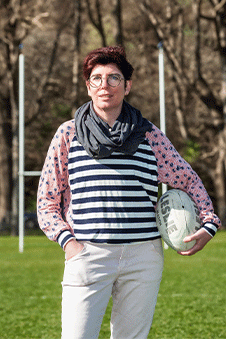 Professor Melanie Bussey
However, Professor Melanie Bussey, of Otago's School of Physical Education, Sport and Exercise Science, says the model does not account for people of different sex, age and size.
"The problem is that almost every commercial system uses a one-size-fits-all approach, assuming every player has the same head as a 50th-percentile adult male, whether they're a 10-year-old girl or a 130kg premier men's player," Professor Bussey says.
"We're calling on researchers, the sports technology industry and governing bodies to incorporate sex and size appropriate scaling into their injury monitoring systems to ensure all players are protected equitably."
Published in the Journal of Biomechanics, the study analysed videos of more than 15,000 head acceleration events from 572 community rugby players aged between 10 and 38 years old and weighing between 34kg and 142kg.
Researchers then assessed the risk of injury using suitable models.
"When we applied a female-appropriate head model to female players instead of the male default, estimated injury risk scores changed by up to 54 per cent," Professor Bussey says.
"We already know that injury prediction models perform inconsistently for female athletes. Using the wrong head parameters makes that problem worse.
"For lighter youth players under 55kg, switching to a more appropriate smaller head model reduced predicted rotational power by more than 60 per cent.
"Crucially, this also affected whether individual impacts were flagged as high-risk or not, meaning the wrong model could lead to players either being unnecessarily pulled from the field or serious impacts being missed."
Even a simple fix, such as using a minimum of three different reference models based on sex and body size, substantially reduces this bias.
"Our study shows that using the right models for the right players makes a big impact," Professor Bussey says.
"If we want smart mouthguards to improve safety across the whole game, then the modelling behind them needs to be inclusive. Accurate monitoring is not just about better technology. It is about making sure that technology works for everyone."
Publication:
Melanie Dawn Bussey, Joshua P McGeown, Sergio Dempsey
Journal of Biomechanics


