
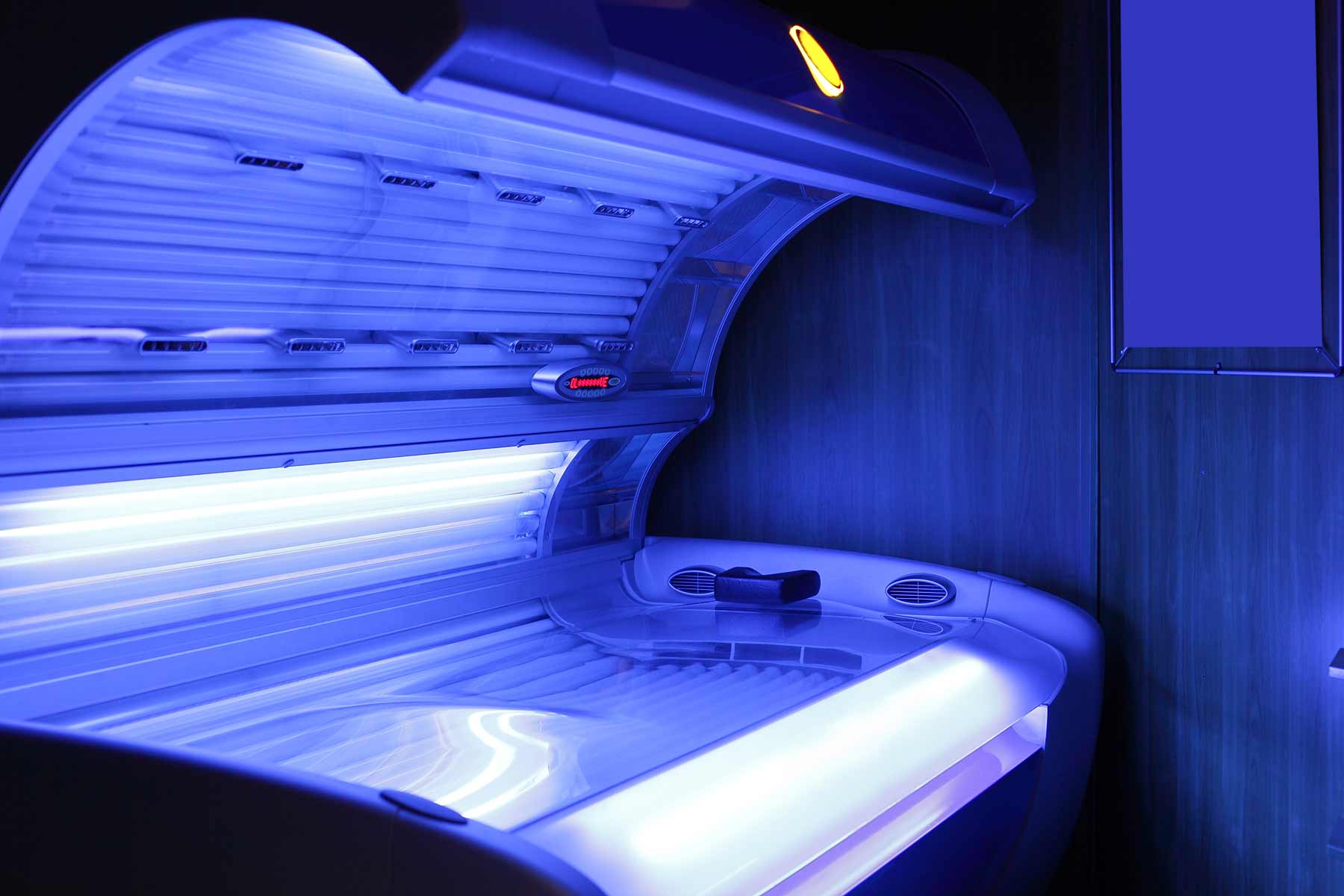
Research reveals that artificial sources of ultraviolet radiation cause cellular mutations that can be the seeds of future cancers, including highly deadly melanoma.
Tanning bed users are known to have a higher risk of skin cancer, but for the first time researchers have found that young indoor tanners undergo genetic changes that can lead to more mutations in their skin cells than people twice their age.
The study, which was led by UC San Francisco and Northwestern University, appears Dec. 12 in Science Advances .
The skin of tanning bed users was riddled with the seeds of cancer - cells with mutations known to lead to melanoma.
A. Hunter Shain, PhD
"We found that tanning bed users in their 30s and 40s had even more mutations than people in the general population who were in their 70s and 80s," said Bishal Tandukar , PhD, a UCSF postdoctoral scholar in Dermatology who is the co-first author of the study. "In other words, the skin of tanning bed users appeared decades older at the genetic level."
Such mutations can lead to skin cancer, which is the most common cancer in the U.S., according to the American Cancer Society. Among those skin cancers is melanoma, which accounts for only about 1% of skin cancers but causes most of the deaths. About 11,000 Americans die annually from melanoma, primarily from exposure to ultraviolet radiation.
UV radiation occurs naturally in sunlight, as well as in artificial light sources like tanning beds. Rates of melanoma have risen along with the use of tanning beds in recent years, disproportionately affecting young women, who are the main clients of the tanning industry.
Numerous countries effectively ban tanning beds, and the World Health Organization classifies them as a group 1 carcinogen, the same category as tobacco smoke and asbestos, but tanning beds remain legal and popular in the U.S.
In their study, the authors looked at the medical records of more than 32,000 dermatology patients including their tanning bed usage, history of sunburn, and family history of melanoma. They also obtained skin samples from 26 donors and sequenced 182 cells.
The young tanning bed users had more skin mutations than people twice their age, especially in their lower backs, an area that does not get much damage from sunlight but has a great deal of exposure from tanning beds.
"The skin of tanning bed users was riddled with the seeds of cancer - cells with mutations known to lead to melanoma," said senior author A. Hunter Shain , PhD, associate professor in the UCSF Department of Dermatology.
"We cannot reverse a mutation once it occurs, so it is essential to limit how many mutations accumulate in the first place," said Shain, whose laboratory focuses on the biology of skin cancer. "One of the simplest ways to do that is to avoid exposure to artificial UV radiation."
Authors: From UCSF, authors include Delahny Deivendran; Limin Chen, PhD; Jessica Tang, PhD; Tuyet Tan; Harsh Sharma, PhD; Aravind K. Bandari, PhD; Noel Cruz-Pacheco, MS; Darwin Chang; Annika L. Marty, MS; Adam Olshen, PhD; Natalia Faraj Murad, PhD; and Iwei Yeh, MD, PhD. Co-first author Pedram Gerami, MD, is with Northwestern University, Chicago.
Funding: The study was supported by the National Cancer Institute (R01 CA265786); the National Institute of Arthritis and Musculoskeletal and Skin Diseases (AR080626); the Department of Defense Melanoma Research Program (ME210014); and the Melanoma Research Alliance. Please see the paper for additional funders.
Disclosures: None reported.


