
Health insurers are calling on the Government to exempt Australians aged over 65 on low incomes — including those on the Age Pension — from changes to the Private Health Insurance Rebate, warning the move could force vulnerable people to drop their cover.
Private Healthcare Australia (PHA), the peak body for health insurers, say requiring pensioners and low-income older Australians to find hundreds of dollars more each year to maintain their private health insurance will lead some to downgrade their cover, or abandon it altogether.
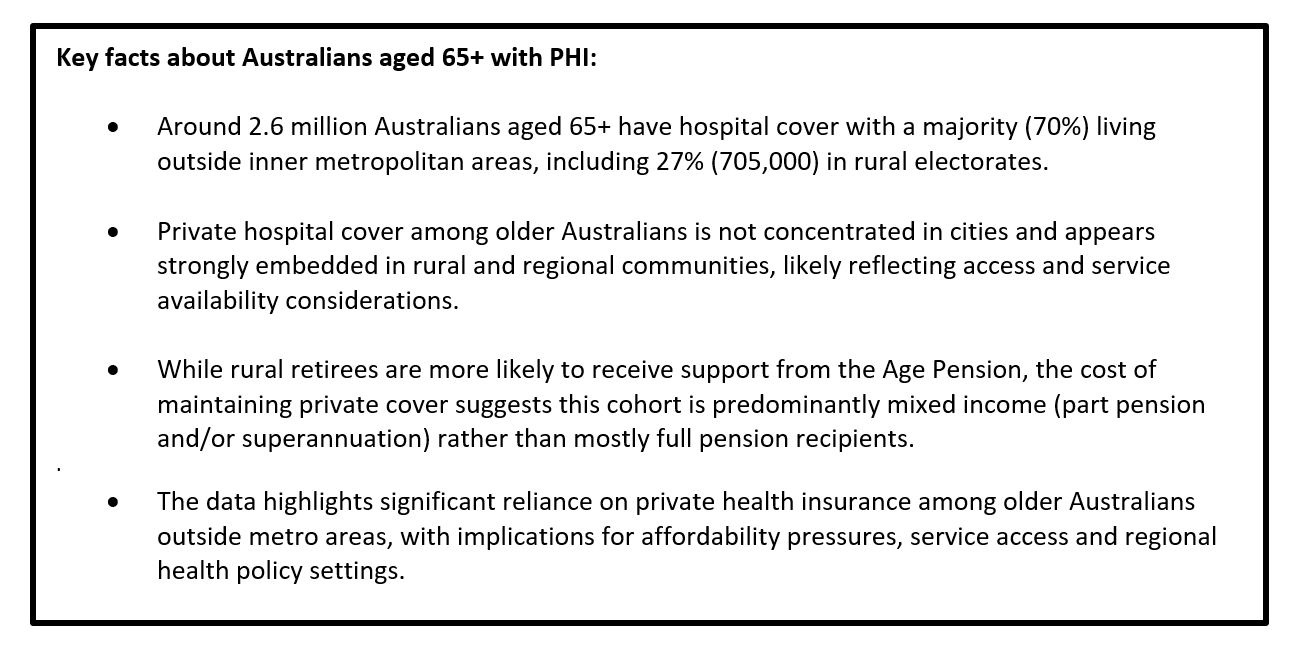
"About 39 per cent of Australians with private health insurance earn less than $55,000 a year. This includes more than 900,000 older Australians who will be affected by the Government's proposed changes announced yesterday as part of its aged care cost-of-living measures," PHA CEO Dr Rachel David said.
"Many of these people have annual incomes under $30,000 and many of them are in rural and regional Australia. While we recognise the Government's equity rationale for aligning rebate rates for those over and under 65, the reality is this broad-brush approach will make private health insurance unaffordable for thousands of vulnerable Australians."
Dr David said that although government modelling suggested around 44,000 people would drop their cover, those most affected would have higher healthcare needs.
"The public hospital system is already under pressure and cannot provide timely care for many of these patients," she said. "That's precisely why they rely on private health cover to manage their health."
PHA is urging the Government to retain higher rebate levels for Australians earning less than $55,000 a year and recommending age-based differentials within each rebate tier be removed.
"There is a large cohort of older Australians with chronic conditions who rely on the private system and already devote a significant share of their limited incomes to their healthcare," Dr David said.
"It is economically counterproductive to reduce the rebate and push high-needs patients out of private cover. This will increase pressure on public emergency departments, public hospital beds and elective surgery waiting lists, which are already struggling."
Dr David supported reducing rebates for higher-income retirees, noting this had been recommended in PHA's 2026 Budget submission.
"Reducing rebates for older Australians on six-figure incomes is sensible. Many do not require additional support," she said.
"But our strong recommendation is to redirect that support to low-income Australians by increasing rebates for those earning under $55,000 a year."
Following yesterday's announcement by Federal Health Minister Mark Butler, PHA is urging the Government to consider a broader reform package that includes:
- increasing the Medicare Levy Surcharge (MLS) for higher-income earners
- removing age-based rebate differentials and introduce a new 28 per cent rebate tier for those earning under $55,000 (or $110,000 for couples and families)
- simplifying rebate tiers from 2027 to whole numbers (24%, 16% and 8%), and
- reducing private healthcare costs by lowering the price of medical devices from 1 July 2026.
"Our initial estimates suggest this package would achieve around 70 to 75 per cent of the Government's revenue target while significantly improving equity," Dr David said.
"It would protect low-income Australians from premium shocks and avoid shifting additional costs onto the public hospital system."
She said this would support the Government's objective of improving intergenerational equity.
She also noted that more than half a million high-income earners currently do not have private health insurance, despite having the capacity to contribute more to their healthcare costs.
"We recommend increasing the Medicare Levy Surcharge to 1.5 per cent for Tier 1 earners, and 3 per cent for Tier 2 and Tier 3 earners," Dr David said.
"This would place downward pressure on premiums, strengthen insurers' risk pools, and support a more sustainable system as Australia's population ages," she said.
PHA is also calling for urgent reform of medical device pricing, which Dr David described as one of the most inflated cost drivers in the private system.
"Many medical devices cost between 30 and 100 per cent more in Australia than in comparable markets such as New Zealand," she said.
"As a first step, aligning prices for common devices with New Zealand benchmarks could save consumers around $300 million a year.
"That's where reform effort should be focused, not on measures that make private health cover less affordable for older Australians on very low incomes who are already struggling due to ongoing cost-of-living pressures."
About us:
Private Healthcare Australia is the peak representative body for Australia's private health insurance industry. PHA represents more than 20 Australian health funds and 15 million Australians (55% of the population) who have private health insurance.


