
At the Department of Ion Physics and Applied Physics at the University of Innsbruck, a research team has succeeded for the first time in storing electrically charged helium nanodroplets in an ion trap for up to one minute. This extends the time window for experiments with these extremely cold "mini-laboratories" by a factor of 10,000 compared to previous methods - and opens up new possibilities for basic research in physics and chemistry.
Helium nanodroplets are ultracold clusters consisting of helium atoms that come very close to the conditions that prevail for atoms and molecules in space. Among other things, this allows spectroscopic analyses of particles that occur in the interstellar medium to be carried out directly in the laboratory. Until now, however, the reaction and observation time was extremely short - investigations were generally limited to the flight distance between the droplet source and a detector, which is travelled in a few milliseconds.
"The long storage time now enables detailed investigations of processes inside the droplets," explains Matthias Veternik, PhD student and first author of the study. "Initial analyses show that collisions with the residual gas in the vacuum chamber as well as infrared-absorbing molecules and clusters in the helium - such as water molecules - limit the lifetime of the droplets. This understanding is crucial in order to further optimise the trap technology." The investigations were supported by Prof Lutz Schweikhard from the University of Greifswald, who played a key role in the development of the new device with his many years of experience in the construction and application of ion traps.
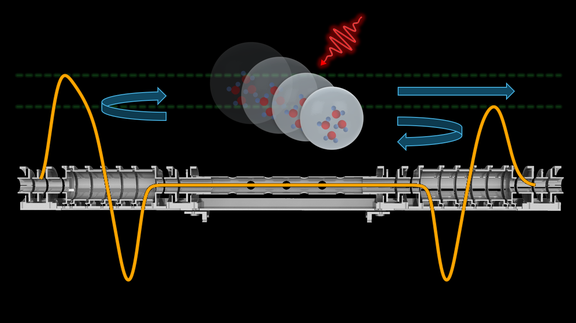
The new setup will allow chemical reactions and spectroscopic properties of molecules in ultracold helium droplets to be analysed much more precisely and over longer periods of time. The next development step is already planned: "By incorporating detection cylinders into the ion trap, we can measure the passing, highly charged helium droplets using an induced signal and thus determine both the mass-to-charge ratio and the charge of each individual helium nanodroplet," explains Elisabeth Gruber, who was recently honoured with an FWF-ASTRA Award to further develop this technology. "We want to use it to gain insights into the temporal development of charged helium droplets for the first time and develop a new form of nanocalorimetry."
The results were recently published in the journal Physical Review Letters and emphasise the great potential of helium nanodroplets as an ultracold laboratory environment for future research.
Publication: Extending the Observation Time of Charged Helium Droplets to the Minute Timescale. Veternik, M., Waldhütter, T., Schweikhard, L., Scheier, P., & Gruber, E. Physical Review Letters, 136, 013201. 2026. DOI: https://doi.org/10.1103/yr98-h791


