
My name is Elizabeth, a Pan-African food campaigner with Greenpeace Africa working to defend food sovereignty, ecological justice and community rights across the continent. A few months ago, Greenpeace Africa called out JBS, the world's largest meat company, which has signed a $2.5 billion deal to import its dangerous business model to Nigeria.
That's why last week I was in Amsterdam, where I watched as Greenpeace Netherlands and dozens of activists took over the JBS' first shareholder meeting since it became a Dutch company in 2025. The purpose? Deliver a Disclosure Letter, a first step toward legal action that could stop JBS' aggressive expansion plans in their tracks.
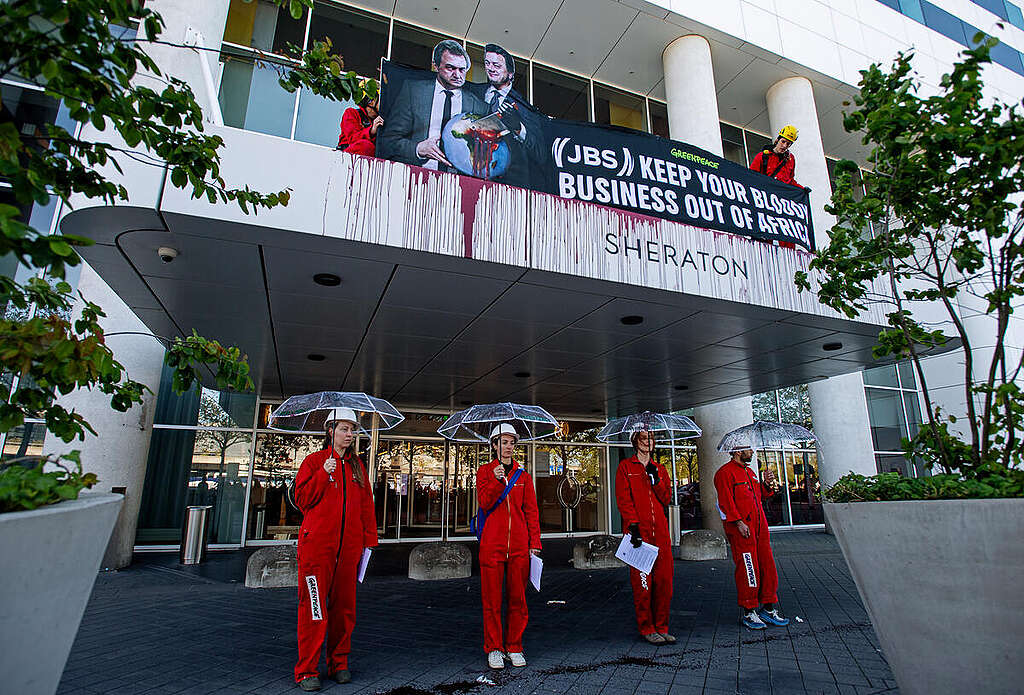
The letter demands that JBS make public plans, impact assessments and consultations about its Nigeria expansion – and seeing JBS executives fleeing their own meeting made clear how desperate they are to avoid scrutiny. But they can't escape our message: Keep JBS' bloody business out of Africa.
When multinationals talk about new markets and "geographic diversification" in the Global South, what they often mean is taking control over land, water, food systems and livelihoods. Nigerians have seen first-hand the destruction that another infamous Dutch company, Shell, already wrought on their country: decades of environmental destruction, pollution and broken promises. JBS follows the same playbook: peddling empty promises, refusing transparency, and ignoring civil society.
JBS has not made public critical information about the impact their plans will have on local communities and on the land and the water they depend on – the things that matter for their immediate security – as well as globally through climate change and biodiversity loss.
But based on JBS' track record - a business model characterised by massive emissions and linked to environmental destruction, corruption scandals and human rights violations - that expansion will come at an intolerable cost to people and planet. All to line their pockets.
Well, not on our watch.
How we stop JBS' expansion
JBS was warned last year, before it relocated its headquarters from Brazil to the Netherlands, that as a Dutch company it would need to play by Dutch law. Greenpeace Netherlands is now laying the foundation for a legal challenge in court to block JBS' expansion plans. This is on the grounds that by causing dangerous harm to climate, nature and human rights , it is in breach of Dutch law.
That is why Greenpeace Netherlands has given JBS three weeks to release the files that could help expose the true scale of the damage its expansion will cause. Under a new Dutch law, if JBS doesn't hand them over, Greenpeace Netherlands can petition a Dutch court to compel it to do so. And in those files, dear friends, we believe is the information that would allow JBS' dangerous $6 billion announced expansion plans , nearly half of which is earmarked for Nigeria , to be assessed and challenged in the Dutch courts.
Stopping their plans will leave space for the real solutions for nature and food sovereignty Africa needs.
And the success of a campaign like this relies on the support from people like you.
JBS is already "active" in Nigeria
In its agreement with Nigeria's government, JBS has pledged to build six giant meat-processing plants that would permanently alter Nigerian food production. These plans are framed as a solution to "food insecurity." But let's be clear about what this really is: a massive corporate takeover that threatens to lock in spiralling emissions for decades, drain water sources, and upend the food sovereignty that millions of families depend on.
After its expansion plans were splashed across Dutch media last week, JBS told journalists that it isn't "active" in Nigeria yet and that "they will inform shareholders when they are". This type of evasive statement is absolutely typical for JBS. But let's be frank: you don't announce a $2.5 billion deal unless you mean business. And what limited information is public gives a strong indication of just how far their plans have advanced already.
In Niger state, the government has already publicly pledged a staggering 1.2 million hectares of land – an area the size of the Gambia – for this expansion. And as the Governor of Ogun state acknowledged last year in the presence of JBS' billionaire bosses Josley and Wesley Batista, JBS has already dispatched a "technical team to Nigeria to conduct feasibility studies" to expand into his state.
Ogun to Benefit as World's Largest Protein Producer Invests $2.5bn in Nigeria
Ogun State is set to benefit significantly as JBS of Brazil, the world's largest protein producer, has committed to investing $2.5 billion in Nigeria's livestock subsector through a strategic… pic.twitter.com/0WNexPHi8M
— Prince Dr. Dapo Abiodun, CON (@DapoAbiodunCON) February 23, 2025
So while available evidence suggests business assessments and massive land deals are being made, actual formal and official information on what and where is unavailable. JBS cannot be allowed to continue operating in the shadows.
To be clear, the challenges facing Nigeria's food production are real. Shrinking grazing corridors, land degradation, and resource-driven conflict are serious, genuine threats that demand urgent action. But as civil society organisations in Nigeria have argued, the response to a system under stress should be properly supporting local farmers and communities and restoring nature. Not transferring food sovereignty away from communities who depend on this land to an unaccountable foreign corporation.
People have a right to know exactly what deals are being struck in their name. And what's more, they should have the right to choose a different food future.
The time of Billionaire impunity is over – climate justice can't wait
While civil society organisations in Nigeria are raising their voices to demand agency over the future of the land, Greenpeace Africa is pressing for a legal framework to ensure giant polluters can finally be held accountable for the damage they cause to the Global South, no matter where they are based in the world.
That is why, in March this year, Greenpeace Africa petitioned the African Court on Human and Peoples' Rights to deliver a ruling declaring as much. This would be a critical milestone in challenging the impunity with which corporations operate in Africa.
Like my colleague Ferdinand said, "Make no mistake: JBS is the new Shell". Because behind their promised development lies a business model that thrives on corruption, treating both nature and food not as fundamental rights, but as extractive resources to line the pockets of wealthy international elites.
The billionaires need to know that the era of corporate impunity on this continent is over. JBS was given 21 days to release the files and they now have 7 days left. The clock is ticking.
Elizabeth Atieno is a food campaigner at Greenpeace Africa


