
"Water Quality of U.S. Drinking Water Kiosks: Lead Release from "Lead-free" Plumbing after Reverse Osmosis Treatment" Environmental Science & Technology
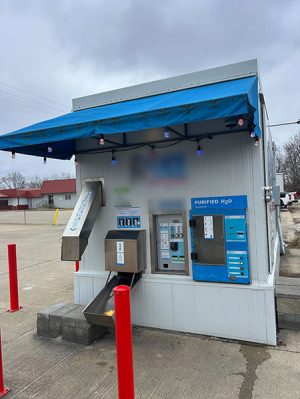
After high-profile water crises like the one in Flint, Michigan, some Americans distrust the safety of tap water, choosing to purchase drinking water from freestanding water vending machines or kiosks. Yet this more expensive water may contain different pollutants than local tap water, according to a study in ACS' Environmental Science & Technology. Researchers report that water sampled from 20 kiosks in six states sometimes contained lead at levels above public health recommendations.
Samantha Zuhlke
"Currently, water kiosks are not regulated the same as tap water; their water is not tested for lead or other metals," says Samantha Zuhlke, a corresponding author of this study. "Updating water kiosk regulations can improve their quality and help consumers make informed decisions about the water they are drinking."
Water kiosks are privately owned vending machines that are often marketed as being safer than tap water, commanding prices of $0.25-$0.35 per gallon (compared to less than 2 cents per gallon for tap water in most U.S. cities). Kiosk operators generally treat local tap water with purification techniques such as filtration, ultraviolet light or reverse osmosis (RO) to remove potentially harmful contaminants such as lead, microbes, residual disinfectants, and per- and polyfluoroalkyl substances (PFAS). But water vending machines in the U.S. are poorly regulated. So, a team of researchers led by Zuhlke and David Cwiertny conducted a comprehensive comparison of the chemical and microbial characteristics of kiosk water and tap water from municipalities close to the monitored kiosks.
The team collected water samples from 20 kiosks operated by four different manufacturers across Iowa and in the surrounding states of Illinois, Kansas, Missouri, Arkansas and Oklahoma. Most of the kiosks advertised treatment of their water by RO, a process that uses pressure to force water through a semipermeable membrane, purifying the water and leaving most contaminants caught behind the membrane. For comparison, the researchers collected tap water samples from community sources within a mile of each kiosk.
They analyzed all samples and found no evidence of microbial contamination in any sample. They also found that RO treatment in kiosks effectively removed most PFAS from the sourced tap water. However, this benefit was offset by concerning levels of lead in some RO-purified kiosk water samples - nearly twice the concentration recommended by the U.S. Environmental Protection Agency.
The researchers traced the lead to the corrosion of brass plumbing in the kiosks following RO treatment. Although the plumbing components are marketed as "lead-free," small amounts of the metal can leach under the low-pH and low-alkalinity conditions of RO-treated water, they say. Replacing the internal metal pieces with other materials could eliminate lead in dispensed water.
"This work adds to growing evidence that allowable levels of lead in 'lead-free' plumbing can still be problematic sources of lead in drinking water when such plumbing is exposed to certain types of water, like that generated after RO treatment," Cwiertny says.
The authors acknowledge funding from the University of Iowa's Center for Social Science Innovation and the Office of Undergraduate Research. This work was conducted through the University of Iowa Center for Health Effects of Environmental Contamination, which receives support through the Iowa Department of Natural Resources.


