
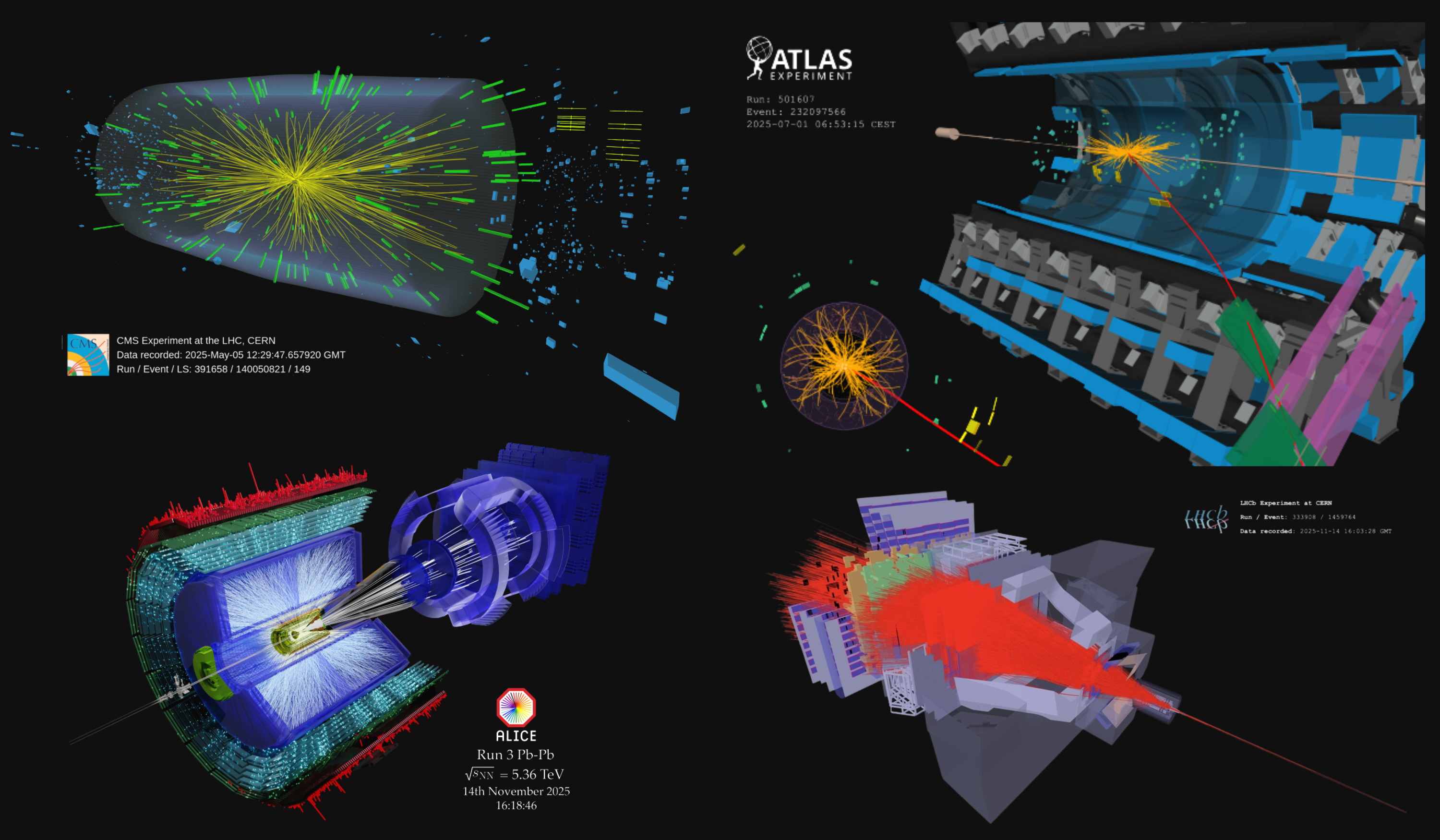
Event displays (particle collisions) captured by the detectors of the LHC's four large experiments during 2025. Top left: first collisions recorded by CMS in May. Top right: proton-oxygen nucleus collisions detected by ATLAS in July. Bottom: lead-ion collisions observed by ALICE (left) and LHCb (right) in November. (Image: CERN)
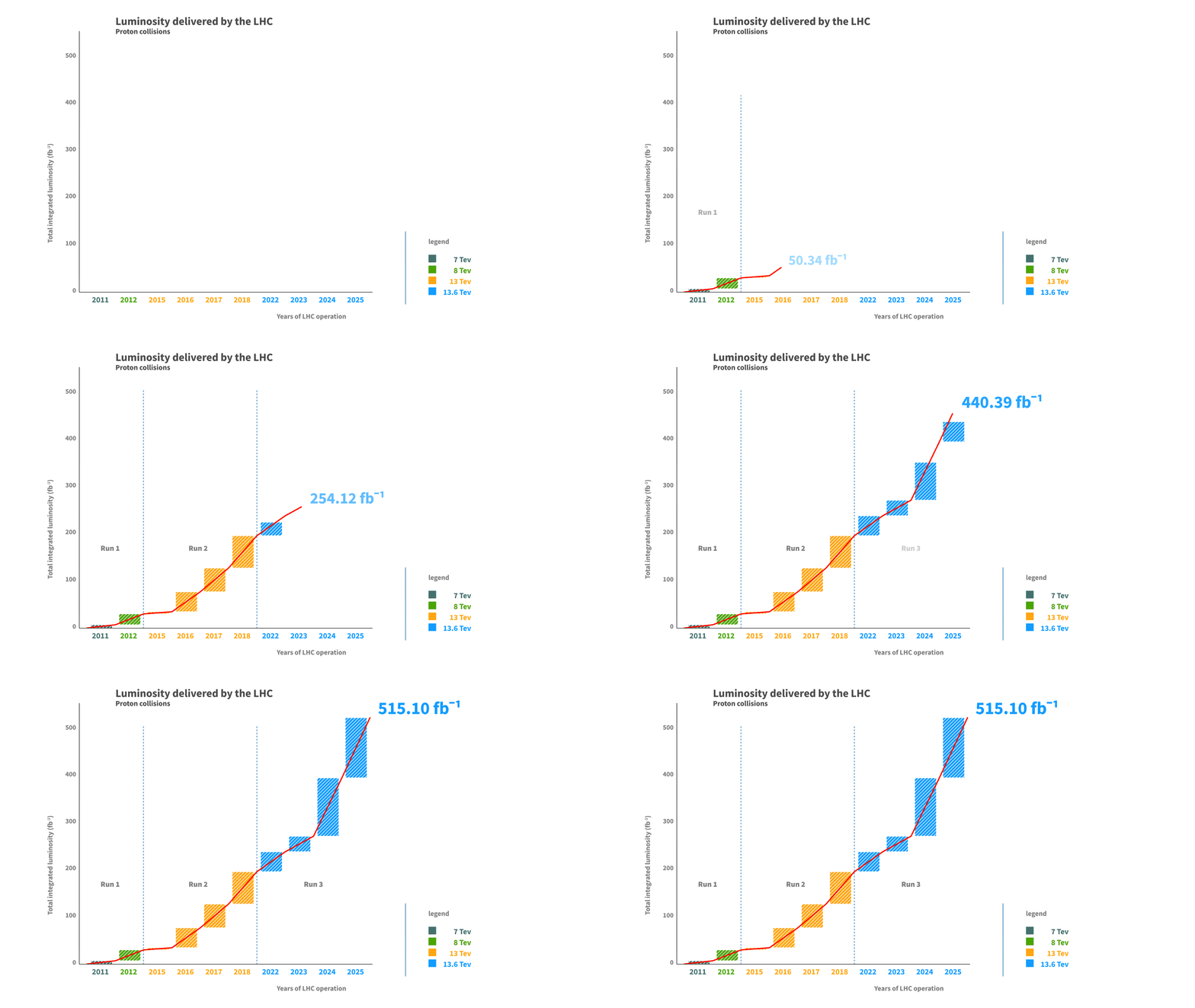
After a few final laps around the ring, the beams of the Large Hadron Collider (LHC) were paused at 6.00 a.m. on Monday, 8 December for the usual year-end technical stop. Launched on 5 May, the LHC's 11th year-long run of high-energy physics broke a new record for integrated luminosity by delivering 125 fb-1 to both the ATLAS and the CMS experiments1. Over the full lifetime of the LHC, ATLAS and CMS have now each been delivered an integrated luminosity of 500 fb-1, equating to approximately 50 million billion particle collisions.
All four LHC experiments performed extremely well throughout the 2025 proton run, detecting more collisions than in any previous year and reporting data-taking efficiencies of over 90%. LHCb continued to benefit from the significant upgrades that were completed in 2023, further increasing its recorded luminosity to a new record of 11.8 fb-1 in 2025.
The year concluded with a 21-day lead-lead run, in which both the machine and all the experiments also performed excellently. ALICE, which is dedicated to this type of heavy-ion collisions, achieved a data-taking efficiency of over 95%. The experiment was able to record a data sample of 2 nb-1 in its most successful heavy-ion run to date.
A major first this year was a special cycle of proton-oxygen, oxygen-oxygen and neon-neon collisions at the LHC, recorded by all the large LHC experiments. Studies of these new collisions have already confirmed the unusual "bowling pin" shape of neon nuclei, while early results from ALICE have also shown significant evidence of quark-gluon plasma (QGP) formation, opening a new way to study the extreme state of matter created just after the Big Bang. LHCb used its unique ability to inject gases into the LHC vacuum chamberduring this cycle to add oxygen-hydrogen and neon-neon collisions to the large family of fixed-target-mode data samples collected so far.
2025 was also the final full year of operation of the third run of the LHC, which began in July 2022. Following a shorter year-end technical stop than normal, next year's physics run is scheduled to begin in March and finish in June. The LHC will then enter a long shutdown period as preparations begin for the High-Luminosity LHC (HL-LHC). Scheduled for completion in 2030, this upgraded version of the LHC will deliver approximately five times more particle collisions to the experiments.
The ATLAS and CMS detectors will undergo major upgrades during LS3 in order to be able to meet the challenges of the increased luminosity in the HL-LHC phase. LHCb and ALICE will both undergo partial upgrades, in preparation for the future major upgrades proposed for the second HL-LHC run.
Some experimental triggers, which select interesting events for later analysis, have already been upgraded in preparation for the increased number of collisions and were tested by all the experiments during this year's run. New innovative CMS triggers, which can record information from every LHC collision in a reduced-data format for later analysis, have already produced results, and their advanced anomaly detection system continues to perform well. ATLAS's first-level trigger has already enhanced trigger performance during this run and will continue to support the experiment.
The increased number of particles delivered by the HL-LHC will cause many more collisions to take place simultaneously, a process known as pile-up. During short test runs this year, the LHC delivered around 150 simultaneous collisions instead of the approximately 60 of normal operation, in preparation for HL-LHC. This significant challenge was handled well by the LHC technical team and all the experiments but also highlighted the importance of the upcoming upgrades.
CERN's technical teams will now get to work on tackling the complex maintenance requirements of the almost 50 kilometres of the accelerator complex, readying the LHC for one last push before the long shutdown begins.
1- Integrated luminosity corresponds to the volume of data collected and is measured in inverse femtobarns (fb-1). One inverse femtobarn corresponds to approximately 100 million million collisions.


