
Following one of Europe's most devastating wildfire summers, better prediction of extreme fire behaviour is increasingly urgent. Research by wildfire expert Marc Castellnou at Wageningen University & Research reveals how interactions between fire plumes and the atmosphere can help anticipate when fires become extreme.
Predicting the unpredictable starts with understanding how extreme wildfires develop and under what conditions. This knowledge is essential to better anticipate and respond to them. To achieve this, firefighter and researcher Marc Castellnou and the GRAF/Bombers Catalonia team measure the atmosphere both inside and outside wildfire plumes.
These measurements provide real-time information to support firefighters battling the flames, while also generating data that can be used to learn from each fire and improve future predictions.
Castellnou sends weather balloons straight into towering wildfire plumes to measure temperature, wind and humidity. By combining these unique measurements with meteorology and computer models, his research opens up a new way to understand - and ultimately predict - extreme wildfires.
"If you want to fight fire, you first need to understand how it behaves," says Castellnou. "As climate change creates fuel and weather conditions favourable to more extreme fires, closing this knowledge gap is more urgent than ever."
When weather drives fire - and fire creates its own weather
As heatwaves and droughts become more intense due to climate change, wildfires pose a particularly dangerous challenge: they can become devastating within minutes, with little warning. Unlike many other natural hazards, extreme wildfires can suddenly accelerate across the landscape, threatening firefighters and communities before they have time to react.
What makes these fires so unpredictable is that they can create their own weather. Weather conditions influence how a fire starts and spreads, but as a fire intensifies, it can generate enormous plumes rising several kilometres into the atmosphere, sometimes forming pyroclouds.
These plumes interact with the surrounding atmosphere, generating powerful winds that can in turn affect the fire itself. This interaction can trigger sudden changes in fire behaviour and sustain extreme fire spread.
Understanding this two-way interaction is crucial. Firefighters need to anticipate not only how the weather will affect a fire, but also how the fire will change the weather - and they need that information fast enough to make life-saving decisions on the ground.
Looking inside the fire to predict its next move
How can firefighters anticipate a fire that can change its behaviour within minutes? Part of the answer lies inside the plume, even before a pyrocloud forms.
Castellnou launches weather balloons directly into rising fire plumes to measure temperature, humidity and wind, comparing these measurements with conditions in the surrounding atmosphere. The principle is simple: warm air is lighter than cold air, so it rises. If the air inside the plume is warmer than the surrounding air, it has the potential to keep rising. How far it rises also depends on the wind and the stability of the atmosphere.
This initial stage is critical. If the plume continues to grow, it can eventually form a pyrocloud and begin creating its own weather. More dangerously, the growing plume can generate powerful inflows and sudden changes in wind direction and speed at the surface, causing the fire to spread rapidly and unpredictably. For firefighters on the ground, these abrupt changes can turn an already dangerous situation into a life-threatening one.
Measuring the plume before a pyrocloud forms could give firefighters precious time to react, improving situational awareness and reducing the risks associated with extreme fire behaviour. At the same time, this information can help validate whether an operational strategy remains safe as conditions change, or indicate when certain tactics should no longer be deployed.
Measuring with weather balloons
Weather balloons measure temperature, wind and humidity in fire plumes. Combined with meteorological data and computer models, these measurements help us better understand and predict extreme wildfires.
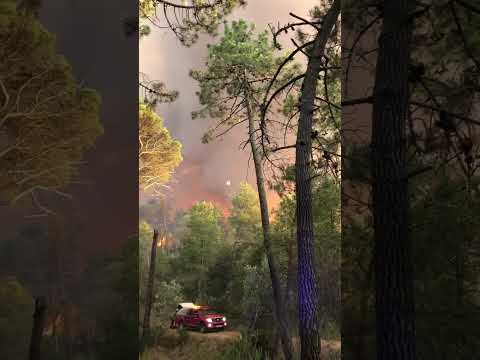
When wildfires refuse to sleep
Traditionally, nighttime offered firefighters an opportunity to bring wildfires under control. At the surface, cooler temperatures and higher humidity slowed the flames, making fires easier to contain. But extreme wildfires can continue burning fiercely through the night.
Castellnou's research helps explain why. When a powerful fire plume rises high into the atmosphere, it can create its own layer of warm, turbulent air that extends beyond the fire itself. This fire-modified atmosphere can persist even after the ground cools at sunset, allowing the plume to keep growing and sustaining extreme fire behaviour throughout the night.
This means firefighters can no longer always count on nighttime to bring relief. By measuring how fires modify the atmosphere, Castellnou's research offers new insights into why some wildfires remain extreme after sunset and how firefighters might better anticipate these dangerous overnight conditions.
From science to the wildfire front lines
Castellnou's findings are already helping firefighters understand and respond to extreme wildfires, including recent fires near Madrid. His research shows the value of bringing science and firefighting together.
By combining field observations, atmospheric physics, computer models and firefighters' experience, scientific discoveries can be turned into practical knowledge for the front line. At the same time, lessons learned while fighting real fires can drive new scientific research. Understanding fire and fighting fire must go hand in hand.


