
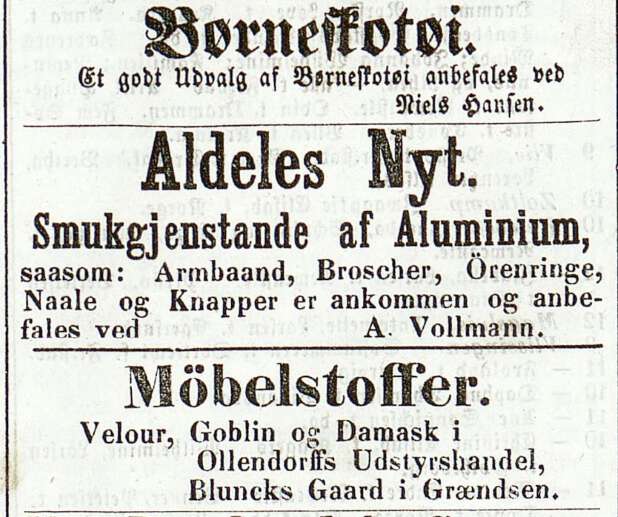
"Entirely new. Beautiful aluminium objects, such as bracelets, brooches …" reads an advertisement published in the Norwegian newspaper Aftenbladet in 1858.
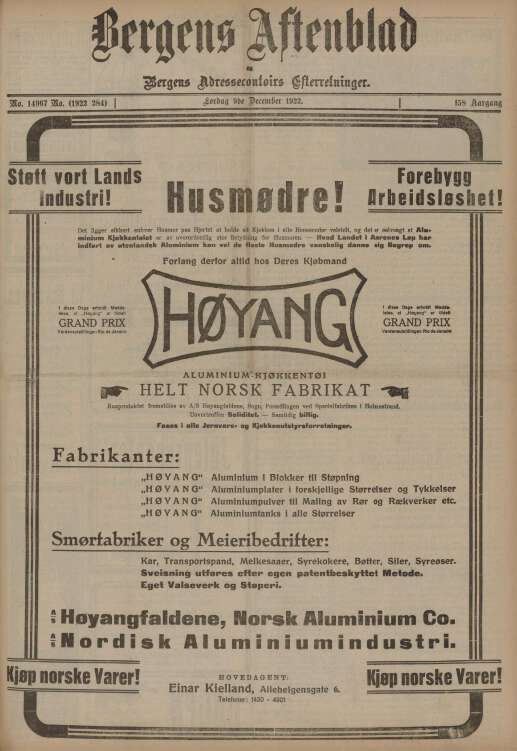
Seventy-four years later, aluminium was no longer being used to make jewellery for the elite, but saucepans for housewives. An advertisement from 1932 for Norsk Aluminium Company (NACO) and Høyanger features a dairymaid carrying a milk churn beneath the slogan: "Norwegian from start to finish".
But Norway's aluminium story contains a paradox: the raw materials needed to produce aluminium are not found in Norway.
"Bauxite, from which aluminium is produced, has to be sourced from elsewhere in the world. It is fascinating to see how aluminium has nevertheless been presented as something almost uniquely Norwegian," says Kjetil Fallan, Professor of Art History at the University of Oslo (UiO).
Aluminium is one of the world's most widely used metals. Fallan and his fellow researchers are examining how its production has developed over time.
"Our main aim is to gain a better understanding of the relationship between design and consumption. We need knowledge of how design affects material consumption if we are to develop products and services that make better use of natural resources," says Fallan, who leads the deXmat research project.
A snapshot in a material's life
We often associate design with making a product look good and work well. But the design process begins long before the finished product appears.
The researchers see design as a process that encompasses a material's entire life cycle.
"An object - such as the cup you drink your coffee from - is only a snapshot in a material's life. The material comes from somewhere and existed in another form before the object was made. It will continue to exist after the object has been thrown away," says Fallan.
The researchers therefore shift attention away from the product itself and towards the entire flow of materials: from the mine, through the factory and shop, until a product reaches the end of its life and ends up in landfill.
This offers a different perspective on how design shapes consumption - and on its environmental consequences.
A solution in search of a problem
Aluminium was discovered by a British chemist in 1808. It was an exclusive and rare material, and for a time it was more expensive than gold. That changed when a method for producing aluminium on a large scale was developed towards the end of the nineteenth century.
Napoléon III's son is said to have received an aluminium rattle decorated with diamonds and emeralds for his christening.
France was the first country in Europe to mass-produce aluminium, thanks to large local deposits of bauxite - the principal raw material used in aluminium production.
Production requires huge amounts of energy. Norway's hydropower resources made it possible to open the country's first aluminium factory in 1908. But there was not yet an established market for the metal. What could it be used for?
"This is where design became important. As more and more aluminium could be produced, someone had to work out what it could be used for. New products had to be developed, and consumers had to be persuaded that they needed them," says Elin Margot Ármannsdóttir, a doctoral researcher at UiO, who has studied the history of aluminium in depth.
Norwegian aluminium is not quite so Norwegian
Norway's aluminium boom gathered pace when Norsk Aluminium Company (NACO) was founded in 1915 and began production in Høyanger. By the 1920s, Norway was Europe's largest producer.
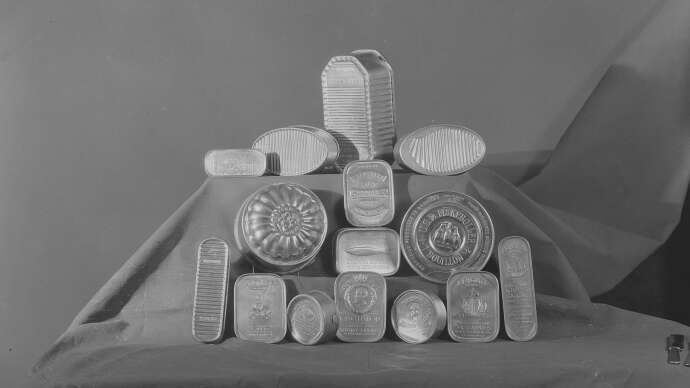
Its products included saucepans and milk churns sold under the Høyang brand, helping aluminium find its way into Norwegian homes. "The modern kitchen is an aluminium kitchen," declared an advertisement from a Danish manufacturer, which described it as "the metal of our time".
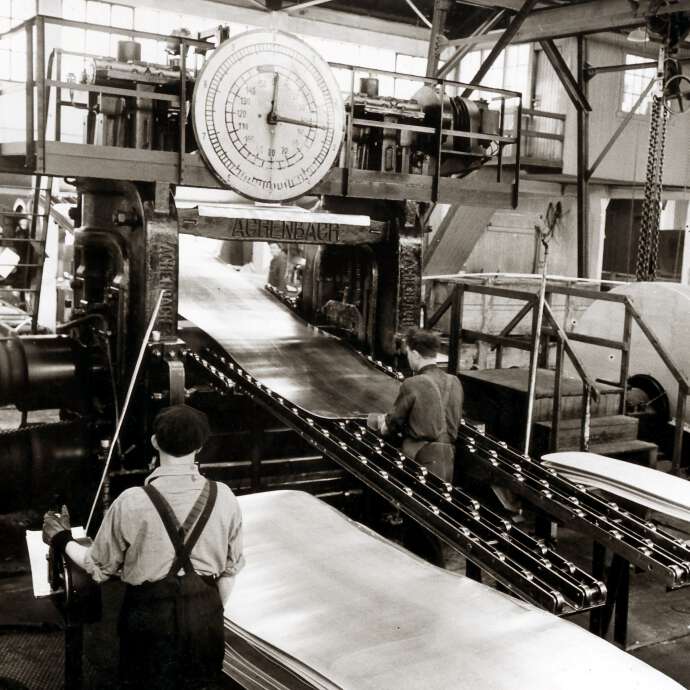
"In the interwar period, aluminium was marketed as a modern, hygienic and efficient material. It fitted perfectly with the period's ideal of making housework more rational and efficient," says Ármannsdóttir.
It was also marketed as Norwegian, at a time when domestic production and self-sufficiency were especially popular. Ármannsdóttir points to a NACO advertisement in which aluminium planes and trains appear to emerge from a roaring waterfall.
How design can trap us
The story of aluminium shows how design can contribute to creating needs that did not previously exist. As new products are developed, they can gradually become so commonplace that it is difficult to imagine life without them.
"Design history shows that the future is constantly in dialogue with the past through today's practices. What has already been designed shapes the future by limiting the range of possible actions," says Fallan.
He uses the car as an example of how we can become locked into earlier systems of production and design. Once the car became such an important part of the transport system, later innovation focused on developing better cars. This has come at the expense of asking how transport needs might be met in other, more sustainable ways.
And what would warfare look like today without aluminium? Its combination of lightness and strength makes it indispensable in modern warfare and defence technology. Drones, for example, are made from aluminium.
From a modern material to a green one
Where aluminium was once marketed as modern, lightweight and future-oriented, today it is often presented as a green material. One reason is that it is relatively easy to recycle and is used in solar technology and wind turbines.
"The properties that once made aluminium a symbol of modernity are now part of the story of the green transition. But bauxite extraction has left major scars on landscapes, and aluminium production still requires enormous amounts of energy," says Ármannsdóttir.
She adds:
"In Iceland, where I come from, 64 per cent of all energy is used by the aluminium industry."
Designing away the need
The title of the research project, Designing with/out Extractive Materials, also contains the idea of "designing away" a need. Fallan explains:
"One hundred and fifty years of reckless consumption of natural resources and mass production have pushed the Earth's ecosystems towards a number of tipping points. We therefore need to find ways of designing ourselves away from the use of non-renewable resources."
This can be done in several ways:
- Prioritising quality over quantity
- Moving from mass production towards maintenance and repair
- Making products that last a long time and can be easily recycled
- Replacing products and technologies with a high climate and environmental impact
- Examining whether the need for a product or service is genuine in the first place
"This perspective shifts attention from the moment of purchase to the places materials come from. Rather than placing all responsibility on individual consumers, we can examine the systems behind what we consume," says Fallan.


