
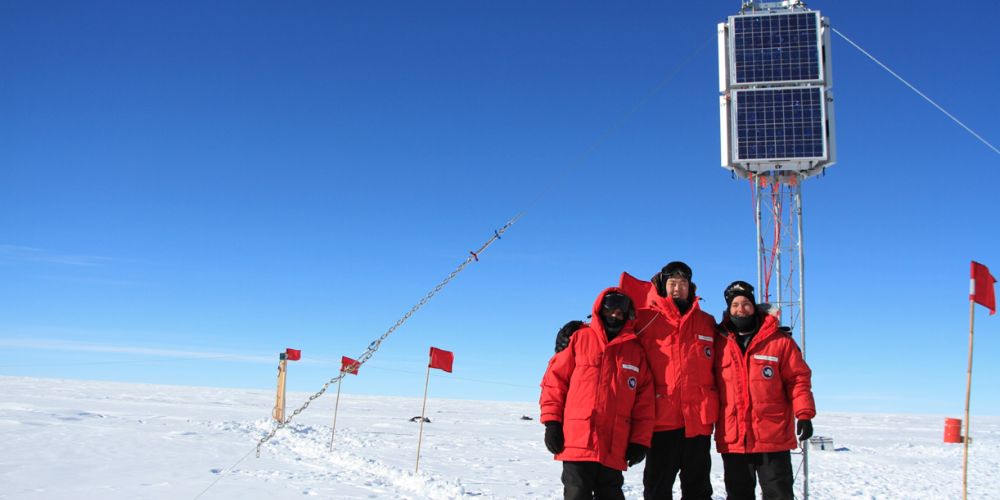
A space weather physicist at The University of Texas at Arlington is leading a project to study differences in how solar wind energy is transferred in the Antarctic and Arctic polar regions.
The project will also support the continued operation of a network of ground-based magnetometers spanning a remote location high on the East Antarctic Plateau. The array provides critical data used to study space weather and geospace dynamics.
Zhonghua Xu, UTA associate professor of physics, is principal investigator for the four-year, $799,527 grant from the National Science Foundation Office of Polar Programs. Kevin Sterne, senior research associate at the Virginia Tech National Security Institute, is co-PI of the study.
The project will operate, restore and maintain the Antarctic PENGUIn (Polar Experimental Network for Geospace Upper atmosphere Investigations) magnetometer array, the only autonomous, year-round network spanning the southern polar cap, cusp and auroral zones, Dr. Xu said.
"One important aspect is that these stations operate autonomously in extremely remote parts of Antarctica, so keeping the existing network functioning reliably is itself a significant part of the project," he said. "By maintaining and restoring these ground-based Antarctic observatories, the project will ensure continuous measurement of Earth's magnetic field in the planet's southernmost regions.
"This data is critical for understanding the powerful solar storms that can disrupt satellites, interfere with aviation communications and threaten power grids."
The PENGUIn (PG) array is joined with a chain of magnetometer stations along the west coast of Greenland, which provides data for the northern hemisphere. These "conjugate" magnetometer chains are useful for observing the similarities and differences between the ionospheric currents flowing in opposite hemispheres as a result of the solar wind's interaction with Earth's magnetosphere.
In coordination with the array in Greenland, the PG array will contribute to a unique global platform for studying unresolved questions about interhemispheric asymmetries in high-latitude geospace dynamics during the active and declining phases of Solar Cycle 25, Xu said. The solar cycle is the cycle that the sun's magnetic field goes through approximately every 11 years; it is characterized by the rise and fall in the numbers and surface areas of sunspots. The current solar cycle, which started in 2019 and is projected to last until 2030, is the 25th since measurements of sunspot activity began in 1755.
Xu said the project will address two core science objectives:
- Characterize the drivers and spatial structure of disruptions in the Earth's magnetosphere during extreme space weather events.
- Quantify how interplanetary shocks and ultra-low frequency waves couple differently into the northern and southern hemispheres. Interplanetary shocks are disturbances propagating through the solar wind, often driven by coronal mass ejections or by fast solar-wind streams overtaking slower ones.
Xu noted that the project will make all its observations available to the global research community, providing an important foundation for better forecasting and preparedness. It will also train the next generation of space weather scientists through hands-on research and connect the public to the excitement of polar science through planetarium activities and educational outreach.
"These activities will highlight how improved understanding of the underlying physics can be used to help protect the modern technologies that millions of Americans rely on daily," Xu said.
The PG array was installed in Antarctica over an eight-year period starting in 2008. Xu has made six trips to Antarctica.
Xu is also leading another project focused on developing the next generation of Antarctic geospace arrays. In 2024, he received a $1.63 million grant from the NSF Directorate for Geosciences for the four-year study, titled "DASI Track 1 - AUtonomous Remote geospace Observation and Research Array," or AURORA.
This study is designed to fill in large gaps in the existing ground-based instrument arrays in the high-latitude and polar regions. Xu and his team are working on the design and testing of small, low-power, multi-instrument adaptive, ground-based geospace observation arrays.
With advanced technologies in solar panels, batteries, satellite communication, low-power sensors and high-performance single-board computers, AURORA will enable year-round observations with multiple cost-effective instruments in the remote, logistically challenging locations found in Antarctica, Xu said.
AURORA's mission is in support of the fifth International Polar Year (IPY-5) in 2032–33. The goal of IPY-5 is to address urgent global challenges by advancing polar research, focusing on the impacts of climate change in the Arctic and Antarctic.
"If this DASI Track 1 instrument-development effort is successful, it could position us to pursue a future DASI Track 2 project to deploy the new autonomous instruments during the IPY-5 period," Xu said.


