
A genetically engineered bacterium can rapidly break down one of Earth's most abundant minerals, opening a promising new pathway for simultaneously removing carbon dioxide from the atmosphere and recovering critical elements used in electric vehicle batteries, according to new Cornell research.
In a study published Aug. 5 in Scientific Reports, researchers determined that an engineered strain of Gluconobacter oxydans (G. oxydans) accelerated the weathering, or natural breakdown, of ultramafic minerals high in magnesium and iron. The process not only released cobalt and nickel - two metals essential for battery manufacturing - but also converted dissolved magnesium into magnesium oxalate, an underexplored mineral capable of storing twice as much carbon per magnesium atom as the more commonly studied mineral magnesite.
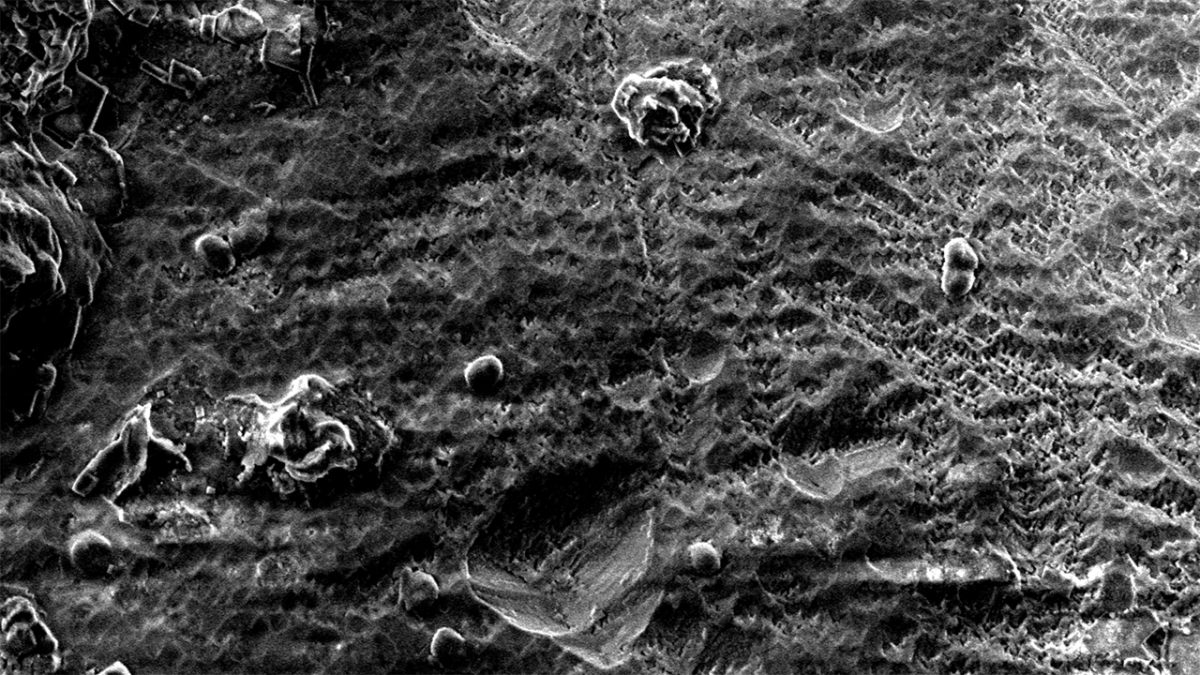
Microscopic view of the olivine surface, showing pits and channels where the rock has been dissolved, demonstrating how the bacteria help break down the mineral.
"This work shows that biology can dramatically accelerate one of Earth's natural carbon-removal processes while creating additional value through critical mineral recovery," said senior author Esteban Gazel, the Charles N. Mellowes Professor in the Department of Earth and Atmospheric Sciences in the Cornell Duffield College of Engineering. "By coupling carbon sequestration with the extraction of valuable battery metals, this approach has the potential to improve the economics of large-scale carbon removal by targeting unconventional sources."
The paper, "Bioleaching of Olivine and Enstatite With Formation of Mg-Oxalate Mediated by Engineered Gluconobacter Oxydans," was led by first author Jacob D. Klug, postdoctoral researcher in the Department of Earth and Atmospheric Sciences. Co-corresponding author Buz Barstow, associate professor of biological and environmental engineering in the College of Agriculture and Life Sciences, led the engineering of the bacterial strain used in the study while Gazel's team focused on elucidating the geochemical processes.
Geoscientists have long recognized that weathering of silicate rocks naturally removes carbon dioxide from the atmosphere. As rainwater and groundwater slowly dissolve minerals such as olivine (an iron-magnesium silicate), magnesium released from the rock reacts with carbon dioxide to form stable carbon-bearing minerals.
"What we're trying to do is engineer the bacteria to accelerate something that is already happening, rather than make something happen that doesn't happen naturally," Barstow said.
The Cornell team focused on G. oxydans, a bacterium previously shown to produce organic acids capable of dissolving minerals. They engineered the microbe to produce an acid-rich biolixiviant and then compared its performance with both synthetic organic acids and a cell-free solution containing only the acids and other compounds produced by the bacteria.
Experiments showed that direct contact between G. oxydans and mineral surfaces significantly increased dissolution rates compared with using the bacteria's acidic by-products alone. The researchers found evidence that the bacteria promoted the oxidation of iron within the minerals, allowing the microbes to continue producing acid and sustain weathering for longer periods. As a result, the engineered bacteria extracted up to 75% of the magnesium contained in olivine samples over just 15 days while also releasing nickel and cobalt from the mineral.
The team also documented the formation of magnesium oxalate under room-temperature, low-pH conditions. Although relatively understudied, magnesium oxalate represents an intriguing carbon-storage material because each magnesium atom can bind two carbon atoms, doubling the theoretical carbon storage capacity compared with conventional magnesium carbonate minerals.
"When people work on carbon mineralization, they often think about the mineral magnesite, a known pathway common in nature," Klug said. "So when I was collecting data and realized that magnesium oxalate, a different carbon-bearing mineral, had formed, it was very exciting," Klug said.
Although the experiments were conducted in laboratory flasks, the researchers see particular promise for applying the approach to ultramafic mine tailings. These mining wastes have already been crushed into fine particles, making them well suited for accelerated weathering while providing an opportunity to recover remaining critical minerals and permanently store carbon.
The authors note that additional work is needed before the technology can be scaled. Future research will focus on increasing the amount of magnesium converted into magnesium oxalate, identifying lower-cost feedstocks for growing the bacteria, understanding the long-term stability of magnesium oxalate as a carbon-storage mineral and further characterizing how engineered microbes interact with rock surfaces during weathering.
Co-authors of the study include doctoral students Luke Plante, Alia Almansoori and Joseph J. Lee, as well as James L. Adair, Ph.D. '25, and Stephanie Murillo Maikut, research support specialist.
The research was funded in part by the Selander Foundation, established in 2004 by Nancy and Bob Selander '72.
Chris Dawson is a communications coordinator for Duffield Engineering.


