
A study by the UAB, the BSC and the UPF reveals that the characteristic "high-bottomed vessels" of post-Talayotic Menorca contained mainly dairy products. It also provides the first evidence on the island of the presence of wine in funerary rituals, served exclusively in locally produced but foreign-inspired vessels. The innovative analysis methodology applied to organic residues has allowed researchers to learn more about the islands' own funerary rituals and validate the hypothesis that one of the recovered vessels served as an infant feeding bottle.
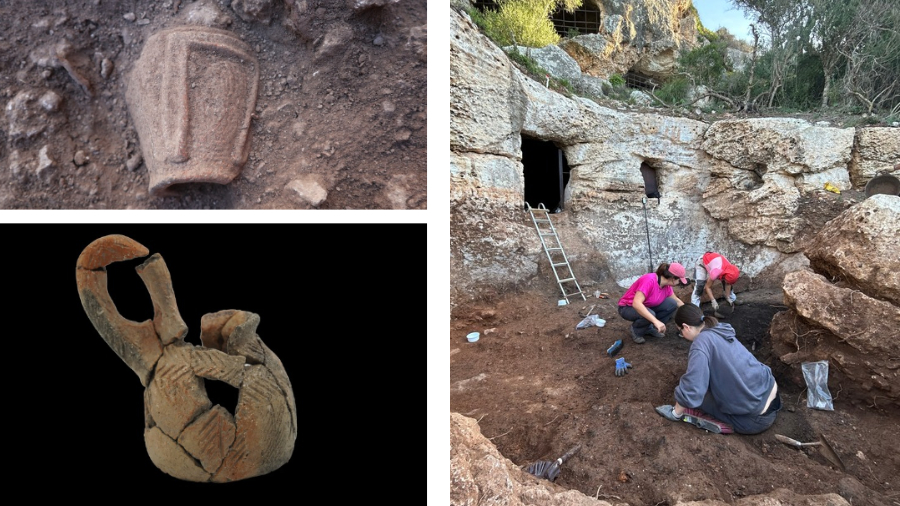
In the Late Iron Age, or Post-Talayotic period, over 2000 years ago, Menorca and the other Balearic Islands experienced increasing connectivity with the wider Mediterranean. However, they also maintained distinctive local funerary traditions, such as burying their loved ones in rock-cut tombs, or artificial caves. Some of these caves contained external courtyards located in front of the burial chambers where animal offerings might have been made. Archaeologists even suspect that perishable foods or liquids were offered in characteristic island containers, such as high-bottomed vessels. Until now, however, the contents of these ceramic containers had never been identified.
A study conducted by the Universitat Autònoma de Barcelona (UAB), the Barcelona Supercomputing Center – Centro Nacional de Supercomputación (BSC-CNS), and the Pompeu Fabra University (UPF) now reveals what these substances were and the vessels in which they were stored in an article published in the Journal of Archaeological Science. The study also managed to identify an indigenous ritual conducted in Menorca during that period.
The analysis of organic residues from 34 ceramic vessels recovered from Cave 45 of the sepulchral complex of Calescoves (Alaior) shows that the small, high-bottomed vessels mainly contained dairy products. Traces of wine were also identified, which only appeared on a few local pieces, classified as foreign "inspired" given that the styles came from other Mediterranean cultures, particularly the Punic world. The study, for the first time on the island, provides evidence that wine, a product of foreign origin, was present in a Menorcan funerary ritual.
The results provide deeper insight into the offerings and funerary practices of the post-Talayotic period. "These findings reveal the complex, interwoven relationships between local communities and people from other regions. While the island's inhabitants adopted foreign ceramic forms, they continued to use them for wine—the very substance for which these vessels were originally designed," notes Sònia Carbonell, a researcher at the BSC-CNS and co-author of the study. Wine likely reached the island through trade networks, driven by the demand from specific individuals or prominent groups within post-Talayotic communities.
"The introduction of wine does not appear to imply a replacement of local traditions, but rather an adaptation of those elements to their own cultural codes, which highlights the persistence and reaffirmation of a distinct cultural identity in a context of contacts and exchanges," emphasises Sònia Carbonell.
"The study offers an answer regarding the purpose and use of the high-bottomed vessels so characteristic of the Menorcan funerary world. But it also demonstrates how questions concerning ceramic typology can be resolved through the study of function and contents," notes Adrià Breu, researcher in the UAB Department of Prehistory and co-author of the study.
The study also validated the hypothesis that another small, globular-bodied vessel with a pouring spout—previously linked to infant burials in Ibiza—served as a baby bottle. "This baby bottle speaks to us of child-rearing and care: of people feeding infants, and of practices that were also incorporated into funerary rituals," explains Margalida Coll, a researcher at UPF and co-author of the study.
Interior and courtyard had different functions
The high-bottomed vessels have very limited capacity, which points to offerings or the symbolic consumption of small quantities of milk. Furthermore, the study suggests that the interior of the cave and the courtyard served different functions. Items such as the infant feeding bottle accompanied the deceased inside the burial chamber. The vessels found in the courtyard, by contrast, reflect the actions of the living at the entrance to the tomb: offerings, shared consumption, and commemorative practices.
The "ritual ware" examined in the study was recovered in 2023 and 2024. A large proportion of the pieces, which in many cases were intact and in an excellent state of preservation, were still in their original position, a very unusual circumstance. In addition to the small high-bottomed vessels and those of foreign inspiration – juglets with side handles, jugs and bowls – the set includes conical vessels typical of the Balearic Islands, and various incense-burner-type vessels, so far documented only in Menorca. Among the identified products, in addition to dairy products and wine, there were also animal fats and various vegetable oils.
Excavations done at cave no. 45 of the Calescoves site. Credit: Sònia Carbonell and Margalida A. Coll.
Bringing to light what was invisible in the archaeological record
The study employed an innovative methodology for analysing organic residues, which combined scanning the artifacts with micro-excavation in the laboratory and chemical analysis.
"The uniqueness of the high-bottomed vessels has forced us to improve our analytical methodologies," explains Adrià Breu. "Normally, the chemical tests for dairy products and for wine are separate procedures that require a double sample. At our UAB laboratories we have succeeded in unifying them into a single procedure and thus halving the amount of sample required. This improvement has been essential to carry the research forward, because the dimensions of the vessels are so small that they would have prevented us from working with the amount of sample normally required," adds the UAB researcher.
This is the first time that an analysis of organic residues has been carried out on such a large and coherent set of samples from Menorca. "This is particularly significant, as it allows the vessels to be studied collectively and the results to be interpreted in the context of consistent ritual and funerary practices," notes Sònia Carbonell.
Local products for high-bottomed vessels
The analyses have shed light on a recurring question in the study of Menorcan funerary contexts: what the contents of the high-bottomed vessels may have been. The analyses have documented dairy residues in most of the pieces, while in a minority, other substances related to animal fats were identified.
The high-bottomed vessels are handmade ceramic pieces. Each one has its own particularities in terms of dimensions and decoration, but they all share a series of common features, such as a raised base and a decorated cartouche with plant or geometric motifs. They have been documented in various archaeological contexts, both ritual (table sanctuaries) and domestic (in houses, known as "circles"), but it is in funerary contexts that they tend to appear in the greatest numbers. It has been suggested that they could constitute a local adaptation of the incense burners documented in the Punic-Hellenistic world. It has also been suggested that they may be pieces crafted by specific individuals, so their deposition in funerary contexts could reflect a certain expression of individuality.
The evidence now found contributes to clarifying the possible functionality of these vessels and opens up new perspectives for interpreting their role within the ritual and funerary practices of the post-Talayotic communities. "It is particularly significant that residue analyses have identified traces of dairy products in the majority of these vessels. This finding takes on special importance when we consider the role of milk and its derivatives in the diet of post-Talayotic communities," the researchers highlight.
The methodology applied to the study of the pieces provides a roadmap for future research into funerary spaces and objects in archaeological contexts.
The research was carried out within the framework of the project "Ritual and Funerary Practices at Calescoves: Excavations in the Courtyard of Cave 45," led by two of the researchers in this study, Sònia Carbonell and Margalida A. Coll, and funded by the Island Council of Menorca.
Original article: Carbonell Pastor, S.; Coll Sabater, M. A.; Breu Barcons, A. (2026). Milk and wine for the departed: Menorcan funerary idioms during the Late Iron Age. The case of courtyard 45 in Calescoves. Journal of Archaeological Science. 10.1016/j.jas.2026.106719


