
From targeted cancer treatments to self-healing materials and microscopic robots, many emerging technologies depend on molecules that can be controlled with light. Researchers at Tohoku University have now developed a way to make these light-responsive molecules much more sensitive to visible light by using a molecular antenna. The breakthrough gives scientist better control over molecular photoswitches remotely and potentially expands their use in medicine and advanced materials.
The findings were published in the Journal of the American Chemical Society on August 19, 2026.
"One of the biggest challenges has been developing photoswitches that respond efficiently to visible light without compromising their thermal stability," says Ryojun Toyoda, an assistant professor at Tohoku University's Graduate School of Science. "Our molecular antenna strategy overcomes this trade-off, allowing us to harvest visible light much more effectively while preserving the switching behavior that practical applications require."
For many real-world applications, photoswitches must function deep inside materials or biological tissues, where light loses intensity as it is scattered. Visible light is especially attractive because it penetrates these environments more effectively than ultraviolet light. However, most conventional azobenzene photoswitches are relatively insensitive to visible wavelengths, and previous efforts to improve their performance often reduced their stability.
To solve this problem, the researchers collaborated with Professor Shirin Faraji's group at Heinrich Heine University Düsseldorf to design azobenzene molecules equipped with dipyrrin complexes that act as highly efficient molecular antennae. These antennae absorb visible light before transferring the captured energy directly to the azobenzene unit, triggering its structural transformation.
The team developed two types of hybrid molecules. One linked azobenzene to a simple boron-based dipyrrin complex, while the other incorporated one-dimensional dipyrrin-zinc nanochains that transport energy along the molecular backbone. Through repeated separation processes, the researchers successfully isolated zinc nanochains of ten discrete lengths, enabling them to investigate how molecular size affects performance.
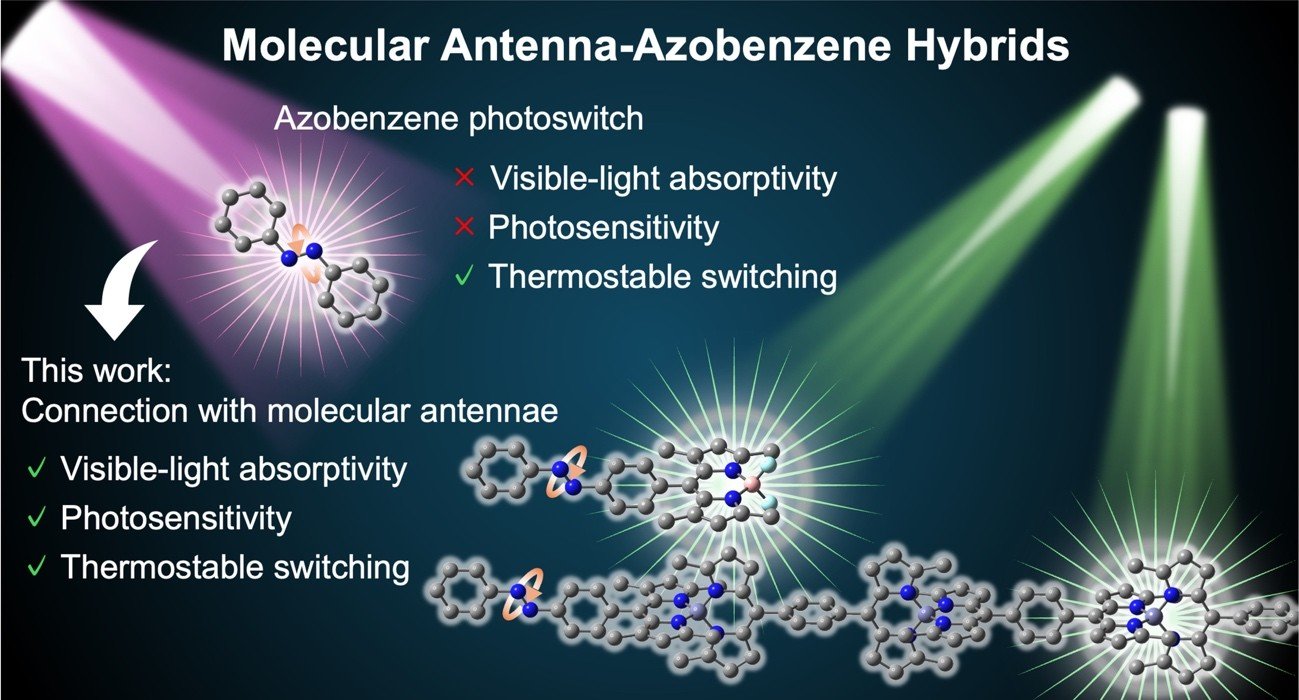
Using UV-visible absorption spectroscopy and proton nuclear magnetic resonance (¹H NMR), the researchers confirmed that the dipyrrin antennae efficiently transferred absorbed light energy to the azobenzene photoswitch. In the zinc nanochain structures, the chains acted as molecular energy highways, transporting excitation energy over long distances to the terminal azobenzene unit.
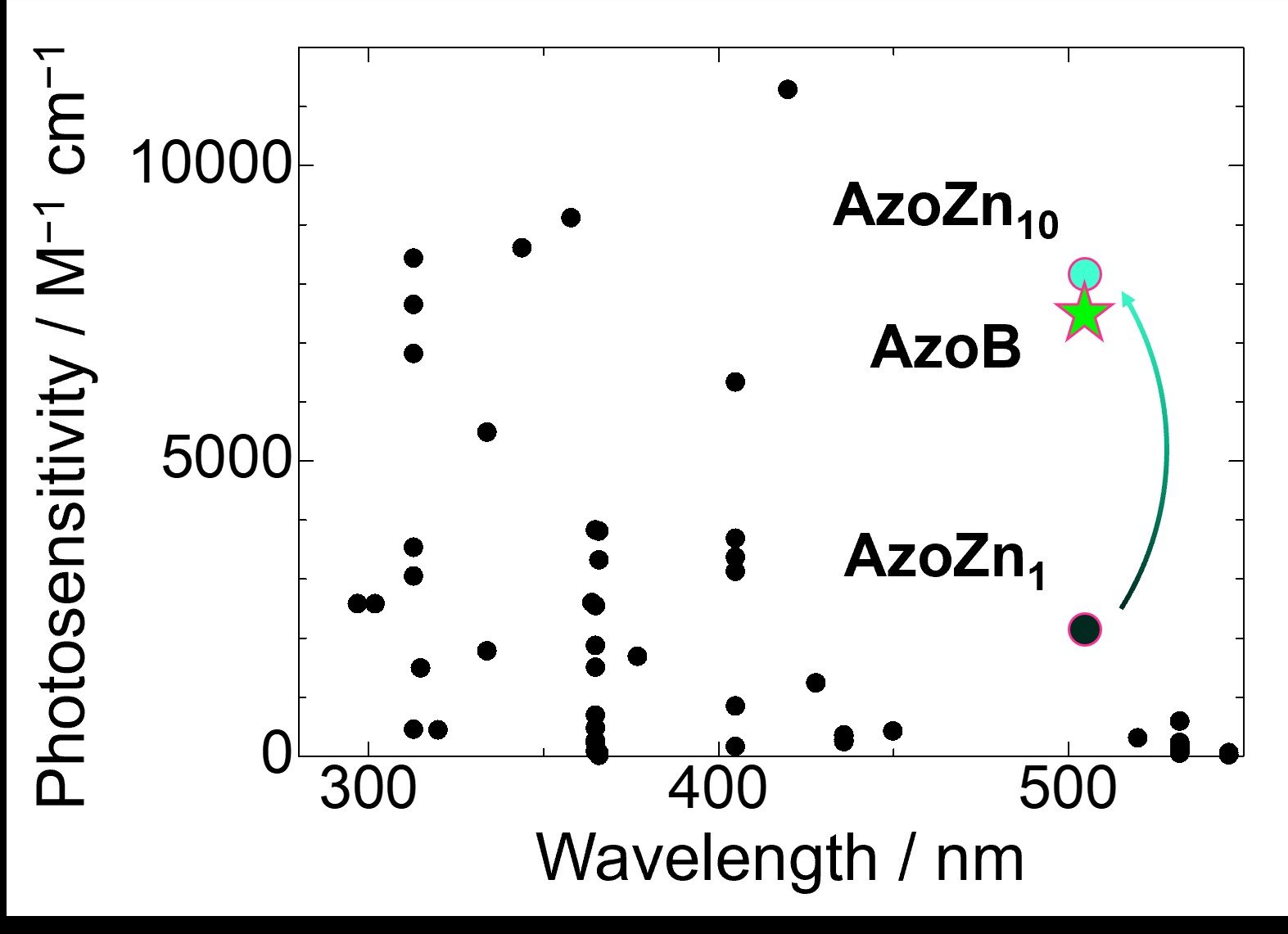
The new design produced some of the highest visible-light sensitivities reported for azobenzene photoswitches. The boron-based hybrid achieved a sensitivity of 7,500 M⁻¹ cm⁻¹, while the longest zinc nanochain reached 8,100 M⁻¹ cm⁻¹. Even more encouragingly, the researchers found that sensitivity increased as the nanochains became longer, suggesting that future designs could achieve even greater performance.
Unlike many previous strategies, the new molecular architecture also preserved the photoswitches' thermostable behavior, allowing them to maintain their switched state rather than rapidly reverting. Quantum chemical calculations further confirmed that the dipyrrin antennae efficiently harvest visible light and funnel the energy to the azobenzene core, validating the mechanism observed experimentally.
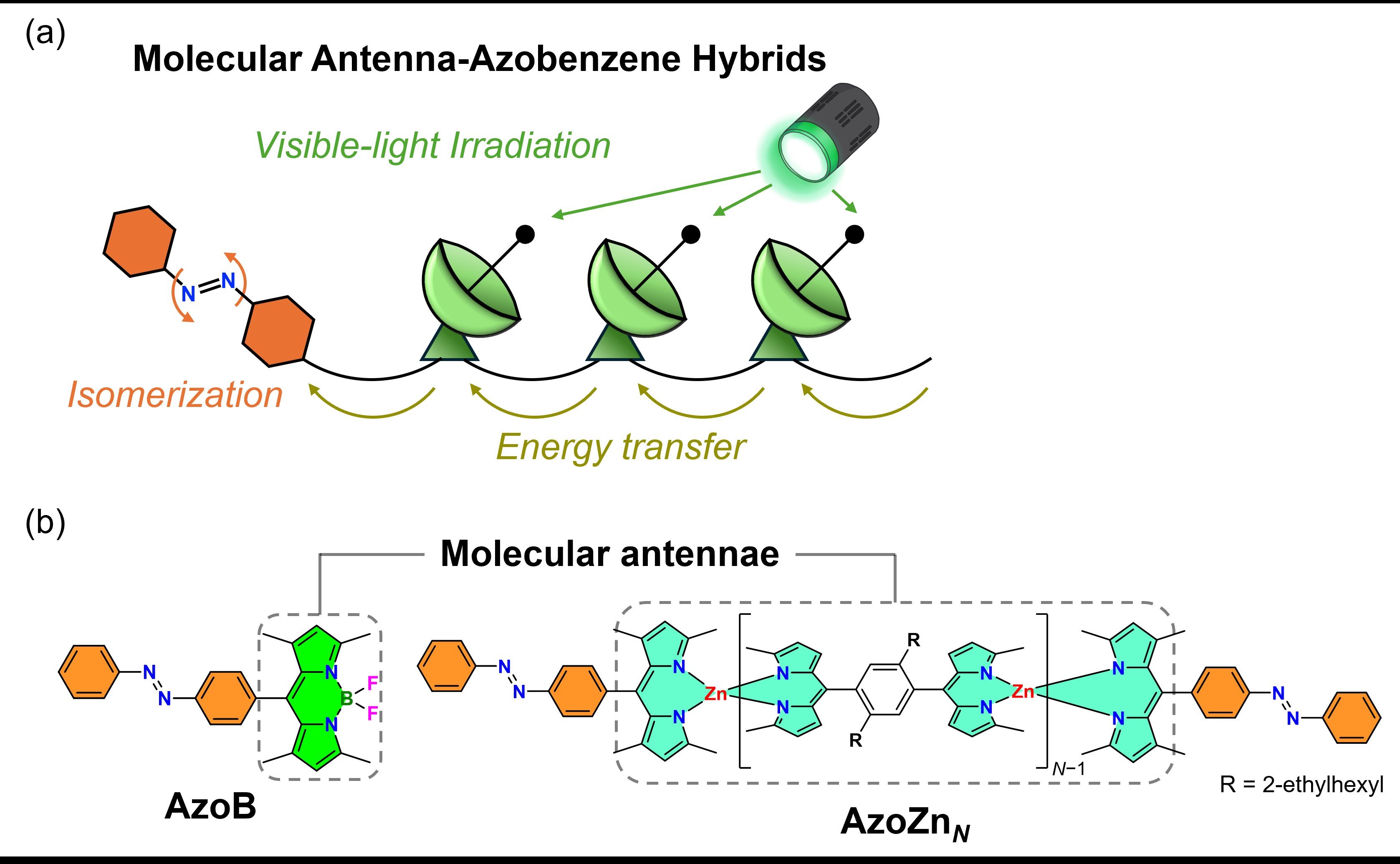
(b) Chemical structures of AzoB, AzoZnN. ©Yuta Chiba et al.
"This work provides a new design principle for highly sensitive molecular photoswitches," adds Toyoda. "We believe these molecular antennae will accelerate the development of molecular machines, smart materials, photopharmacology, and other technologies that rely on precise light-controlled molecular motion."
The researchers next plan to integrate these highly sensitive photoswitches into functional systems, including molecular robots, light-responsive smart surfaces, and technologies for manipulating DNA and proteins with light. They also hope the approach will contribute to the development of photopharmacology, in which medicines can be activated only at targeted locations within the body, reducing unwanted side effects.
Such technology could one day enable everything from smart materials that respond to their environment to drugs that can be activated only where and when they are needed.
- Publication Details:
Title: Molecular Antennae Enhance Visible-Light Sensitivity of Azobenzene Photoswitches
Authors: Yuta Chiba, Rio Shoji, Mira Kim, Shinya Takaishi, Ryota Sakamoto, Shirin Faraji*, Ryojun Toyoda
Journal: Journal of the American Chemical Society
DOI: 10.1021/jacs.6c12118


