
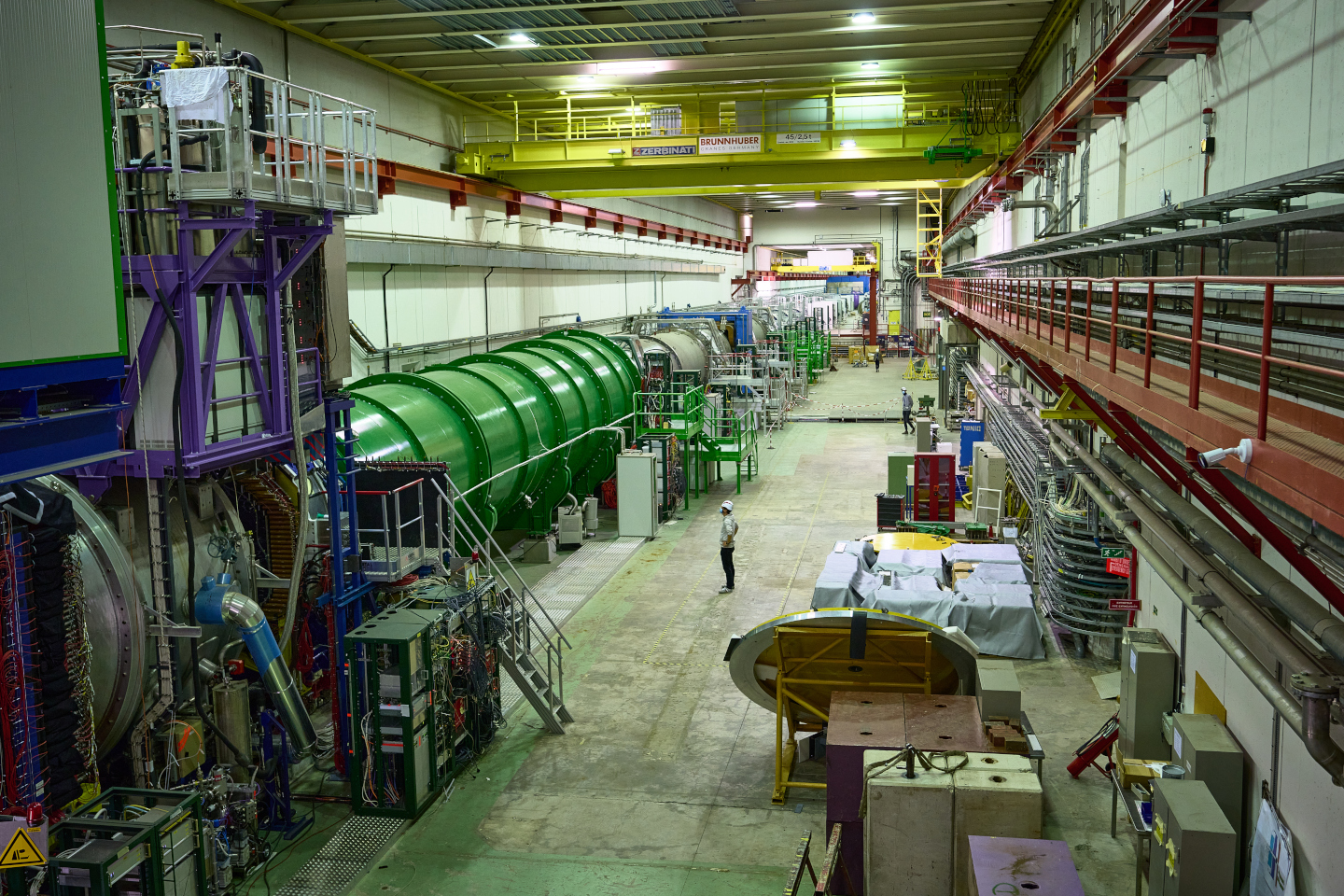
The NA62 experiment, housed in the North Area at CERN. (Image: CERN)
The NA62 Collaboration has dramatically reduced the uncertainty in its measurement of an extremely rare particle decay, in results just presented at the 2026 La Thuile conference.
The study of rare decays gives physicists the chance to probe the Standard Model of particle physics. Researchers can determine what is known as the branching ratio of a decay, which describes how many particles decay through a particular process as a fraction of the total number of decays that occur. The branching ratio of the decay that the NA62 Collaboration has studied - the decay of a positively charged kaon into a positively charged pion and neutrino-antineutrino pair (written K+→π+νν) - can be predicted theoretically with a very high degree of precision. Thanks to this 'theoretical cleanliness', this particular kaon decay is extremely sensitive to new physics beyond the Standard Model but, with a predicted branching ratio of less than one in 10 billion, it is extremely rare and very challenging to observe.
The NA62 experiment was designed to study the K+→π+νν process in depth and therefore produces a lot of kaons, which is why it is also known as the "kaon factory". The kaons are created by firing a high-intensity beam of protons from the Super Proton Synchrotron at a beryllium target. This produces nearly a billion particles every second, of which around 6% are kaons whose decay products can be studied in great detail using the NA62 detectors.
In 2024, the NA62 Collaboration reported having observed this process with a statistical significance of five standard deviations, the gold standard in particle physics for claiming a discovery. Now, the researchers have included the data recorded in 2023-2024 in their analyses and used improved data analysis techniques based on cutting-edge machine learning algorithms. The results, combined with the previous data taken since the experiment began, have significantly refined their understanding of the ultra-rare kaon decay.
With the full dataset, the NA62 Collaboration obtained an updated value of the K+→π+νν branching ratio of 9.6+1.9
-1.8 × 10⁻¹¹, with an uncertainty 40% smaller than before.
"This is the most sensitive dataset we have analysed yet," said lead data analyst Joel Swallow. "The fact that we can see clearly and measure with precision something so rare and elusive is a great success from a technological point of view."
With the precision of the current result, the kaon decay appears to occur as predicted by theory and sets powerful constraints on new physics beyond the Standard Model.
"This stress test of the Standard Model is remarkable given the extreme rareness and theoretical cleanliness of the process that we investigated," said NA62 spokesperson Giuseppe Ruggiero. "We have demonstrated once again that our current leading theory of nature has incredible predictive power."


