
Hair damaged by dyes, bleaching or harsh sunlight has just got special treatment. Green chemistry researchers at Flinders University are experimenting with plant-based oils to develop a promising new structural keratin-type repair application to reduce breakage and improve hair health.

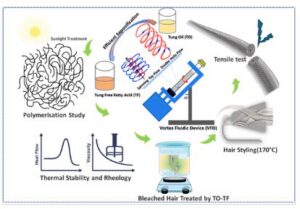
The latest study, published in ACS Applied Bio Materials (American Chemical Society), demonstrates the potential for a sustainable biopolymer mixture made from a rich tung oil acid emulsion to seal cuticles and increase elasticity and reinforce hair damaged by chemicals or heat.
The results follow a string of other studies using a powerful Flinders University nanotech vortex processing device to create promising new ingredients for low-cost and safe-to-use natural food supplements, cosmetic and personal products.
 The clean beauty movement is driving demand for new products as awareness rises about harmful and non-biodegradable fossil-based ingredients used in conventional cosmetic formation, environmental regulations and a decline in non-renewable sources.
Used by researchers around the world, the novel Vortex Fluidic Device (VFD) microfluidic platform provides a new model to scale-up non-toxic processing of a wide range of substances - from organic cosmetics and nutraceuticals to biofuel, protein science and chemicals synthesis - providing solutions for resource management and environmental degradation.
 "We are breaking into many new green chemistry arenas with our VFD's thin-film microfluidic technology," says Professor Colin Raston, who leads the Raston Lab at Flinders University.

"It also shows that expensive energy and potentially harmful chemicals are not necessary, when the VFD is used with various speed, tilt and light settings we can produce higher quality molecules and transform some of the most complex materials," says Professor Raston, who also is a chief investigator with the ARC Industrial Transformation Training Centre for Green Chemistry in Manufacturing.
Keratin hair treatments are chemical protein treatments that make hair shiny and silky while also reducing frizz. Some popular brands use biodegradable natural compounds.
Recent market research suggests the global organic cosmetics market could rise from $US21.6bn in 2024 to almost $US35.5bn by 2034.
PhD candidate Ms Xuejiao Cao is using the technology to convert materials such as tung free fatty acids and plant-based medium-chain free fatty acids to develop organic hair and skin products in line with organic certification and safety requirements.

Demand for organic cosmetics has surged in recent years as consumers become increasingly conscious of any harmful, synthetic ingredients in skincare products and their environmental impact," says Ms Cao, on her latest study led by the Raston Lab.
"Our tests from the sustainable biopolymer-based on tung oil and tung free fatty acids showed significant mechanical recovery in damaged hair."
"We hope to showcase more positive results with these natural, renewable feedstocks."
Researchers from the Flinders Institute for Nanoscale Science and Technology group extracted the tung oil from the seeds of a small evergreen tree commonly found in Asia (Aleurites fordii). Tung oil was traditionally used for lighting but also has modern industrial uses such as a drying agent in paints, varnishes and printing inks.
The article, 'Sustainable biopolymer based on tung oil and tung free fatty acids for hair tensile enhancement' (2026) by Xuejiao Cao, Yanting Yin, Jonathan A Campbell, Xuan Luo, Youhong Tang and Colin L Raston has been published in ACS Applied Bio Materials DOI: 10.1021/acsabm.5c02572.


