
The NASA Innovative Advanced Concepts (NIAC) program has created 18 new awards to support visionary ideas to improve aerospace technologies in areas ranging from the exploration of the solar system to understanding the universe.
The 18 NIAC Phase I awards total $3.2 million. Each award provides up to $175,000 for a nine-month initial investigation. The NIAC projects are about early-stage concept development and are not considered official NASA missions.
"NASA has outlined an ambitious vision for the future of space exploration, we're returning the Moon to stay, advancing to Mars, and pushing to deepen our understanding of space," said Greg Stover, director of the Advanced Research and Technology division within the Research and Technology Mission Directorate at NASA Headquarters in Washington. "Achieving that will require more than incremental technological advancement. It means we need great leaps. These awards are the kinds of innovation the world needs NASA to help foster."
As an innovation incubator, NIAC funds early development of potential breakthrough technologies. Concepts for award consideration must have both transformative potential and possible feasibility for eventual implementation.
"Every innovation, every leap in technology, starts with a seed of an idea," said Phillip Williams, NIAC's acting program executive. "The NIAC program allows NASA to germinate those seeds and determine if there's something that could be grown to benefit future space missions and our nation's aerospace economy."
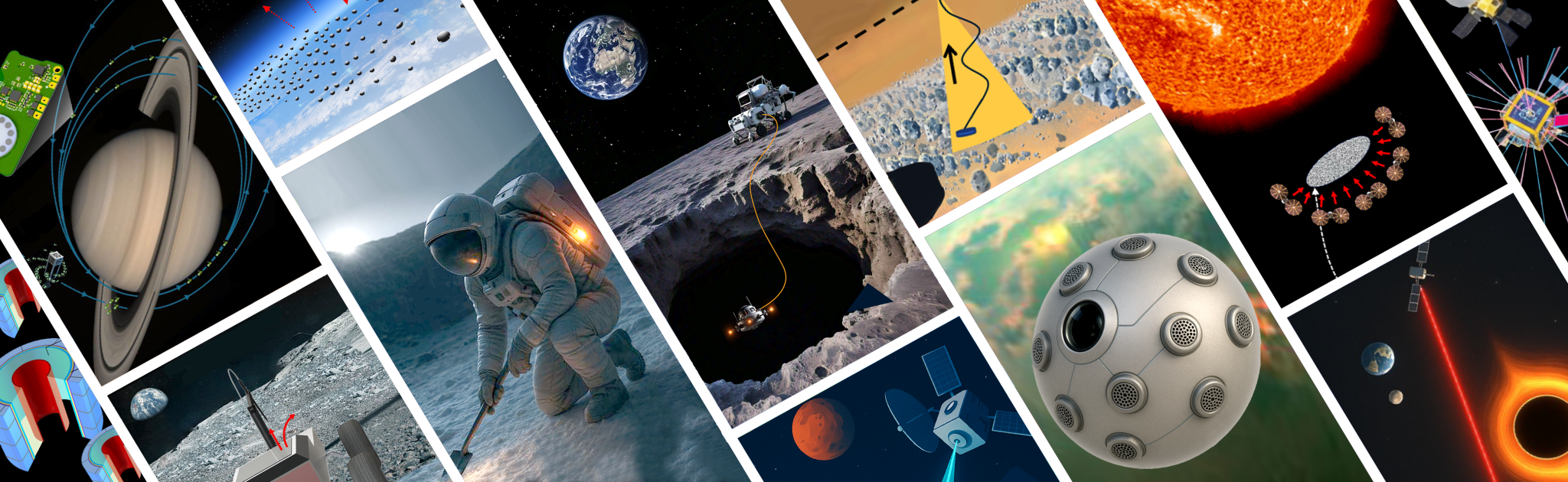
As NASA and its partners push for sustained lunar presence, some of the 2026 awardees focused on ways to help explore the Moon and build infrastructure there. These include a system to support hovering robots to explore lava tubes under the Moon's surface, a method to manage temperatures for small mobile exploration robots, and a way to incorporate radioisotopic heat sources into suits to help keep astronauts warm when operating in the Moon's nearly two-week-long lunar nights.
Other concepts focus on exploring some of the solar system's most remarkable features. Venus, with its hot atmosphere, presents an imposing challenge for research vehicles, so one NIAC awardee explores methods for hardening instruments for longer missions.
Two other concepts could help study planetary rings. One would use a swarm of 10,000 tiny satellites to map and analyze the rings of Saturn, while another would create a system for collecting samples from rings such as those circling Saturn, Uranus, and Neptune.
Some NIAC awardees will look far beyond the solar system, exploring ways to power interstellar spacecraft, map out continents on exoplanets, observe the photon rings around black holes, and detect subtle gravitational waves to explain how galaxies formed. Others will work to answer questions directly related to life on Earth, like the potential use of spaceborne dust to reduce solar radiation, and awareness about the debris orbiting Earth.


