
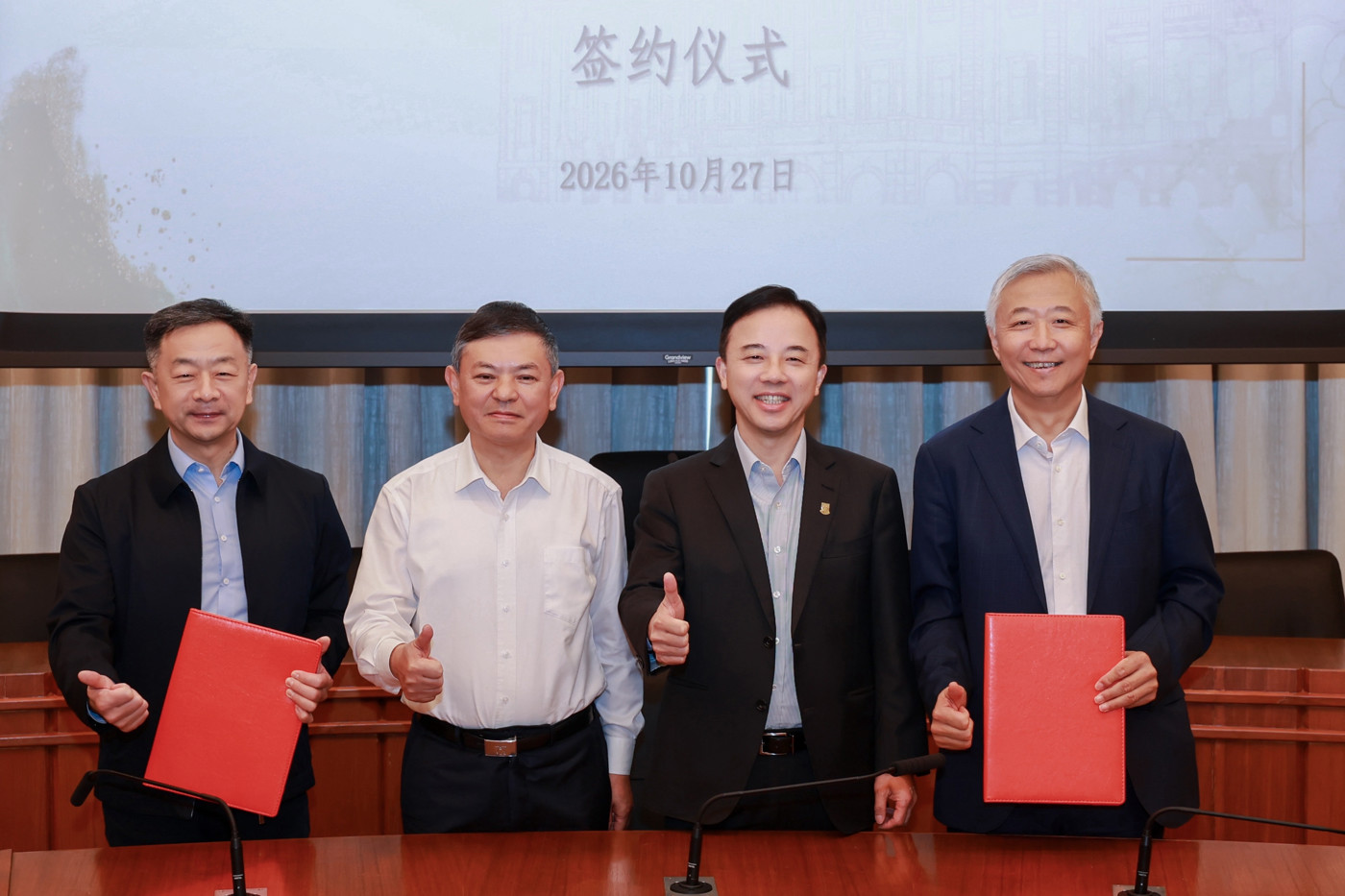
At the invitation of the Institute for Climate and Carbon Neutrality (ICCN) at the University of Hong Kong (HKU), Mr Huang Runqiu, Minister of Ecology and Environment, visited HKU for a discussion and cooperation launch ceremony. The initiative marks the formal launch of a strategic, long-term partnership between both parties, focusing on capacity building, talent exchange, and joint research in climate action and carbon neutrality.
Professor Xiang Zhang, President and Vice-Chancellor of HKU, warmly welcomed Mr Huang and his delegation on behalf of the University and expressed his sincere appreciation to the Ministry for its support for HKU's climate research and talent development. Professor Zhang noted that addressing climate change and advancing sustainable development are central to HKU's mission. The University has consistently prioritised climate and sustainability as core research areas, pursuing cutting-edge research through interdisciplinary platforms such as ICCN. During the keynote session, Minister Huang shared a systematic overview of China's environmental protection journey in his address titled 'Winning the Battle Against Air Pollution,' highlighting the landmark achievements and practical experience gained in air pollution control in recent years.
Professor Peng Gong, Vice-President and Pro-Vice-Chancellor (Academic Development), Chair of Global Sustainability, Department of Geography, Faculty of Social Sciences and Department of Earth Sciences, Faculty of Science, moderated the discussion. Mr Huang engaged with faculty members and students on environmental governance in theGreater Bay Area during the sharing session, highlighting international climate cooperation and the skills needed for green development. The visit also marked the launch of long-term cooperation.
Coordinated Environmental Governance and International Climate Cooperation
Discussing priorities such as the coordinated control of fine particulate matter (PM2.5) and ozone in the Greater Bay Area, as well as synergies between pollution reduction and carbon mitigation, Mr Huang called for the need for deeper research into pollution sources, formation mechanisms and patterns of transport across regions. He encouraged Hong Kong's universities to draw on their research strengths in environmental science, monitoring technologies and data analysis to advance pollution source apportionment, modelling of pollutant formation mechanisms and assessment of pollution control measures, providing a robust scientific basis for sustained improvements in the Greater Bay Area's air quality.
Addressing China's 2035 Nationally Determined Contribution targets and the development of the national carbon market, Mr Huang noted that climate action requires emissions reduction targets to be translated into practical measures for energy transition, industrial upgrading and technological innovation, alongside attention to climate adaptation and resilience. He highlighted Hong Kong's status as an international financial centre, its strengths in professional services and its extensive international connections. These advantages enable Hong Kong to play a distinctive role in financing green projects, research on carbon accounting and disclosure, and exchanges on low-carbon technologies, helping to connect research outcomes, industry needs and capital more effectively.
Developing Green Talent and Interdisciplinary Skills
In response to emerging needs in areas such as product carbon footprint management, carbon market mechanisms, carbon emission factor database, digital monitoring and biodiversity conservation, Mr Huang encouraged students to build strong foundations in their disciplines while exploring the connections between environmental and climate issues and economics, law, finance and data science. He emphasised the importance of developing interdisciplinary skills to solve practical problems. He advised students to refine their research interests and career choices through research projects, field studies and platforms for collaboration among industry, aligning their personal development with the national green development goals.
Launching Long-Term Cooperation and Sharing Opportunities for Green Development
During the discussion, participants witnessed the launch of cooperation on capacity building and talent exchanges between HKU's ICCN and the Department of International Cooperation of the Ministry of Ecology and Environment. The ceremony marked a substantive step towards deeper collaboration in talent development, academic exchanges and international cooperation. Building on this momentum, ICCN will draw on flagship platforms such as Hong Kong Climate Week and Hong Kong's unique position as a city with strong ties to the motherland and extensive global connections to strengthen collaboration among government, industry, universities and research institutions, expand international dialogue and cooperation, and bring together talent, knowledge and innovation resources to advance green development.


