- Science
- James Webb Space Telescope (JWST)
- Scientists Identify…
- Webb
- News
- Overview
- Science
- Observatory
- Multimedia
- Team
- More
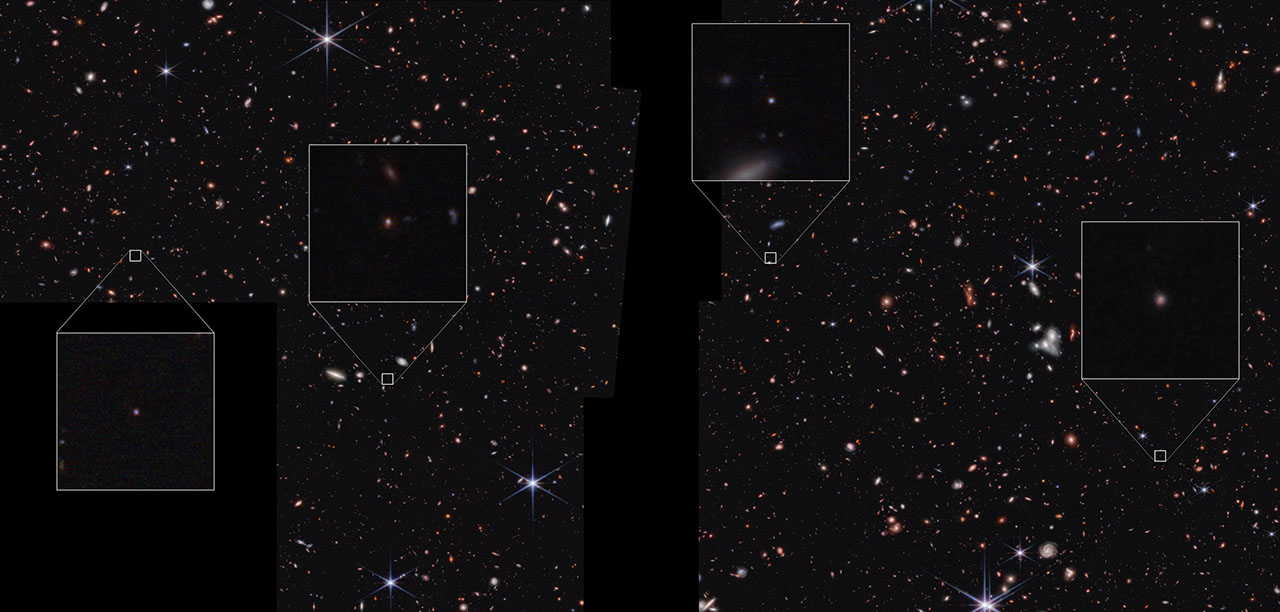
Image: NASA, ESA, CSA, Steve Finkelstein (UT Austin); Image Processing: Alyssa Pagan (STScI)
After combing through NASA's James Webb Space Telescope's archive of sweeping extragalactic cosmic fields, a small team of astronomers at the University of Missouri says they have identified a sample of galaxies that have a previously unseen combination of features. Principal investigator Haojing Yan compares the discovery to an infamous oddball in another branch of science: biology's taxonomy-defying platypus.
"It seems that we've identified a population of galaxies that we can't categorize, they are so odd. On the one hand they are extremely tiny and compact, like a point source, yet we do not see the characteristics of a quasar, an active supermassive black hole, which is what most distant point sources are," said Yan.
The research was presented in a press conference at the 247th meeting of the American Astronomical Society in Phoenix.
Image A: Galaxies in CEERS Field (NIRCam image)
"I looked at these characteristics and thought, this is like looking at a platypus. You think that these things should not exist together, but there it is right in front of you, and it's undeniable," Yan said.
The team whittled down a sample of 2,000 sources across several Webb surveys to identify nine point-like sources that existed 12 to 12.6 billion years ago (compared to the universe's age of 13.8 billion years). Spectral data