
A Dstl project has revolutionised training delivery across the Royal Air Force, strengthening Britain's air combat capability and operational readiness.
Through pioneering neuroscience based training methods, the Developing Education Learning and Training Advances (DELTA) project reached over 1,200 Royal Air Force (RAF) personnel and industry technicians responsible for operating and maintaining the Typhoon platform - a cornerstone of UK air defence.
The project's lectures on learning neuroscience and future training approaches have become mandated training for all 50 instructional staff at RAF Coningsby's Typhoon Training Facility. This ensures that pilots, technicians, engineers and groundcrew members receive training optimised for 21st-century learning, directly enhancing the operational effectiveness of one of Britain's most critical combat assets.
Supporting the Government's Strategic Defence Review 2025
DELTA is part of the Defence Science and Technology Laboratory (Dstl) future workforce and training programme, which is preparing the UK's future force through science and technology.
Engine for economic growth
By modernising training across Defence and industry partnerships, DELTA strengthens the UK's aerospace sector capabilities. This supports the whole force approach essential to maintaining our competitive edge in global defence markets.
Warfighting readiness
With Typhoon remaining central to UK air power until approximately 2035, DELTA's influence on training quality directly enhances deterrence capability and operational preparedness across all force levels.
UK innovation
The project demonstrates how Dstl's national science and technology expertise can transform traditional training approaches, positioning the UK at the forefront of educational neuroscience applications in defence contexts.
Operational advantage
Beyond Typhoon operations, DELTA's impact extends throughout Defence education infrastructure. The lectures have informed practices at the Joint Services Command and Staff College, influencing 4,000 officers in the training pipeline.
This comprehensive reach ensures that evidence based training principles are embedded across strategic decision-making, capability development, procurement, and front-line operations.
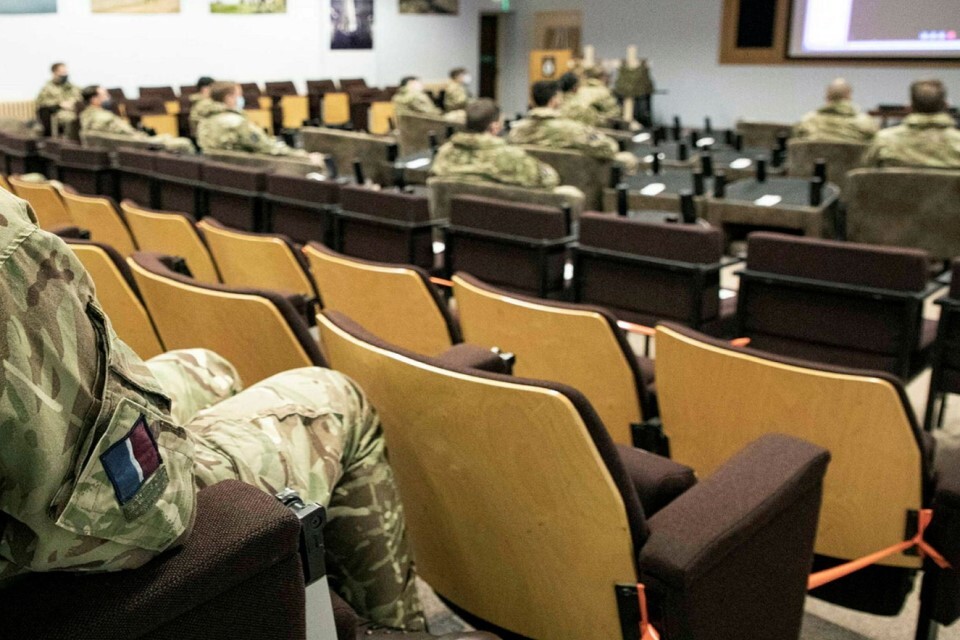
Lecture hall at RAF Coningsby
Neil Storey, Training Delivery Manager at RAF Coningsby, said:
This means we can transform our teaching methodology to something more appropriate for the 21st century.
The sustained adoption of these approaches reinforces the UK's position as a leader in defence innovation and training excellence.
Continuing impact
Building on the success of this approach, Dstl is now supporting the launch of the Infinite Network at HMS Raleigh, engaging directly with Royal Navy training audiences on neuroscience, neurodiversity, and performance.
This work is also supporting the Defence Infrastructure Organisation (DIO) on the themes of neurodiversity within teamwork and resilience.
The importance of this lies in the shift to Defence-wide influence: engagement with HMS Raleigh extends neuroscience into initial entry training pipelines, where it can shape how personnel are developed from the outset, while engagement with DIO demonstrates pull from wider Defence functions concerned with workforce resilience and performance.
Together, these engagements position Dstl as a critical enabler within the National Armaments Director Group; providing the scientific authority that underpins NAD decision-making while also extending influence across the wider Defence enterprise.


