An enzyme (a protein that speeds up chemical reactions) that breaks down polyethylene terephthalate (PET) plastic works ten times quicker, using 10 times using less enzyme just by changing the liquid it works in and making small changes to the enzyme's structure.
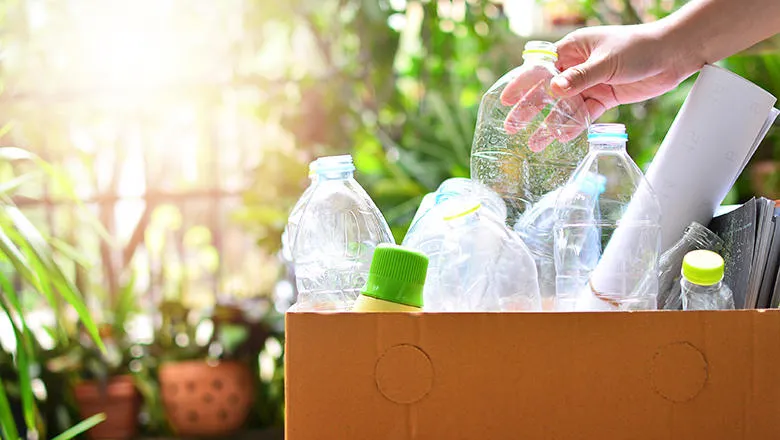
The new research from King's College London and Rutgers University in New Jersey, found that their new approach helped the enzyme keep breaking down hard to recycle plastic at a consistent rate for at least seven days, whereas the unmodified enzyme working in water began losing activity substantially after the first day. The method also worked on flakes cut from a used drinks bottle without having to first heat or otherwise prepare the plastic to make it easier to break down.
The findings could help pave the way for more efficient, cost-effective ways to recycle plastic. By keeping enzymes active for longer, the approach could reduce the amount of enzyme needed, while recovering and reusing the liquid could help manufacturers cut material costs. The researchers were also able to recover one of PET's main chemical building blocks, as a pure powder, which could potentially be used to make new plastic, reducing the need for virgin, fossil fuel-derived raw materials.
PET is one of the world's most widely used plastics. It is found in drinks bottles, food packaging, clothing and many other everyday products. Much PET waste is recycled by melting it down and reshaping it. But repeated processing can affect the quality of the plastic, and not all discarded plastic can be recycled this way.
One alternative is to break plastic down into its original chemical building blocks, which can then be used to make plastic again. Enzymes can help carry out this process, acting like tiny biological tools that cut the chemical links holding the plastic together. But many enzymes struggle to break PET down quickly and can stop working as the process goes on.
The researchers used a naturally occurring enzyme called cutinase, which can break down PET plastic. The researchers chemically changed the enzyme's surface to protect it against the heat and chemical conditions involved in breaking down the plastic, so it could remain active for longer. They then paired it with a specially selected liquid known as an ionic liquid. This liquid helps loosen the tightly packed structure of PET plastic, making the chemical links within the plastic more accessible to the enzyme. It also allows the reaction to take place at high temperatures, when PET becomes more susceptible to breakdown.
In experiments using PET powder, the modified enzyme continued breaking down the plastic at a steady rate over seven days, rather than losing much of its activity after the first day. By comparison, the unmodified enzyme working in water lost activity substantially after the first day, with its activity lasting around 36 hours before declining.
In these laboratory tests, the modified enzyme in the ionic liquid showed a 9.2-fold increase in the speed it was able to break the chemical links in the plastic. The modified enzyme system also carried out around 9.5 times as many chemical reactions over the course of the experiments.
The ionic liquid could be recovered for almost continuous reuse. In a laboratory experiment, the team recovered 97.1% of the liquid. The researchers were also able to isolate terephthalic acid, one of PET's main chemical building blocks, as a pure powder. However, the enzyme stopped working effectively after the recovery process. The researchers are working to improve enzyme recovery so that both the liquid and enzyme can be reused, reducing the need for fresh materials.
The researchers did not test the approach using some of the most advanced plastic-degrading enzymes, which have been specially engineered to break down PET. Earlier studies have shown that these engineered enzymes can break down certain forms of PET to a high degree in around two days. Instead, the researchers used the enzyme, cutinase, as a test case, to investigate whether changing the enzyme's chemical properties and the liquid around it could improve how it works at scale, with less enzymes used overall.
The researchers estimate that applying their approach to advanced enzymes could reduce the time needed for near-complete PET breakdown from around two days to approximately five hours and significantly cut the amount of water used in the process. This estimate is based on results from previous studies using those enzymes, rather than experiments carried out in the current study.
Further work is needed to develop the process for use at an industrial scale, particularly to improve enzyme recovery and assess its energy requirements and overall environmental and economic performance.
Dr Alex Brogan, corresponding author, and Senior Lecturer in Chemistry, King's College London, said:
"The research in my lab is aiming to provide new solutions to help us move away from an oil-based economy to a circular bio-based economy. Enzymatic plastic recycling is therefore very important to achieving those aims, and in this paper we have made an important step in sustainably recovering the building blocks of this important and commonly used plastic. We hope that in the future it will be applied to a variety of different enzymes and plastics."