
Our lymphatic system is like a big network of roots spread throughout the body. It serves as part of our immune system, transporting immune cells and filtering excess fluid (lymph) before returning it to the bloodstream. Following the intricate, intertwined passages of this network is complicated - but a full understanding is essential for developing effective ways to treat lymphatic pathologies.
For example, after breast or uterine cancer surgery, one of the main complications affecting many patients is lymphedema. The limbs become severely swollen and prone to infection, which greatly interferes with daily activities. Additionally, since the lymph nodes transport fluid throughout the body to re-enter the bloodstream, it can serve as a sneaky method for cancer to spread called "lymph node metastasis." Both pathologies lack radical or definitive treatments. To address these challenges, it was essential to understand the anatomical and physiological structure of the lymphatic network with greater precision than ever before.
Until now, lymphatic vessels were believed to have only a one-way path that ultimately connects to a special vein called the subclavian vein, and the high endothelial venule (HEV) was thought to correspond to fluid entering the lymph sinus from the venule within the lymph node. However, a research team led by Dr. Ariunbuyan Sukhbaatar, Professor Tsuyoshi Sugiura, and Professor Tetsuya Kodama (Graduate School of Dentistry and Graduate School of Biomedical Engineering, Tohoku University) identified the existence of intranodal lympho-venous shunts (inLVS)―structures where lymphatic fluid flows from lymph sinus directly into veins within lymph nodes―for the first time ever.
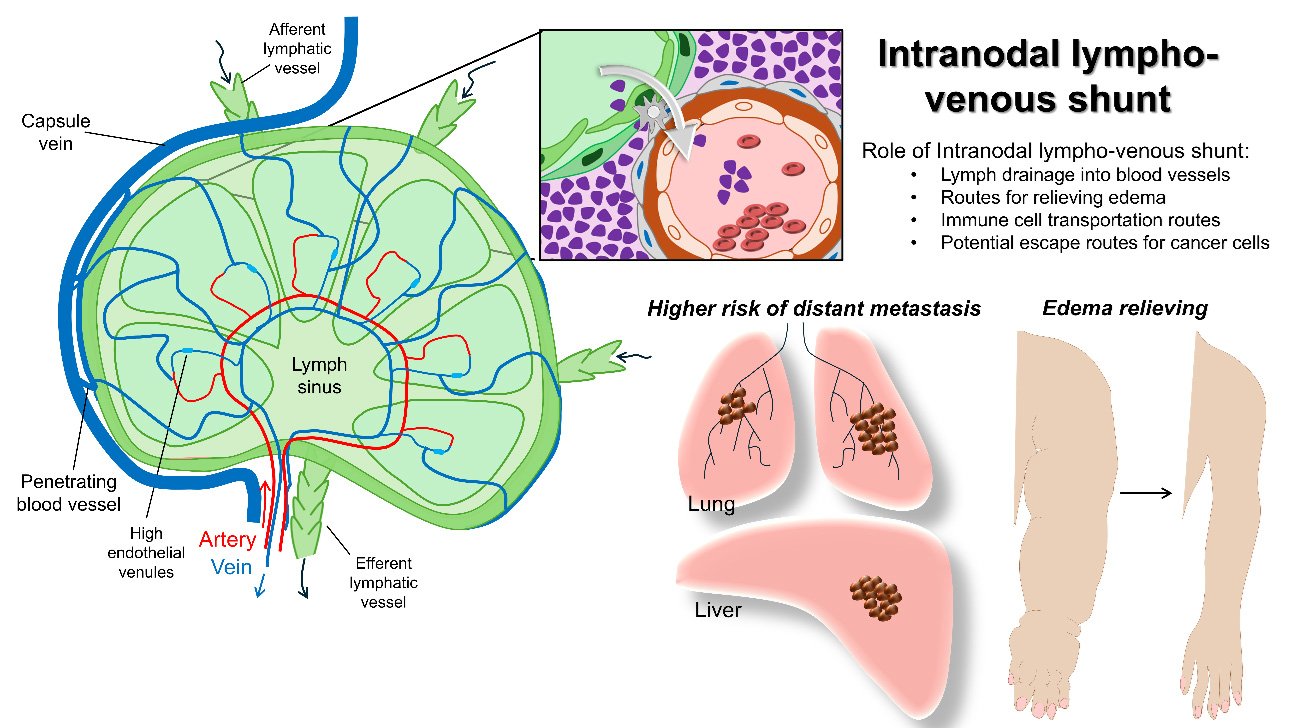
To make this remarkable discovery, the research team conducted a comprehensive analysis of all 22 types of lymph nodes throughout the body using the latest imaging technologies (including microCT and iron nanoparticles). They used a mouse model of lymphadenopathy with lymph node structures similar to those of humans.
"We determined that the intranodal lympho-venous shunt is a bypass route that directly connects lymph sinuses to the veins, which challenges the traditional ideas we had about lymphatic fluid movement," explains Sukhbaatar.
This finding could spark innovative advancements in understanding the pathogenesis of lymphedema - which greatly impacts patients' quality of life - as well as in understanding the mechanisms of lymph node metastasis and distant metastasis of cancer.
"For example, imagine if we develop new treatment strategies to reduce swelling by adjusting shunt function in patients with lymphedema, or close the shunt to block malignant cancer cells from entering the bloodstream," says Kodama, "With this newfound knowledge, we may be able to develop highly accurate drug delivery systems that target the lymphatic system, enhancing therapeutic outcomes and minimizing side effects."
This result is a fundamental discovery that may cause a paradigm shift across many fields like immunology, oncology, and regenerative medicine.
The findings were published in The Journal of Pathology on February 4, 2026.
- Publication Details:
Title: Lymphatic topology reveals a novel intranodal lympho-venous shunt
Authors: Ariunbuyan Sukhbaatar, Radhika Mishra, Akira Nakamura, Shiro Mori, Tsuyoshi Sugiura, and Tetsuya Kodama
Journal: The Journal of Pathology
DOI: 10.1002/path.70032


