
Researchers at the UAB and CREAF have developed a method that improves the knowledge collected on the height of plants, buildings, and other objects of a region. The tool can be used to obtain digital models of extension and vertical evolution with much more precision than before, with a large amount of associated metadata that can be consulted in open access.
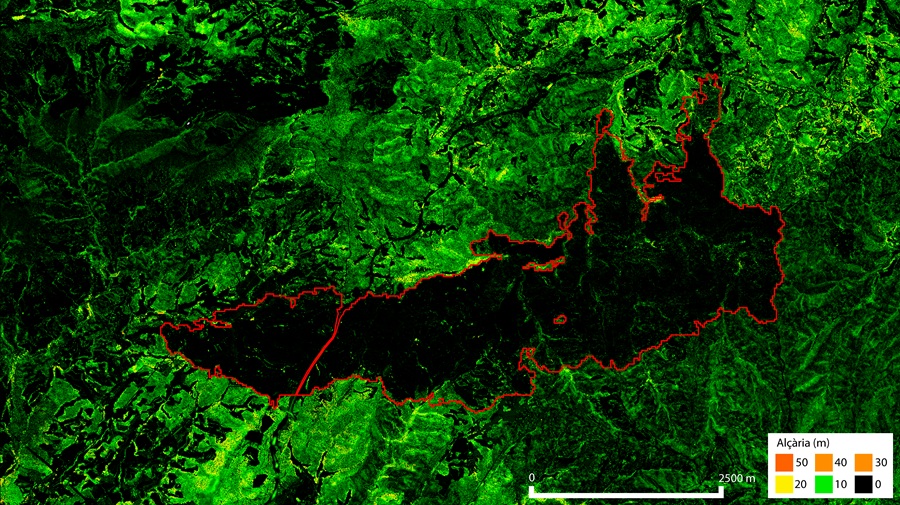
The LidarTeam method allows analysing large areas with a great amount of detail, with information for each 2 x 2 metres, and for the first time makes it easier to compile full vertical dynamic data per region and throughout multiple time periods. It was developed by the research group in Methods and Applications of Remote Sensing and Geographic Information Systems (GRUMETS) and is published in the International Journal of Digital Earth, with a link to open access data. Participating in the project were researchers from the departments of Geography and of Animal Biology, Plant Biology and Ecology of the UAB and CREAF.
LidarTeam is based on massive data processing obtained using lidar technology in flights by the Institute of Cartography and Geology of Catalonia. This technology allows gathering dense and detailed information of the land – billions of points over tens of thousands of square kilometres – with rapid updates; something that until now was too complex for Geographic Information System (GIS) applications. This method prevents common errors found in previous procedures, such as in areas with steep slopes or due to bird flocks, and achieves high accuracy thanks to the synergy with other remote sensing data (satellite, aerial infrared ortho) and other land and slope models. In addition, it includes advanced metadata that provide temporal and quality context to make reliable comparisons and understand the vertical dynamics of the land.
The research team validated the method through the production of three digital height models – two of all of Catalonia and one for the Barcelona Metropolitan Area (BMA). They cover a total of 65,000 square kilometres based on data from 5,355 points on buildings and 4,160 in forests.
"We designed a scenario in which, with the tip of your fingers, you can consult the height of trees, bushes, buildings, etc., with such precision across the entire country and, plus, in two (all of Catalonia) or three (Catalonia+BMA) there is data to study the vertical dynamics in detail, in forests and urban areas", highlights study coordinator Xavier Pons. He goes on to say that, "the high level of detail that we have achieved is especially important in an area as fragmented as Catalonia, if we want to understand the texture of the land and its evolution, even in the densest areas".
The information provided by the new method is key to properly conducting studies of vertical growth rate, the relationship with other time series such as forest fires, or land use and cover over the course of almost half a century. It is also relevant for tracking variations in the volume of wood in forests over time and conducting biodiversity studies.
A tool with which to measure Catalonia
The new tool allows users to discover data such as where the tallest forests in Catalonia are located or which species grow the fastest. The ranking of trees with the greatest height is headed by those in the Vall d'Aran, where the median of the trees is 13 metres high; the Pla de l'Estany, with 12 m; and the Ripollès, with 11.7 m. Among the trees growing the fastest are the firs (Abies alba), with growth rates reaching 27 cm per year in half of their population, and beech forests (Fagus sylvatica), with 24 cm.
The largest height detected so far with the LidarTeam has been a London plane (Platanus sp.) in the Devesa Park of Girona, which measured 54.55 metres, the equivalent of an 18-story building, according to the latest available data from 2021. The tree continues to grow today in the park.
With regard to urban areas, the neighbourhoods in Barcelona with the highest medians (22 to 23 metres) are: Dreta de l'Eixample, the Antiga and the Nova Esquerra de l'Eixample, and Sant Antoni. However, researchers highlight the significant vertical development of the Gothic Quarter, Raval and Sant Pere, Santa Caterina and Ribera neighbourhoods, with medians between 19 and 20 metres. Maximum heights exceed 100 m in eight neighbourhoods containing emblematically tall buildings, such as Vallvidrera, Tibidabo and les Planes (Torre de Collserola), Barceloneta (Hotel Arts), Raval (Torre de Jaume I), Poblenou and Diagonal Mar (Hotel Melià Barcelona Sky) and, of course, the Sagrada Família in the neighbourhood that bears its name.
The tallest tree in Catalonia detected with the new method is a London plane in the Devesa Park of Girona that measured 54.55 meters in 2021 (latest available data), the equivalent of an 18-story building. Xavier Pons, researcher at the UAB and CREAF, verified in March that the tree was still standing.
Open to scientists, technicians and citizens
The dataset is available to the public in general and can be both downloaded or consulted through the geoservice created under the FAIR (Findability, Accessibility, Interoperability, and Reuse) principles. The geoservice includes functionalities that allow users - scientists, technicians and citizens - to comment and report information with high geographical precision. All data is accessible in the open source browser of the free GIS and remote sensing software MiraMon, created by GRUMETS and used by some 200,000 people in 41 countries.
The research group's proposal is part of the Digital Twin of the Earth concept which involves "making available much more detailed information about the third dimension of the land, and doing so multi-temporally, something crucial to advance our understanding of terrestrial systems and be able to carry out effective management and planning", researchers conclude.
Reference article: Pons, X., González-Guerrero, O., Masó, J., Zabala, A., Serral, I., & Ninyerola, M. (2025). LidarTeam: a remote sensing driven method for massive lidar data to regional DHM refined through user feedback. International Journal of Digital Earth, 18(2). https://doi.org/10.1080/17538947.2025.2562051


