
Abstract
A research team, affiliated with UNIST has unveiled an innovative, cost-effective biosensor capable of being washed and reused, paving the way for more accessible liquid biopsy diagnostics. This new platform aims to reduce the high costs and complexity associated with traditional cancer detection methods.
Professor Myungsoo Kim from the Department of Electrical Engineering at UNIST, in collaboration with Professor Woojung Shin of KAIST and Professor Joohoon Kang of Yonsei University, announced the successful creation of a highly sensitive, reusable liquid biopsy sensor that leverages molybdenum disulfide (MoS₂) and radio frequency (RF) technology.
Liquid biopsy is a non-invasive method that detects circulating tumor DNA fragments in blood or bodily fluids, enabling early cancer detection without the need for tissue removal. However, existing sensors are often single-use or expensive to produce, limiting their widespread clinical application.
The new MoS₂-based sensor addresses these challenges by offering easy regeneration and low manufacturing costs. Its fabrication involves applying MoS₂ ink onto a substrate and then removing the solvent-an approach that is simple, scalable, and cost-effective.
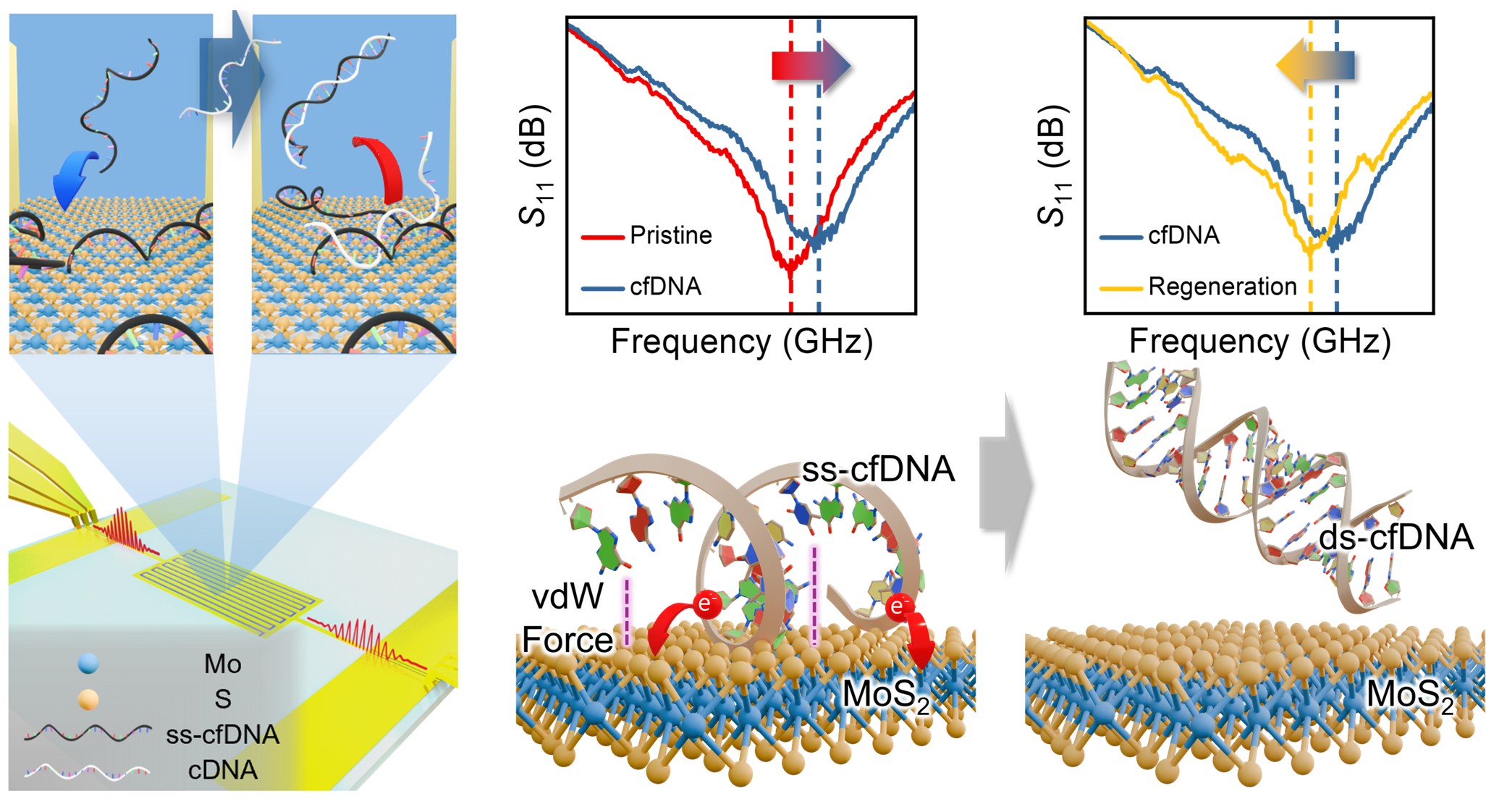 Figure. Schematic illustration of the MoS2-based RF sensor.
During testing, the sensor analyzes a patient's bodily fluid using RF signals to monitor changes in electrical properties. When target DNA binds to the sensor surface, it causes shifts in permittivity and resistance, which alter the resonant frequency of the RF signal-enabling precise and label-free detection.
Remarkably, the sensor can selectively detect single-stranded DNA (ssDNA), a vital biomarker for advanced-stage cancers and lymph node metastasis that are often missed by conventional methods. In experiments, it accurately detected the cancer-related AluSx1 DNA fragment at concentrations as low as 154.67 nanomolar.
The detection mechanism relies on the base pairing of DNA. The sensor can be washed with a solution containing complementary DNA bases, which re-form the double helix and naturally detach the ssDNA, allowing the sensor to be reused up to five times without significant performance loss.
Led by Professors Myungsoo Kim and Woojung Shin as corresponding authors, with first authors Seungchan Lee of UNIST and Eunho Choi of KAIST, the research highlights the potential of this technology to revolutionize cancer diagnostics. "Detecting single-stranded DNA associated with cancer metastasis at a low cost could significantly impact early diagnosis and prognosis monitoring," they noted. "Our goal is to develop home-based diagnostic devices and smart healthcare systems that enable individuals to monitor their health outside clinical settings."
This research was supported by the National Research Foundation of Korea (NRF), the Ministry of Science and ICT (MSIT), and the Korea Institute for Advancement of Technology (KIAT). The study was published online in Sensors and Actuators B: Chemical on January 22, 2026.
Journal Reference
Seungchan Lee, Eunho Choi, Jieun Kim, et al., "Reusable RF sensor based on solution-processed MoS2 for liquid biopsy of single-stranded circulating cell-free DNA," Sens. Actuator B-Chem., (2026).


