
A specific protein controls mRNA transport in fungi and distinguishes important from unimportant binding sites in the transported mRNAs. Researchers from Würzburg and Düsseldorf have discovered this mechanism.
Cells are highly complex logistics centres whose survival depends on the error-free distribution of their building material. In order for proteins to be produced exactly where they are needed, the targeted transport of their building instructions - the mRNA molecules (messenger ribonucleic acid) - is required.
In the filamentous hyphal cells of the pathogenic fungus Ustilago maydis, this takes place via the principle of "vesicle hitchhiking": the mRNA molecules act like hitchhikers, jumping onto small transport vesicles (endosomes). The protein Rrm4 takes on the role of the loading master. It recognises the mRNA packages and links them to the endosomes, which move through the cell like trains on the tracks of the cytoskeleton.
Researchers at Julius-Maximilians-Universität Würzburg (JMU) and the University of Düsseldorf have now analysed this mechanism in detail. The results have been published in the renowned journal Nucleic Acids Research.
The research team found that Rrm4 transports in particular the building instructions for the cytoskeleton itself. If this transport is disrupted, the fungus loses its orientation: instead of organised fungal filaments, malformations develop. Deciphering the hitchhiker code reveals how cells precisely organise their internal logistics to enable orderly mRNA transport.
Cracking the code of the binding sites
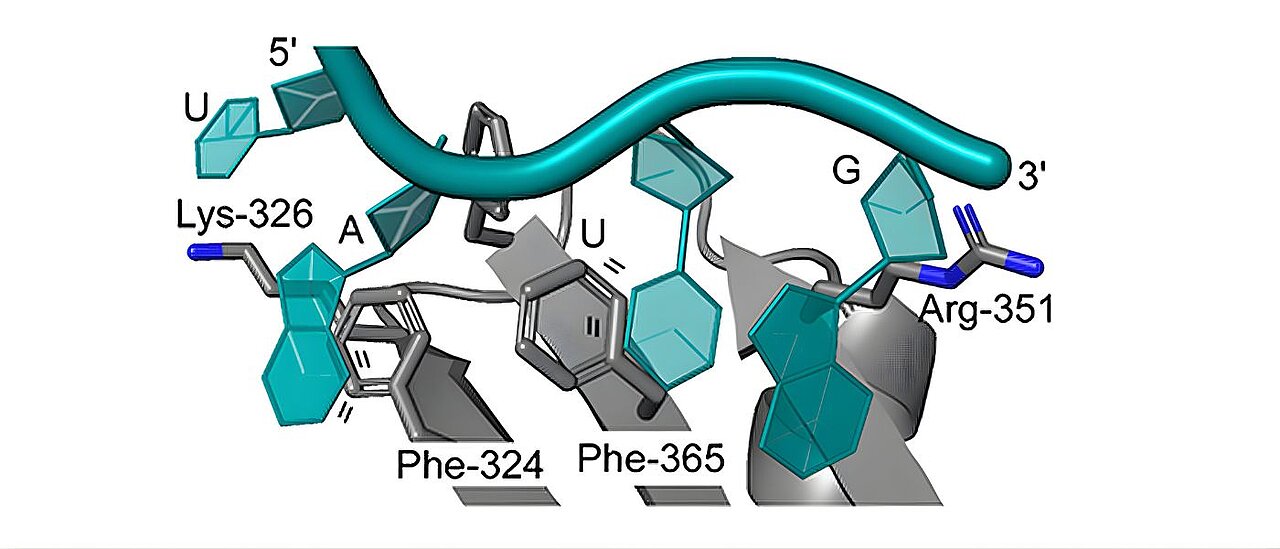
"Using an innovative comparative method, we were able to analyse the interaction between the protein Rrm4 and the mRNA with the highest precision. We were able to identify over 50,000 binding sites in the data sets," says Professor Kathi Zarnack, holder of the JMU Chair of Bioinformatics II and head of the study together with Professor Michael Feldbrügge, microbiologist at the University of Düsseldorf.
The key challenge was to decipher the functional code of these binding sites. Analysing the three binding domains of the protein (RRM1, RRM2 and RRM3) revealed a differentiated system:
- RRM1 and RRM2 (tandem domains): They form the essential core of the transport system. Binding sites that are primarily recognised by these domains are important for the targeted growth of the fungal cell.
- RRM3 domain: It recognises the motif that acts like a postcode on the mRNA. Although this domain forms the most bonds with more than 10,000 identified sites, it proved to be largely dispensable for basic growth.
- Cooperative interplay: RRM3 can support the two tandem domains in recognising important targets in order to stabilise binding.
"Our data shows a paradigm shift in the way we look at molecular bonds," explains the bioinformatician. "The bonds that are most visible in the experiment, such as those of the RRM3 domain, are not necessarily the functionally most important." The cell uses a tiered system in which RRM3 acts more as a supporting accessory, while RRM1 and RRM2 take over the recognition of the crucial mRNAs.
Evolutionary bridge: From fungi to human nerve cells
The significance of this discovery extends far beyond fungal research, as evolution often maintains successful cellular logistics systems over millions of years. The research team therefore also looked at a system in human nerve cells that is responsible for similar transport tasks. "The similarity between the fungal system and human cells is astounding," adds Professor Julian König, Head of the JMU Chair of Biochemistry and RNA Biology.
The study is a significant step forward in deciphering generally applicable RNA binding dynamics. "The new knowledge about the distinction between functional and purely concomitant binding sites will make it possible to decipher the involvement of RNA-binding proteins in a variety of human diseases in the future," says Kathi Zarnack.
Original publication
Dissecting the RNA-binding capacity of the multi-RRM protein Rrm4 essential for endosomal mRNA transport. Nina Kim Stoffel*, Srimeenakshi Sankaranarayanan*, Kira Müntjes, Anke Busch, Julian König, Kathi Zarnack**, Michael Feldbrügge**. Nucleic Acids Research. 1 April 2026, https://doi.org/10.1093/nar/gkag210
*Shared authorship, **shared correspondence


