
Scientists have developed a new edge-of-field water-treatment system that reduces the load of excess nutrients washing into waterways from farm drainage systems. Their method combines a woodchip bioreactor with a two-step biochar water-treatment module. A one-year field trial demonstrated that the system reduced both nitrogen and phosphorus runoff from farmland.
The study, published in the Journal of Water Process Engineering, also included a techno-economic analysis that found that the bioreactor-biochar system could become a cost-effective alternative to current edge-of-field practices while achieving better water-quality outcomes.
Nutrient runoff from agricultural fields is a persistent contributor to water pollution, fueling harmful algal blooms and degrading freshwater and coastal ecosystems. While woodchip bioreactors are used to reduce nitrogen runoff, they are not designed to remove phosphorus, said Wei Zheng, a principal research scientist in environmental chemistry at the Illinois Sustainable Technology Center, a division of the Prairie Research Institute at the University of Illinois Urbana-Champaign. Zheng led the study with ISTC postdoctoral researcher Hongxu Zhou.
"Dissolved phosphorus is a major concern in farm drainage water," Zheng said. "Like nitrogen, phosphorus promotes algal blooms in rivers or lakes that can produce toxins, block sunlight and deprive aquatic organisms of oxygen."
Phosphorus runoff may even increase when a woodchip bioreactor is first installed, as phosphorus that is naturally present in the wood may leach into the water.
"To address this, we wanted to develop a new edge-of-field treatment system capable of capturing multiple nutrients at once," Zheng said. "So we combined a woodchip bioreactor with a biochar-sorption channel to remove both nitrogen and phosphorus."
Bioreactors are large trenches filled with woodchips through which farm water runoff is routed. The woodchips support denitrifying bacteria, which consume carbon in the wood biomass and, under oxygen-limited conditions, convert nitrate into harmless nitrogen gas. The second stage of the system, a biochar-sorption channel, captures dissolved phosphorus through chemical reactions that form solid compounds such as magnesium phosphate and calcium phosphate, both of which can be reused as fertilizer.
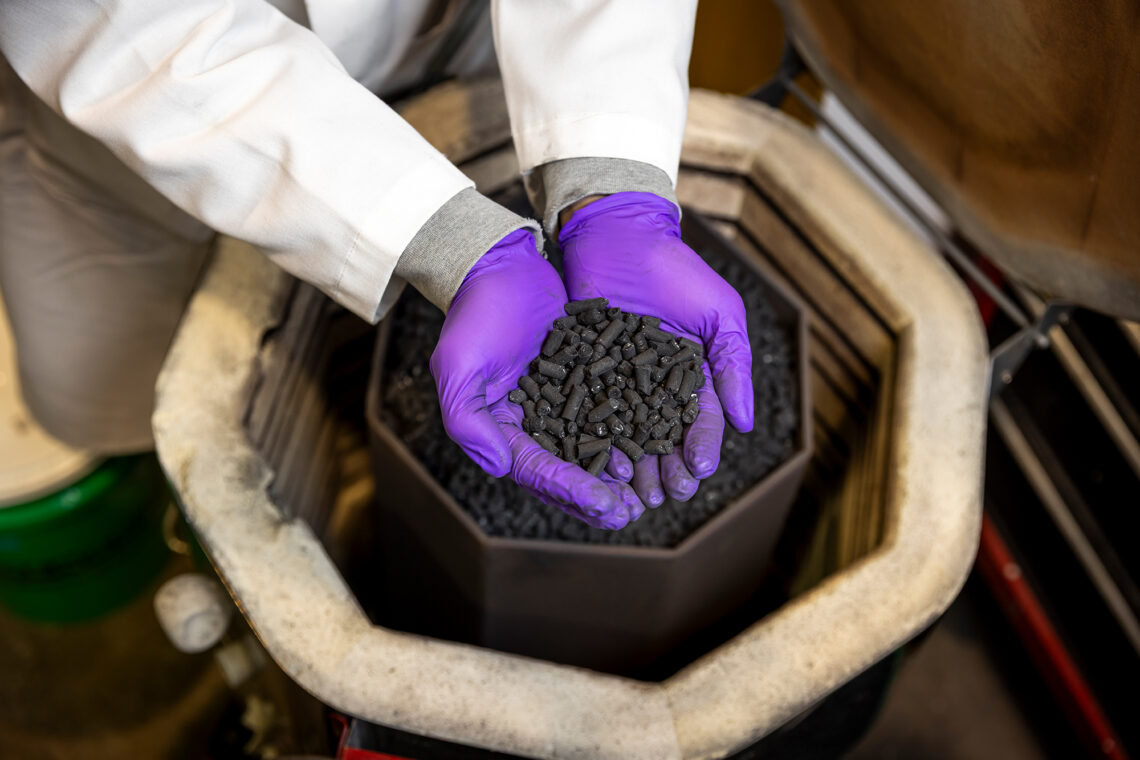
Zheng and his colleagues produced their "designer" biochar with lime sludge, a byproduct of lime processing in water treatment plants. They mixed the sludge with fine sawdust and heated it to high temperatures in low-oxygen conditions. The resulting biochar powder was then compressed into pellets.
"Pelletizing the biochar ensures the material stays in sorption channels and doesn't wash away by water flow," Zheng said.
When tested in a one-hectare field trial, the bioreactor-biochar system reduced nitrate-nitrogen loads in farm runoff by 58% and lessened ammonium-nitrogen loads by 72%. The biochar-sorption module reduced the concentrations of dissolved phosphorus by 3-92% and total phosphorus by 20-92%, depending on seasonal flow conditions.
A techno-economic assessment estimated that the system achieved unit removal costs of $90.30 per kilogram of nitrate-nitrogen retained per year and $63.90 per kilogram of dissolved reactive phosphorus removed from the drainage water per year. Modeling suggests that scaling the system to a 10-hectare site would substantially lower these costs, the researchers found.
The new approach could also help offset its costs because the spent biochar, which is loaded with phosphorus, can be reapplied to fields as fertilizer. In addition, adding biochar to the soil may improve soil health, increase crop yields and make farmers eligible for carbon credits.
Zheng and his colleagues are now evaluating this edge-of-field practice at a larger scale on a commercial farm.
The U.S. Environmental Protection Agency supported this research.


