
DNA, the blueprint of life, is best known for its fundamental role as genetic material: storing and transmitting biological information through the precise sequence of its bases. For decades, this information-storage function has defined how we think about DNA. But what if DNA could do more than encode life--what if it could act as a reaction vessel that precisely guides and controls specific chemical reactions?
Recent advances are reshaping this view by recognizing that DNA can also act as a molecular guide that precisely positions chemicals to trigger specific reactions. The highly ordered, three-dimensional scaffold structure of DNA makes it highly suitable for the task. Scientists can exploit its base-pairing specificity and structural programmability to bring reactive moieties into close proximity and enable chemical reactions with remarkable selectivity and efficiency. This paradigm shift transforms DNA from a passive information carrier into an active participant in chemical reactivity, opening new opportunities in molecular engineering, chemical biology, and nucleic-acid-based technologies.
Building on this emerging concept, researchers at the Institute of Multidisciplinary Research for Advanced Materials (IMRAM), Tohoku University, have developed a new technology that uses the light-responsive artificial nucleic acid thioguanosine (TG) to achieve highly efficient and controllable interstrand crosslinking of DNA. This breakthrough marks a significant leap forward for both DNA nanotechnology and the burgeoning field of nucleic acid-based medicine.
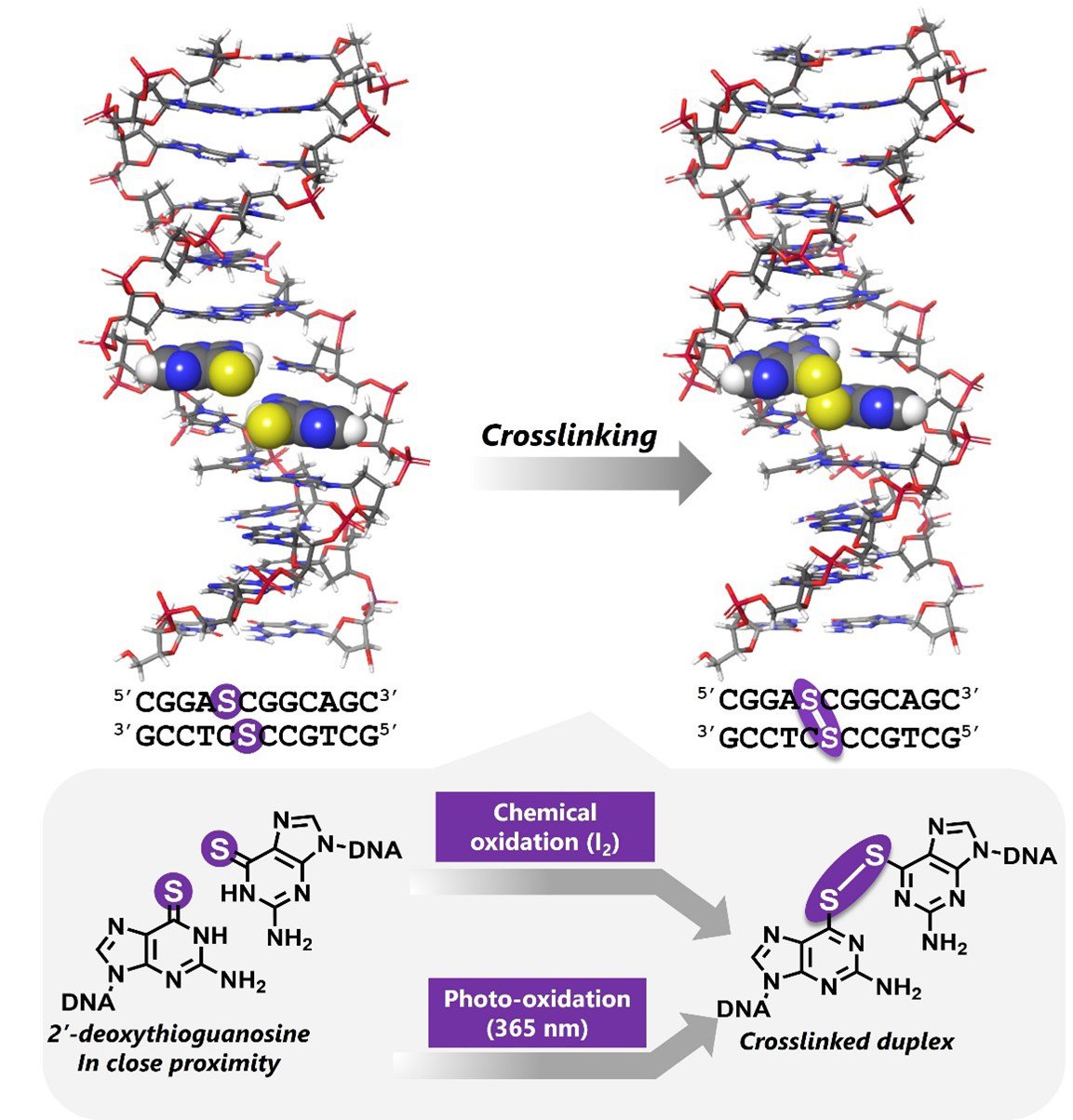
Remarkably, the research team found that crosslinking can be triggered either by light irradiation or by mild chemical oxidants, while preserving the native double-helical structure of DNA. By discovering a previously unknown photoinduced reactivity of thioguanosine, the study reveals a novel electron-transfer-based reaction mechanism within DNA duplex.
"There are many things that make this crosslinked DNA special, such as its high thermal stability and the fact that the crosslinks can easily be connected and disconnected," says Kazumitsu Onizuka (Tohoku University), "We have a lot of control over how the DNA is connected, which allows us to consistently produce a desired outcome in chemical reactions"
The reversibility of these crosslinks is a key feature of this technology. Reversible redox switching or light activation can break the connections without distorting the native DNA structure. This unique combination of stability and reversibility makes the system ideally suited for applications requiring reversible crosslinking for dynamic control, such as stimuli-responsive materials, intracellular drug delivery systems, and biochemical studies of nucleic acid function.
By establishing clear design principles and uncovering new reaction mechanisms, this work significantly expands the toolbox of nucleic acid chemistry. The introduction of thioguanosine-based, proximity-driven, and light-activated crosslinking provides a versatile platform for dynamic and reversible DNA modification. These capabilities are expected to enable next-generation bionanomaterials, including intracellularly responsive drug delivery systems, programmable DNA nanostructures, and DNA-based nanomachines, positioning controllable DNA crosslinking as a powerful strategy for future nanotechnology and medical applications.
The findings of this research were published in Communications Chemistry on December 23, 2025.
- Publication Details:
Title: Chemical and photoinduced interstrand crosslinking of oligo DNA duplexes containing 2′-deoxythioguanosines
Authors: Jamila Abbas Osman, Kazumitsu Onizuka, Yuuhei Yamano, Fumi Nagatsugi
Journal: Communications Chemistry


