
Insects first took to the skies about 350 million years ago, some 200 million years before birds first flapped their wings.
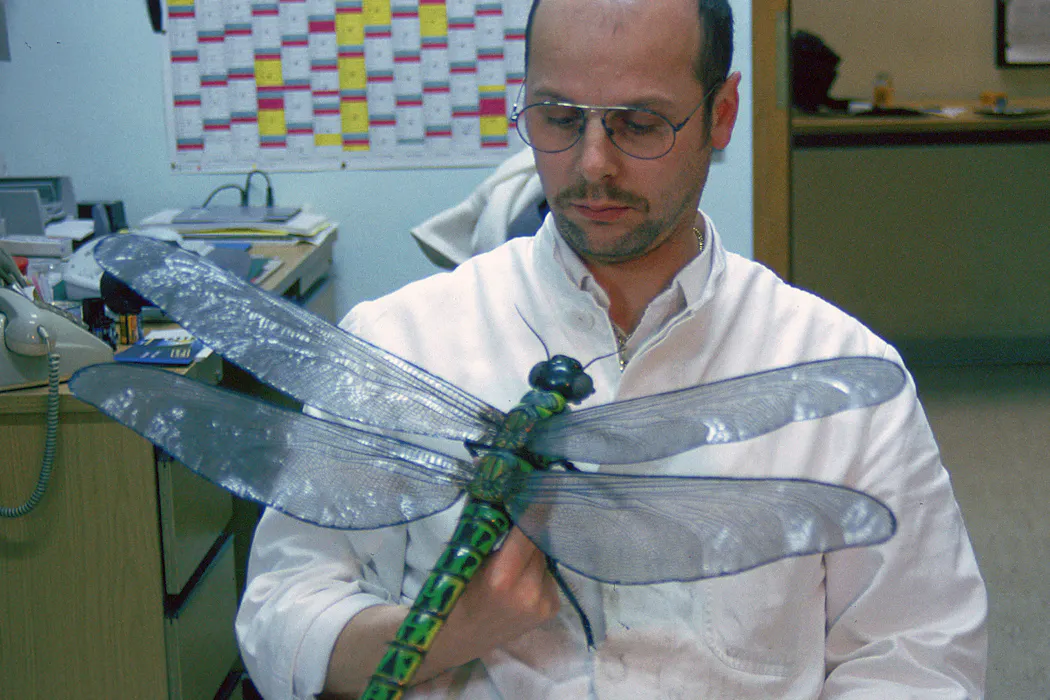
By the end of the Carboniferous period, 300 million years ago, some flying insects had become gigantic. Huge dragonfly-like insects called griffinflies had wingspans of 70cm - five times the size of the largest modern dragonflies.
These giant insects lived in a time when Earth's atmosphere contained more oxygen than it does today: around 30% , compared with the modern 21%.
Because large flying insects lived in a time of high oxygen levels, scientists have proposed that they required these high external oxygen levels to power the rapid burn of energy during flight.
In new research published today in Nature, we studied the muscles of dozens of modern flying insects and made a surprising discovery: there is no reason the griffinfly could not survive in today's atmosphere.
The structure of the insect flight respiratory system
Flying takes more energy than running or swimming, because a flapping flier must constantly work against gravity to remain in the air.
Consequently, the flight muscles use a lot of oxygen, and the rate of oxygen consumption increases roughly in proportion to the weight of the flier. The highest rate of oxygen consumption per gram by any known tissue occurs in a flying bee.
Oxygen is supplied to insect flight muscles through the "tracheal system", a tree-like branching system of air-filled tubes that lead to the smallest branches, called "tracheoles", where oxygen moves into the muscle tissue.
Each tracheole is a dead end, which means oxygen delivered to the muscle travels primarily by diffusion. First it diffuses through the air inside each tracheole, and then through the muscle tissue itself.
The old hypothesis
In modern insects, oxygen levels near the oxygen-consuming mitochondria that power the flight muscle are very close to zero. This implies that the structure of the tracheal system was just adequate to supply sufficient oxygen.
A larger insect would need a greater supply of oxygen, which would mean a greater driving force for diffusion, which in turn means more oxygen in Earth's atmosphere.
The idea that the structure and function of the insect tracheal system limits body size has prevailed for the past 30 years and appears in educational textbooks.
Our interest in the theory arose 15 years ago, when we looked at thin slices of the flight muscle of locusts . The tracheoles appearing between and within the muscle fibres were few and took up only about 1% of the area, compared with the mitochondria that were occupying about 20%.
New evidence
We initially thought all an insect had to do to increase its oxygen delivery would be to increase the number of tracheoles. After all, this is where oxygen is supplied to the mitochondria.
To be sure the locust was not exceptional and to properly understand the effect of body size, we measured 44 species of flying insects of different body masses and metabolic rates. The project required five years and 1,320 transmission electron micrographs.
But the results were essentially the same: the tracheoles occupied only about 1% of the cross-sectional area of the flight muscles regardless of body size. In contrast, the blood-filled capillaries in the flight and cardiac tissue of some birds and mammals occupy about 10% of the area.
This shows there is plenty of scope to increase the number and volume of tracheoles without weakening the muscle. So the structure of the tracheal system is not an important constraint on body size.
Evidence from developing insects shows insects can grow more tracheoles in flight muscle in lower oxygen levels, and they pass this trait to their offspring. The conclusion is that the body size of flying insects has never been limited by the structure or function of their tracheal systems.
There is no physiological reason why insects the size of griffinflies could not fly in today's atmosphere. And yet they don't exist today.
The simpler reasons may be that larger animal species are more prone to extinction than smaller ones - and 300 million years ago, the griffinfly had no bird or mammal predators to watch out for.

Roger S. Seymour receives funding from the Australian Research Council.
Edward Snelling receives funding from the National Research Foundation of South Africa.


