

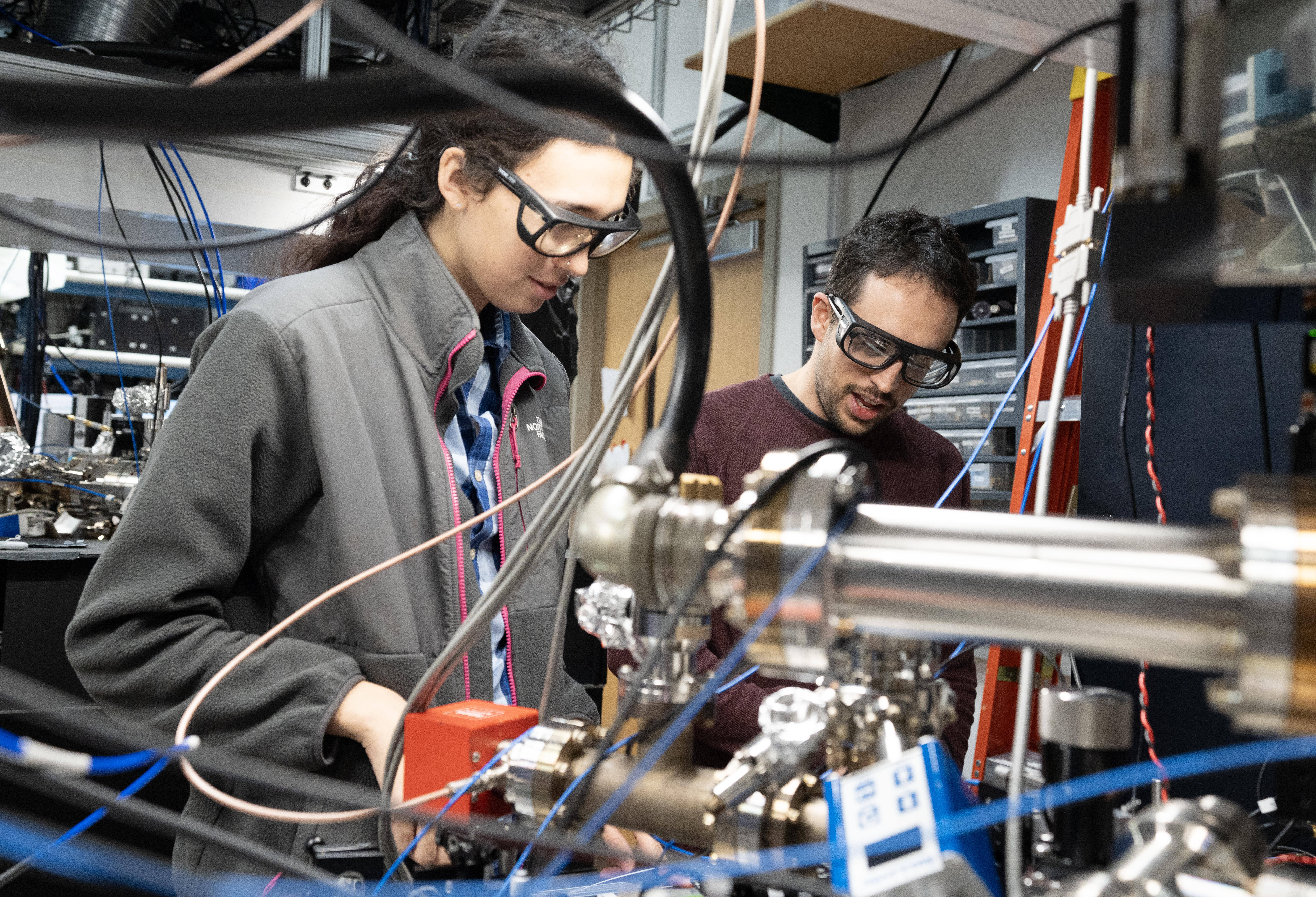
Graduate student April Sheffield (front) and NIST postdoctoral fellow Baruch Margulis witness the calcium ion in their experiment "flash," indicating the orientation of its companion molecule. Using quantum logic spectroscopy, the team demonstrated near-perfect control of a calcium hydride molecule, an important step in developing molecules for quantum technology.
R. Jacobson/NIST
Scientists have made leaps and bounds in bending atoms to their will, making them into everything from ultraprecise clocks to bits of quantum data. Translating these quantum technologies from obedient atoms to unruly molecules could offer greater possibilities. Molecules can rotate and vibrate. That makes molecules more sensitive to certain changes in the environment, like temperature.
"If you're sensitive to something, it can be a curse, because you would like to not be sensitive, or it can be a blessing," said NIST physicist Dietrich Leibfried. "You can use that sensitivity to your advantage."
But that same sensitivity has made molecules difficult to control. Recently, physicists at the National Institute of Standards and Technology (NIST) achieved new levels of control over molecules. In a study published in Physical Review Letters, they were able to manipulate a calcium hydride molecular ion - made up of one atom of hydrogen and one atom of calcium, with one electron removed to make it a charged molecule - with almost perfect success. And this control opens possibilities for quantum technology, chemical research and exploring new physics.
Quantum Peekaboo
Molecules have more freedom of expression than individual atoms do. A single atom might look like a ball; it appears the same no matter how you rotate it. But even a simple molecule can be a lot more complicated. Calcium hydride looks like a lopsided dumbbell, with two unevenly sized atoms holding onto each other; each way you turn it looks very different.
"To control a particle, we need to pinpoint it in one specific state. A molecule has a large number of states it can be in because of its rotation and vibration," said Dalton Chaffee, lead author on the paper. "This, in essence, is what makes molecules so much harder to control than atoms."
R. Jacobson/NIST
NIST physicists want to control the rotation or angular momentum of the molecules so they can do useful things with them. But unlike single atoms or ions, molecules are like ornery teenagers; they don't "talk" to the team's lasers to indicate their orientation.
To gain this control, the team used a technique called quantum logic spectroscopy, first developed to increase the precision and accuracy of clocks made of electrically charged aluminum atoms (ions). To communicate with their molecular ion, the researchers used a calcium ion as a helper. They trapped the calcium helper ion and the charged calcium hydride molecule together, and since they are equally charged, they naturally repel each other. Think of them as if they were pushed apart by a loaded spring between them, Leibfried said.
The calcium hydride molecule doesn't interact well with the laser, but the solo calcium ion does. Using lasers, the researchers cool the calcium ion, slowing its motion. As the calcium slows its momentum, its molecule friend slows too. Cooling the molecule is critical, graduate student April Sheffield pointed out. And in addition to laser cooling, a cold environment allows scientists to hold the molecular state unchanged for 10 times longer than they could at room temperatures.
Then the researchers shine a laser on the molecule to change its rotation. They can't tell if the molecule is rotating, but the calcium ion can. When the molecule changes rotation, the helper calcium ion picks up on it and releases a tiny flash of photons, which researchers see as a bright dot. They tell the molecule to change the rotation back, and the calcium ion flashes again.
That double flash of the calcium ion signals two quantum leaps, or two jumps between two different states of the molecule. Seeing that level of quantum control in action is satisfying as a scientist, said NIST postdoctoral fellow Baruch Margulis.
"That's quantum mechanics. In our lab, we can see with the camera if our ion is in one quantum state or another, which I find super cool," he said. "It's captivating to see it with your own eyes."
The molecule can remain in its rotational state for around 18 seconds before the surrounding thermal radiation forces the molecule to change its state and the ion stops flashing. That's one of the main results of their study, Margulis pointed out. Those 18 seconds are important, Leibfried added, because it gives the researchers thousands of opportunities to measure the molecule's state before it changes.
"It's sort of a peekaboo game, if you wish," Margulis explained. "As soon as thermal radiation drives the molecule to a different state, the flashes of light from the observer ion cease, and we're able to see that almost as it happens, within 10 milliseconds or so."
One peek at the ion isn't enough; scientists checked repeatedly if the calcium ion was bright or dark, proving that they had control over the molecule's state and the result wasn't a fluke. The team achieved a 99.8% success rate, meaning that if they made 1,000 attempts to manipulate the molecule, they were successful about 998 times.
Quantum Thermometers and Tackling Other Molecules
During the experiment the molecule gave a significantly more accurate and detailed depiction of the thermal radiation surrounding it than the thermometer inside the vacuum did, Sheffield explained. This means that molecules can be used as microscopic thermometers.
A quantum thermometer could be useful for atomic clocks, Leibfried added, which can be plagued by minuscule fluctuations in thermal radiation. A molecule-based quantum thermometer would even allow scientists to measure specific frequencies of thermal radiation.
Precise molecular control also opens up the nearly unfathomably large zoo of molecular species for new quantum technologies. Physicists working on quantum computing or sensors have generally been limited to a few kinds of charged atoms (ions), such as calcium and barium, which are in a small portion of the periodic table. The tools used in this experiment are not specific to any species, which means they can be adapted for other molecules. Ultimately scientists envision being able to have precise molecular control over chemical reactions, potentially opening new avenues for chemical studies. But that is still a long way from reality, the team cautioned.
"It's not just a one-off, but it's a demonstration of a protocol that can be used for many other molecules," Margulis added. "When you think about a periodic table, it has a finite number of elements. Molecules are more diverse. So, although they are hard to control, there's a huge pool of molecules. If you had perfect control, you could select a candidate based on which technology you're interested in, whether it's quantum sensing, quantum information science, or the search for new physics."
Paper: Baruch Margulis, et al. High-Fidelity Quantum State Control of a Polar Molecular Ion in a Cryogenic Environment. Physical Review Letters. Published online Dec. 9, 2025. DOI: 10.1103/7ypf-91jr


