
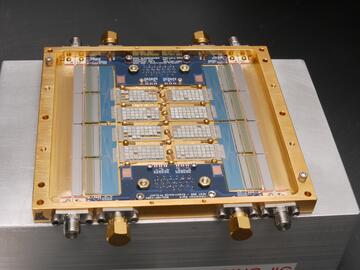
Image shows an array of about 250 gamma-ray transition edge sensors developed at NIST and used in the new study.
NIST
To monitor the amount and type of nuclear material at power plants and weapons facilities, scientists look for a special signal - the unique pattern of gamma rays emitted by specific radioactive elements. However, some of these elements also emit X-rays in the same energy range as the gamma-ray emissions, masking the signal and making nuclear stockpiles harder to assess.
Now, researchers at the National Institute of Standards and Technology (NIST) have measured the confounding X-ray emissions from plutonium, uranium and neptunium (a nuclear decay product of uranium) with unprecedented accuracy. This achievement allows scientists to filter out the X-ray background noise so they can more precisely evaluate the accumulation of nuclear materials.
"Our measurements support international nuclear safeguards by enabling more precise accounting of material in nuclear facilities," said Jonathan Dean, a physicist at NIST and the University of Colorado Boulder.
Dean and his colleagues, including researchers from NIST, the University of Colorado Boulder, the Los Alamos National Laboratory in New Mexico, Houghton University in New York and the Kastler Brossel Laboratory at Sorbonne University in Paris, reported their work in Physical Review Letters.
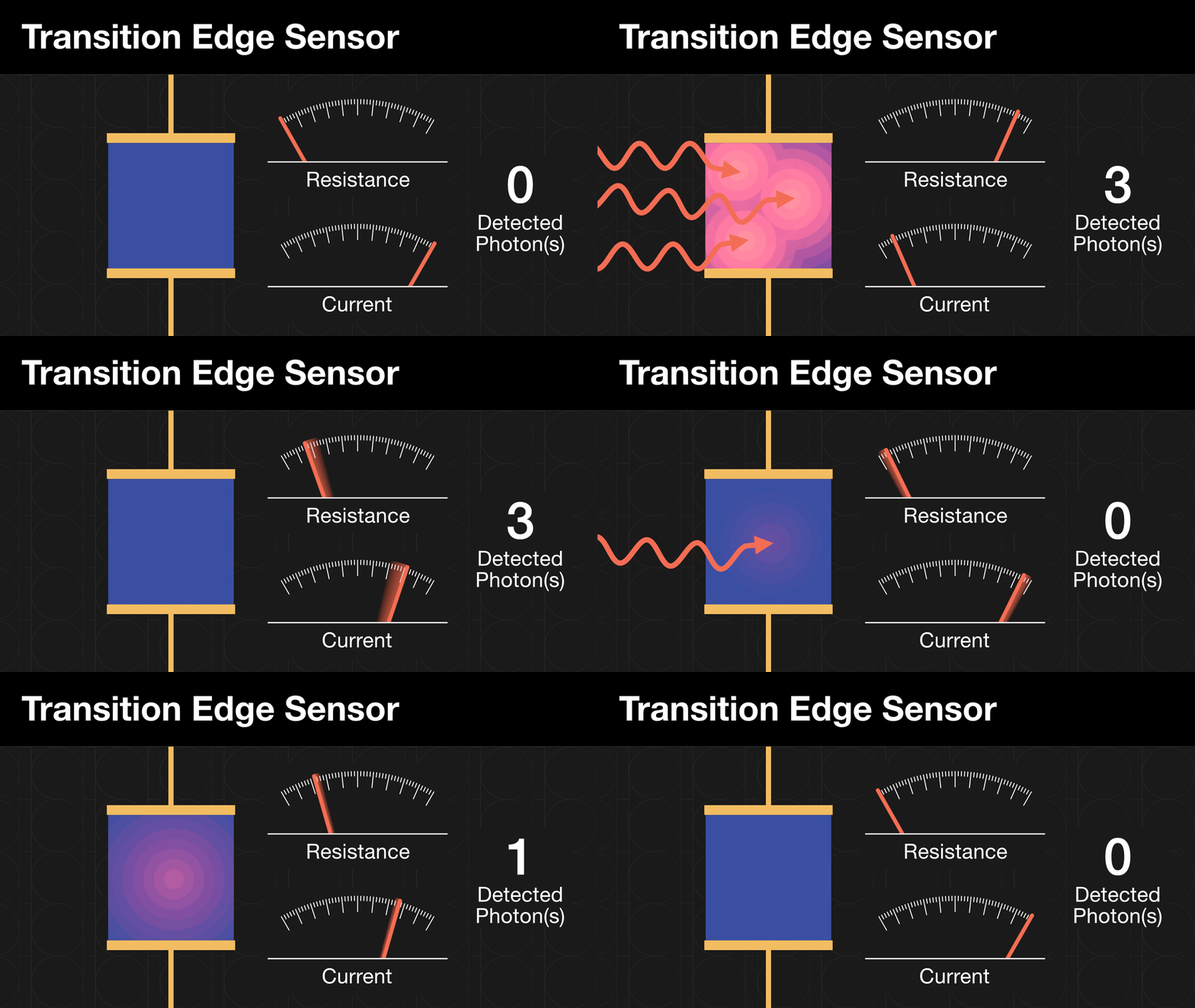
To make the X-ray measurements, the team employed an array of quantum sensors developed at NIST, which act as miniature, exquisitely sensitive thermometers. These devices, known as transition edge sensors (TESs), consist of a superconducting film held at a temperature just a fraction of a degree above absolute zero. At this temperature, the film lies right at the transition region between a zero-resistance superconductor and an ordinary metal with measurable resistance. When an individual particle of light, such as an X-ray photon, strikes the sensor, it imparts a minuscule amount of heat - but just enough to sharply increase the resistance of the superconducting film.
The resistance is directly proportional to the energy of the photon, enabling the sensor to make high-resolution energy measurements. The researchers measured the X-rays emitted by uranium, plutonium and neptunium in the energy range where they overlap with gamma-ray emissions. The sensitivity of the TES reduced the uncertainty of the X-ray energy measurements by one-third to one-eighth compared with previous measurements.
S. Kelley/NIST
By precisely measuring and effectively subtracting the obscuring X-ray radiation, TESs and other detectors that record gamma-rays can more accurately characterize nuclear materials. For instance, atoms of a single element can contain different numbers of neutrons in their nuclei - distinct forms called isotopes. Measuring the ratio between these isotopes is critical because it can indicate whether a material is intended for use in a nuclear power plant or a nuclear weapon.
For example, the isotope uranium-235 accounts for only 0.7% of the total abundance of uranium in nature but must be enriched to a relative abundance of a few percent for fuel and 90% for weapons-grade material.
In addition to having greater accuracy, the new measurements allow scientists to assess the composition of nuclear material more rapidly. Rapid assessments should come in handy at nuclear power plants, Dean said. Generating electricity from the heat unleashed by fissioning uranium atoms is a multistep process, and at each step the composition of the nuclear fuel must be reassessed before proceeding. Measuring the composition more quickly should shorten the hold-up time between steps and has the potential to increase efficiency and reduce costs at nuclear power plants.
The sensors must be cooled to a fraction of a degree above absolute zero, and the necessary cooling equipment is too bulky to be handheld. However, arrays of TES detectors can operate at any location that has a source of electricity sufficient to power the refrigeration system. In other locations where a TES is not immediately available, scientists can take samples of the radioactive material and send them to a separate laboratory. "Our instruments are compatible with both approaches," Dean said.
In partnership with the Los Alamos National Laboratory, NIST scientists have installed TES detectors at three Department of Energy laboratories to monitor nuclear material at those sites. NIST has also deployed TES detectors for use in research projects at the SLAC National Accelerator Laboratory at Stanford University, the Advanced Photon Source synchrotron at Argonne National Laboratory, the National Synchrotron Light Source at Brookhaven National Laboratory and at several international facilities including the CERN particle accelerator in Switzerland.
The team is now working on pushing the detectors' accuracy to new levels to aid in the search for new types of fundamental particles in collaboration with CERN and to install a new detector at NASA Goddard to help understand the most extreme environments in our universe.
In addition, NIST is working to simplify, miniaturize and reduce the cost of the equipment for chilling the sensors. Two U.S. companies have adapted and now manufacture a NIST-designed compact refrigeration system for the TESs.
Paper: A. Wessels, et al. Measured and theoretical Kα x-ray emission linewidths of U, Np, and Pu. Physical Review Letters. Published online Sept. 10, 2026. DOI: 10.1103/tcbz-kqk1


